- 888 pages
- English
- ePUB (mobile friendly)
- Available on iOS & Android
eBook - ePub
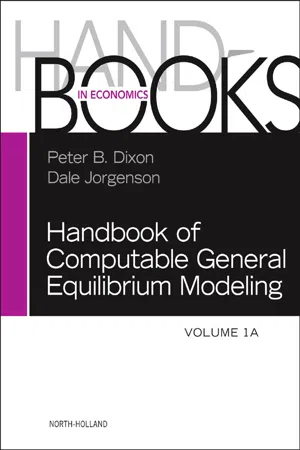
Handbook of Computable General Equilibrium Modeling
About this book
In this collection of 17 articles, top scholars synthesize and analyze scholarship on this widely used tool of policy analysis, setting forth its accomplishments, difficulties, and means of implementation. Though CGE modeling does not play a prominent role in top US graduate schools, it is employed universally in the development of economic policy. This collection is particularly important because it presents a history of modeling applications and examines competing points of view.
- Presents coherent summaries of CGE theories that inform major model types
- Covers the construction of CGE databases, model solving, and computer-assisted interpretation of results
- Shows how CGE modeling has made a contribution to economic policy
Information
Chapter 1
Introduction
1.1 Overview
Computable general equilibrium (CGE) modeling is a challenging field. It requires mastery of economic theory, meticulous preparation of data and familiarity with underlying accounting conventions, knowledge of econometric methods, and an understanding of solution algorithms and associated software for solving large equation systems. However, the most important requirement is the ability to communicate. CGE modeling is primarily about shedding light on real-world policy issues. For CGE analyses to be influential, modelers must explain their results in a way that is comprehensible and convincing to their fellow economist, and eventually to policy makers.
While CGE modeling is challenging, it is also rewarding. CGE models are used in almost every part of the world to generate insights into the effects of policies and other shocks in the areas of trade, taxation, public expenditure, social security, demography, immigration, technology, labor markets, environment, resources, infrastructure and major-project expenditures, natural and man-made disasters, and financial crises. CGE modeling is the only practical way of quantifying these effects on industries, occupations, regions and socioeconomic groups.
In 2010, CGE modeling had its 50th birthday, marked by a celebration in Oslo commemorating the publication in 1960 of Leif Johansen’s A Multisectoral Study of Economic Growth.1 In that book, Johansen describes a 22-sector model of Norway which is generally recognized as the first CGE model. What distinguishes his model from other economy-wide models of that time is the explicit identification of behavior by separate agents. In Johansen’s model, households maximize utility subject to their budget constraints, industries choose their inputs to minimize the costs of producing the level of output that will satisfy demand and capitalists allocate the economy’s capital stock between industries so that rates of return reflect historical relativities. The behavior of these individual agents is coordinated through prices determined by interaction of demand and supply. In contrast to Johansen’s multiple-agent approach, earlier and contemporaneous economy-wide models in the 1960s [e.g. the input-output and linear programming systems of Leontief (1936, 1941), and Sandee (1960) and Manne (1963)] visualized the economy as a single agent. In those models, the economy produced the output vector necessary to satisfy exogenous final demands or to optimize an economy-wide welfare function.
Fifty years on, CGE modeling is an established field. It has textbooks [e.g. Dervis et al., (1982), Dixon et al., (1992) and Burfisher (2011)], survey articles [e.g. Shoven and Whalley (1984), Robinson (1989), Bandara (1991), and Partridge and Rickman (1998, 2010)] and conference volumes [e.g. Kelley et al., (1983), Scarf and Shoven (1984), Bergman et al., (1990), and Mercenier and Srinivasan (1994)]. It is the subject of many monographs and journal articles, and provides the substance of thousands of consultancy reports. So what is added by the Handbook of Computable General Equilibrium Modeling?
This Handbook is not a textbook, a survey or a conference volume. It is a collection of chapters setting out the experience of leading CGE modelers. Each chapter contains essential knowledge but just as importantly, each chapter points to new horizons. As evidenced in the Handbook, CGE modeling embraces new problems as they arise in a real-world context. Important current focuses are aging, greenhouse gases and global financial imbalances.
In planning the Handbook we had a four-part structure in mind: single-country models; global models; technical aspects of CGE modeling covering data, parameter estimation, computation and validation, and current cutting-edge methodological areas. Broadly, this is how things worked out; but of course chapters that were initially planned for one section describe contributions that fit into other sections as well.
1.2 Single-country models
Norway and Australia are the two countries in which CGE modeling has had its highest profile in policy formation. Both these countries have long-standing CGE modeling projects with continuous histories up to the present day. In Norway, the MSG (multisectoral growth) project located in the Norwegian government’s statistical agency (Statistics Norway) goes back to Johansen in the 1960s. In Australia, the MONASH project, currently located in Monash University’s Centre of Policy Studies, goes back to the setting up in the Australian government bureaucracy of the IMPACT project in 1975. The MSG and MONASH projects are related. The MONASH project adopted and extended Johansen’s techniques and carried his style of CGE modeling to the rest of the world.
As explained in Chapter 2 by Peter Dixon, Bob Koopman and Maureen Rimmer, creation of the first MONASH model, ORANI, involved a series of enhancements to Johansen’s model, including: (i) a computational procedure that eliminated Johansen’s linearization errors without sacrificing simplicity, (ii) endogenization of trade flows by introducing into CGE modeling imperfect substitution between imported and domestic varieties (the Armington assumption), (iii) increased dimensionality allowing for policy-relevant detail such as transport margins, (iv) flexible closures, and (v) complex functional forms to specify production technologies. ORANI was a large-scale comparative statical model used in Australia’s tariff debate of the 1970s. Modern MONASH models are dynamic. They have proved remarkably flexible and operate in numerous countries on a wide variety of policy issues. As well as broad theoretical features of MONASH models, the chapter covers data preparation and introduces the GEMPACK purpose-built CGE software, discussed in detail in Chapter 20.
To a large extent MONASH models have evolved to meet the needs of clients in government and business. The models can be used for four modes of analysis: historical, decomposition, forecast and policy. Historical simulations produce up-to-date data, and estimate trends in technologies, preferences and other naturally exogenous but unobservable variables. Decomposition simulations explain historical episodes and place policy effects in historical context. Forecast simulations provide baselines using extrapolated trends from historical simulations together with specialist forecasts. Policy simulations generate the effects of policies as deviations from baselines. To emphasize the practical orientation of MONASH models, the chapter starts with a MONASH-style policy story on the effects on the US economy of restricting the number of illegal immigrants working in the US. The story is told in a way that is typical of policy briefs provided by MONASH modelers to government-sector economic advisors. It is a quantitative story that exposes the main mechanisms and data items that drive the results but does not require advisors to have a CGE background. Among the factors identified in the story is the Occupation-mix effect. This is the idea that a reduction in low-skilled immigrant employment creates job vacancies for legal residents at the low-skilled end of the occupational ladder, while closing off vacancies at the top end. In the long run, this causes a deterioration in the occupational mix of employment of legal US residents.
In Chapter 3, Erling Holmøy and Birger Strøm consider applications of MSG6, the most recent version of the MSG model of Norway originally developed by Leif Johansen (1960, 1974). Holmøy (2012) has traced the development of successive generations of the MSG model over the past half century. Although the different versions of MSG have common features, such as integration with the Norwegian national accounts and an emphasis on long-term trends, the current version bears relatively little resemblance to Johansen’s model. In place of constant returns to scale and perfect competition for individual industries, as in Johansen’s approach, individual industries in MSG6 are modeled as imperfectly competitive with increasing returns to scale. Second, the model incorporates a detailed microsimulation model for Norway in order to capture the role of changing demographics and the distributional impact of alternative policies.
Holmøy and Strøm consider applications of MSG6 to assessments of the fiscal sustainability of government tax and spending programs in Norway. Despite Norway’s massive revenues from the sale of petroleum and natural gas in buoyant international markets, the Norwegian economy faces a severe problem of fiscal sustainability in the future. This can be traced to the relatively high level of government services, the aging of the Norwegian population and the eventual depletion of oil and gas resources. This finding is robust to variations in assumptions about productivity growth, the level of petroleum prices, longevity of the Norwegian population, immigration policies and health of the elderly. The authors emphasize the crucial role of general equilibrium effects in the outcomes of the policy simulations. General equilibrium modeling is particularly important for distinguishing between the transitory impact of large petroleum revenues and the long-term effects of an aging population on the Norwegian economy.
Apart from public sector institutions in Norway and Australia, another institution that has had a long-standing involvement in CGE modeling is the World Bank. Chapters 4, 5 and 6 discuss some of the Bank’s current and past single-country CGE modeling. Later chapters (Chapters 13, 14 and 21) cover the Bank’s contributions to global modeling.
In Chapter 4, Hans Lofgren, Martin Cicowiez and Carolina Diaz-Bonilla describe the World Bank’s program to develop a standardized modeling approach for assessing progress toward the Millennium Development Goals (MDGs). These goals were established at the UN Millennium Summit in 2000, and called for halving poverty rates, achieving universal primary education, reducing under-5 and maternal mortality rates, and reducing the share of the population without access to improved sources of water and sanitation, all by 2015. In 2004 the World Bank established the MAMS (Maquette for MDG Simulations) framework for CGE modeling of the MDGs and launched a pilot project for Ethiopia. This framework has now been applied to more than 40 countries by the World Bank staff, the staff of the UN Department of Social and Economic Affairs and national researchers in emerging economies. Applications have been extended beyond the MDGs to include alternative targets, additional issues and longer time horizons.
Lofgren, Cicowiez and Diaz-Bonilla describe the MAMS framework, its implementation in the GAMS software package and the development of an Excel-based front end to make the model results accessible to a wider range of users. A major finding from cross-country comparisons is that achievement of the MDGs is heavily dependent on each country’s initial situation. This leads to the conclusion that countries may be better off pursuing country-specific goals for poverty reduction and human development. A relatively balanced development program consisting of public infrastructure and human development services generates the most desirable outcomes. Second, a focus on human development programs such as education and health generates large demands for highly educated labor and undesirable distributional effects. The MAMS framework has also been used to analyze the potential for currency appreciation from foreign aid that could undermine competitiveness. The authors present a relatively detailed model for Yemen to illustrate the CGE approach and its application to development policy.
Chapter 5 is a reflective piece by Shanta Devarajan and Sherman Robinson. It draws on their long experience in applying CGE models in developing countries on behalf of the World Bank and other organizations. The chapter provides a taxonomy of CGE models (stylized versus detailed; static versus dynamic; recursive versus perfect foresight) and identifies model characteristics necessary for addressing different policy problems in developing countries. The chapter then discusses the ways in which CGE models have been used in policy formulation and the lessons learned from past experience. An interesting conclusion is that the process of policy making in many developing countries is becoming more democratic and that this should change the way in which CGE models are used. Rather than being a tool purely for government technocrats, CGE models should become relevant and accessible to different groups in the political/economic debate. This may require modelers for developing countries to broaden the range of questions they address and to rethink their communication strategies.
Chapter 6 by David Tarr describes a World Bank CGE-based study on Russian accession to the World Trade Organization (WTO). The chapter starts with a stylized model in which services in a country are produced by domestic-owned and foreign-owned firms located in the country. The foreign-owned firms have a much more efficient technology than domestic-owned firms. However, domestic-owned firms can survive because foreign-owned firms face extremely high discriminatory taxes and red-tape requirements. When discrimination is removed, foreign-owned firms drive out domestic firms. Large welfare benefits result. Having established his main ideas via the stylized model, Tarr moves on to a detailed empirical model. Simulations with the detailed model show that the major benefit of WTO accession for Russia would be liberalization of foreign direct investment, allowing highly efficient foreign service providers to dramatically expand their operations. The projected welfare gains generated from improved service provision are about 5% of GDP, with the total benefits of all aspects of WTO accession being about 7% of GDP. As with Devarajan and Robinson in Chapter 5, Tarr emphasizes the importance of effective public communication. He cites evidence of the impact of the World Bank study on moving public opinion in favor of WTO accession.
In many countries, especially federations, the regional dimension is a key aspect in the discussion of economic policies. Consequently, in countries such as Australia, Canada and the US, an early development in national CGE modeling was the creation of facilities for working out the implications of policies for states and provinces. Chapter 7 is a comprehensive introduction to and survey of regional CGE modeling. In this chapter, James Giesecke and John Madden start with a discussion of applications. They distinguish between those concerned with national shocks, such as changes in tariffs, for which top-down (national to regional) methods are adequate and those concerned with region-specific shocks, such as major events in particular states, for which bottom-up (regional to national) methods are required. Bottom-up modeling introduces theoretical and data challenges in the handling of interregional trade and factor mobility, cross-border ownership of productive assets, the regional location of margin providers, intergovernmental finances and agglomeration economies. A “typical” multiregional CGE model is set out in the chapter to explain how these challenges are being met. Throughout the chapter, Giesecke and Madden emphasize result interpretation. They demonstrate the use back-of-the-envelope (BOTE) models to explain results from regional CGE calculations and show how intuitive explanations can be deepened and checked through regression analyses.
Chapters 8 and 9 describe CGE models for the US and Australia that have been used in high profile studies of climate policies.
In Chapter 8, Dale Jorgenson, Richard Goettle, Mun Ho and Peter Wilcoxen present their Intertemporal General Equilibrium Model (IGEM) for analyzing energy and environmental policies in the US. This model has been employed in a series of policy studies by the US Environmental Protection Agency. A distinctive feature of the IGEM model is that the behavioral responses of producers and consumers to changes in policy are obtained from econometric estimates. The econometric methods used in IGEM are discussed in more detail in Chapter 17. Jorgenson, Goettle, Ho and Wilcoxen compare a base-case simulation of the US economy, based on no change in energy and environmental policies, with alternative cases corresponding to specific policy changes. They evaluate these policy changes by means of equivalent variations in the wealth of individual households. These are defined in terms of differences between the wealth required to achieve the time path of lifetime consumption under the policy case with the wealth required under the base case, both evaluated at prices of the base case. If the difference is positive, the policy change can be recommended for implementation; if not, the current policy is preferred and no change in policy is recommended.
Jorgenson, Goettle, Ho and Wilcoxen focus on market-based environmental policies, such as environmental taxes or tradable permits. Each policy regime corresponds to an intertemporal equilibrium of the US economy. This consists of a market equilibrium between supply and demand for commodities and factors of production achieved through the price system. Markets can be extended by incorporating environmental taxes or tradable emissions permits. Supply–demand balance in each period is linked to similar balances in future periods by arbitrage conditions that assure equality between the current price of an asset and the present value of its future services. Supply–demand balance is linked to the past through the accumulation of assets from past investments. ...
Table of contents
- Cover image
- Title page
- Table of Contents
- Introduction to the Series
- Copyright
- Contributors
- Preface
- Chapter 1. Introduction
- Chapter 2. The MONASH Style of Computable General Equilibrium Modeling: A Framework for Practical Policy Analysis
- Chapter 3. Computable General Equilibrium Assessments of Fiscal Sustainability in Norway
- Chapter 4. MAMS – A Computable General Equilibrium Model for Developing Country Strategy Analysis
- Chapter 5. Contribution of Computable General Equilibrium Modeling to Policy Formulation in Developing Countries
- Chapter 6. Putting Services and Foreign Direct Investment with Endogenous Productivity Effects in Computable General Equilibrium Models
- Chapter 7. Regional Computable General Equilibrium Modeling
- Chapter 8. Energy, the Environment and US Economic Growth
- Chapter 9. Computable General Equilibrium Modeling of Environmental Issues in Australia
- Chapter 10. Taxation, Efficiency and Economic Growth
- Chapter 11. Dynamic Overlapping Generations Computable General Equilibrium Models and the Analysis of Tax Policy: The Diamond–Zodrow Model
- Index
Trusted by 375,005 students
Access to over 1.5 million titles for a fair monthly price.
Study more efficiently using our study tools.
Frequently asked questions
Yes, you can cancel anytime from the Subscription tab in your account settings on the Perlego website. Your subscription will stay active until the end of your current billing period. Learn how to cancel your subscription
No, books cannot be downloaded as external files, such as PDFs, for use outside of Perlego. However, you can download books within the Perlego app for offline reading on mobile or tablet. Learn how to download books offline
Perlego offers two plans: Essential and Complete
- Essential is ideal for learners and professionals who enjoy exploring a wide range of subjects. Access the Essential Library with 800,000+ trusted titles and best-sellers across business, personal growth, and the humanities. Includes unlimited reading time and Standard Read Aloud voice.
- Complete: Perfect for advanced learners and researchers needing full, unrestricted access. Unlock 1.5M+ books across hundreds of subjects, including academic and specialized titles. The Complete Plan also includes advanced features like Premium Read Aloud and Research Assistant.
We are an online textbook subscription service, where you can get access to an entire online library for less than the price of a single book per month. With over 1.5 million books across 990+ topics, we’ve got you covered! Learn about our mission
Look out for the read-aloud symbol on your next book to see if you can listen to it. The read-aloud tool reads text aloud for you, highlighting the text as it is being read. You can pause it, speed it up and slow it down. Learn more about Read Aloud
Yes! You can use the Perlego app on both iOS and Android devices to read anytime, anywhere — even offline. Perfect for commutes or when you’re on the go.
Please note we cannot support devices running on iOS 13 and Android 7 or earlier. Learn more about using the app
Please note we cannot support devices running on iOS 13 and Android 7 or earlier. Learn more about using the app
Yes, you can access Handbook of Computable General Equilibrium Modeling by Peter B. Dixon,Dale Jorgenson in PDF and/or ePUB format, as well as other popular books in Economics & Business Mathematics. We have over 1.5 million books available in our catalogue for you to explore.