- 712 pages
- English
- ePUB (mobile friendly)
- Available on iOS & Android
eBook - ePub
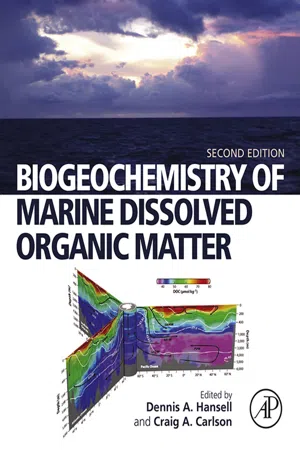
Biogeochemistry of Marine Dissolved Organic Matter
About this book
Marine dissolved organic matter (DOM) is a complex mixture of molecules found throughout the world's oceans. It plays a key role in the export, distribution, and sequestration of carbon in the oceanic water column, posited to be a source of atmospheric climate regulation. Biogeochemistry of Marine Dissolved Organic Matter, Second Edition, focuses on the chemical constituents of DOM and its biogeochemical, biological, and ecological significance in the global ocean, and provides a single, unique source for the references, information, and informed judgments of the community of marine biogeochemists.
Presented by some of the world's leading scientists, this revised edition reports on the major advances in this area and includes new chapters covering the role of DOM in ancient ocean carbon cycles, the long term stability of marine DOM, the biophysical dynamics of DOM, fluvial DOM qualities and fate, and the Mediterranean Sea. Biogeochemistry of Marine Dissolved Organic Matter, Second Edition, is an extremely useful resource that helps people interested in the largest pool of active carbon on the planet (DOC) get a firm grounding on the general paradigms and many of the relevant references on this topic.
- Features up-to-date knowledge of DOM, including five new chapters
- The only published work to synthesize recent research on dissolved organic carbon in the Mediterranean Sea
- Includes chapters that address inputs from freshwater terrestrial DOM
Information
Topic
Scienze fisicheSubtopic
Geologia e scienze della terraChapter 1
Why Dissolved Organics Matter
DOC in Ancient Oceans and Past Climate Change
Andy Ridgwell; Sandra Arndt School of Geographical Sciences, University of Bristol, Bristol, UK
Abstract
Earth history is punctuated by a huge variety of transitions and perturbations in climate and global biogeochemical cycles. Some of these events exhibit evidence for greenhouse warming and CO2 release and hence potentially provide clues regarding future changes. Negative spikes and transients in the isotopic composition of carbon in sedimentary rocks bear the testimony of these carbon cycle perturbations and are generally taken to indicate the introduction of carbon with a relatively depleted isotopic signature into the ocean and atmosphere. One reservoir of isotopically depleted carbon is the dissolved organic carbon (DOC) present in the ocean. This has led to the idea that both the cycling of DOC and its reservoir size could have been fundamentally different in the past and that change in the oceanic DOC cycle may be mechanistically linked to major events in the geological record. This chapter provides an overview of how the proposed link between DOC and major global carbon cycle perturbation events in the geological record arises. We start by presenting a summary of the traditional view of how the marine carbon cycle operates. We then introduce how the geological record is interpreted, focusing on the ways in which the carbon isotopic signature of sedimentary rocks reflects past changes in global carbon cycling. We go on to critically assess recent thinking on the potential role of DOC as a driver for extreme climate events before touching on the future implications of a DOC cycle active on geological timescales.
Keywords
Geological record
Marine carbon cycling
Palaeoclimate
Carbon isotopes
Dissolved organic carbon (DOC)
Acknowledgements
AR and SA acknowledge support from The Royal Society in the form of University Research Fellowship, and the Natural Environmental Research Council in the form of a Postdoctoral Fellowship.
I Overview
The ocean and its underlying sediments are the largest sinks of CO2 within the Earth system that are able to respond to changes in atmospheric CO2 on both human-induced (anthropogenic) and geologically relevant time scales. We need a complete understanding of their dynamics and strength of feedbacks with climate and other drivers of global change if we are to make confident projections regarding the full consequences of continued fossil fuel CO2 emissions. To this end, in the past couple of decades, we have made rapid progress in elucidating the roles that basic physical (e.g. ocean circulation) and inorganic geochemical processes (e.g. gas exchange) play in regulating the uptake of CO2 from the atmosphere. In contrast, the role and response of the “biological carbon pump”—the interplay of biological, geochemical, and physical processes that transfer carbon from the surface ocean where it is fixed by primary producers to the depths where it is either consumed or buried in the underlying sediments—is much less well understood. Even the sign of some of the main feedbacks involved and whether the response of the biological carbon pump will act to amplify or reduce future climate warming and ocean deoxygenation is somewhat uncertain.
Two research directions are providing new insights into the marine carbon cycle and how it responds to perturbation. The first revolves around ongoing efforts to understand the mechanistic operation of the biological carbon pump and, in particular, the cycling of carbon through dissolved organic carbon (DOC) in the ocean, as described in this book. The second is an increased appreciation of what might be learned from the geological record. Earth history is punctuated by a huge variety of transitions and perturbations in climate and global biogeochemical cycles, with some events exhibiting evidence for greenhouse warming and CO2 release and hence potentially providing clues regarding future changes. The conjunction of these two developments has led to the idea that both the cycling of carbon through DOC and its reservoir size could have been fundamentally different in the past and that changes in that cycling may be mechanistically linked to major events in the geological record. The breath of speculation about how the marine carbon cycle may have operated during the Precambrian (prior to 541 Ma) and under very different conditions of oxygenation and ecosystem function from today also highlights the importance of first being able to ground our geologic interpretation in a full mechanistic understanding of the sources and sinks of DOC in the modern ocean.
This chapter provides an overview of how the proposed link between DOC and major global carbon cycle perturbations in the geological record arises. We start by presenting a brief summary of how the marine carbon cycle operates. We then introduce how the geological record can be interpreted, focusing on the ways in which the carbon isotopic signature of sedimentary rocks reflects past changes in global carbon cycling. We finish by critically assessing recent thinking regarding the potential role of DOC dynamics as a driver or amplifier of extreme climate events in the past as well as the potential future implications.
II Marine Carbon Cycling
Geological rock reservoirs dominate the global inventory of carbon on Earth (Figure 1.1). However, the response time for the formation or any substantive depletion of these reservoirs is counted in 10s, if not 100s, of millions of years, being largely governed by plate tectonics and major biological evolutionary innovations such as the advent and proliferation of calcifying plankton (Ridgwell, 2005). At ~ 38,000 PgC (1 PgC = 1015 gC), the present-day ocean dissolved inorganic carbon (DIC) reservoir is the next largest carbon store on Earth and is an order of magnitude larger than the likely extractable resources of fossil fuel carbon or the terrestrial biosphere (and soils). One way to influence atmospheric pCO2 and climate via greenhouse warming is to create an imbalance in the inputs versus sinks of carbon to the ocean. However, the response time of the ocean plus atmosphere as a whole—calculated as its carbon inventory (Figure 1.1) divided by the rate of carbon throughput from weathering and mantle CO2 outgassing (Figure 1.2b and c)—comes out to be of the order of 100,000 years (100 ky). Perturbations of the global carbon cycle that change the DIC inventory of the ocean as a whole in this way are hence only arguably relevant on geological time scales. Ocean alkalinity (and pH) influence the speciation of DIC (between CO2(aq), HCO3−, and CO32 −), but similar time scales apply if one wishes to change the alkalinity (ALK) inventory of the ocean as a whole.

Figure 1.1 Illustration of the primary reservoirs and processes constituting the (natural) global carbon cycle. Approximate carbon inventories (brackets) and representative carbon isotopic compositions (bold and in parentheses) are shown for the main reservoirs and fluxes. Adapted from Hönisch et al. (2012) with representative isotopic compositions from Maslin and Thomas (2003) and inventories from IPCC (2007).

Figure 1.2 Schematic w...
Table of contents
- Cover image
- Title page
- Table of Contents
- Copyright
- Dedication
- List of Contributors
- Foreword
- Preface
- Chapter 1: Why Dissolved Organics Matter: DOC in Ancient Oceans and Past Climate Change
- Chapter 2: Chemical Characterization and Cycling of Dissolved Organic Matter
- Chapter 3: DOM Sources, Sinks, Reactivity, and Budgets
- Chapter 4: Dynamics of Dissolved Organic Nitrogen
- Chapter 5: Dynamics of Dissolved Organic Phosphorus
- Chapter 6: The Carbon Isotopic Composition of Marine DOC
- Chapter 7: Reasons Behind the Long-Term Stability of Dissolved Organic Matter
- Chapter 8: Marine Photochemistry of Organic Matter: Processes and Impacts
- Chapter 9: Marine Microgels
- Chapter 10: The Optical Properties of DOM in the Ocean
- Chapter 11: Riverine DOM
- Chapter 12: Sediment Pore Waters
- Chapter 13: DOC in the Mediterranean Sea
- Chapter 14: DOM in the Arctic Ocean
- Chapter 15: Modeling DOM Biogeochemistry
- Index
Trusted by 375,005 students
Access to over 1.5 million titles for a fair monthly price.
Study more efficiently using our study tools.
Frequently asked questions
Yes, you can cancel anytime from the Subscription tab in your account settings on the Perlego website. Your subscription will stay active until the end of your current billing period. Learn how to cancel your subscription
No, books cannot be downloaded as external files, such as PDFs, for use outside of Perlego. However, you can download books within the Perlego app for offline reading on mobile or tablet. Learn how to download books offline
Perlego offers two plans: Essential and Complete
- Essential is ideal for learners and professionals who enjoy exploring a wide range of subjects. Access the Essential Library with 800,000+ trusted titles and best-sellers across business, personal growth, and the humanities. Includes unlimited reading time and Standard Read Aloud voice.
- Complete: Perfect for advanced learners and researchers needing full, unrestricted access. Unlock 1.5M+ books across hundreds of subjects, including academic and specialized titles. The Complete Plan also includes advanced features like Premium Read Aloud and Research Assistant.
We are an online textbook subscription service, where you can get access to an entire online library for less than the price of a single book per month. With over 1.5 million books across 990+ topics, we’ve got you covered! Learn about our mission
Look out for the read-aloud symbol on your next book to see if you can listen to it. The read-aloud tool reads text aloud for you, highlighting the text as it is being read. You can pause it, speed it up and slow it down. Learn more about Read Aloud
Yes! You can use the Perlego app on both iOS and Android devices to read anytime, anywhere — even offline. Perfect for commutes or when you’re on the go.
Please note we cannot support devices running on iOS 13 and Android 7 or earlier. Learn more about using the app
Please note we cannot support devices running on iOS 13 and Android 7 or earlier. Learn more about using the app
Yes, you can access Biogeochemistry of Marine Dissolved Organic Matter by Dennis A. Hansell,Craig A. Carlson in PDF and/or ePUB format, as well as other popular books in Scienze fisiche & Geologia e scienze della terra. We have over 1.5 million books available in our catalogue for you to explore.