- 280 pages
- English
- ePUB (mobile friendly)
- Available on iOS & Android
eBook - ePub
About this book
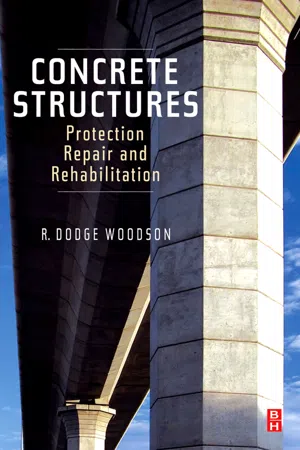
The success of a repair or rehabilitation project depends on the specific plans designed for it. Concrete Structures: Protection, Repair and Rehabilitation provides guidance on evaluating the condition of the concrete in a structure, relating the condition of the concrete to the underlying cause or causes of that condition, selecting an appropriate repair material and method for any deficiency found, and using the selected materials and methods to repair or rehabilitate the structure. Guidance is also provided for engineers focused on maintaining concrete and preparing concrete investigation reports for repair and rehabilitation projects. Considerations for certain specialized types of rehabilitation projects are also given. In addition, the author translates cryptic codes, theories, specifications and details into easy to understand language. Tip boxes are used to highlight key elements of the text as well as code considerations based on the International Code Council or International Building Codes. The book contains various worked out examples and equations. Case Studies will be included along with diagrams and schematics to provide visuals to the book.
- Deals primarily with evaluation and repair of concrete structures
- Provides the reader with a Step by Step method for evaluation and repair of Structures
- Covers all types of Concrete structures ranging from bridges to sidewalks
- Handy tables outlining the properties of certain types of concrete and their uses
Information
Chapter 1. Understanding concrete
Time takes its toll on concrete structure, which creates a problem for the use of concrete in a country’s infrastructure. Knowing the right principles and procedures for the repair and rehabilitation of concrete structures is a critical element to financial success. Tearing down existing structures and rebuilding them from the ground up can be cost prohibitive. Learning and perfecting the ways to make the most of existing infrastructures are key elements when it comes to sustainable living and safe living conditions.
Many people look at concrete and see nothing but, well, concrete. But the knowledgeable mind sees much more. Are there stress cracks in the surface? Were expansion joints installed properly? Does the color of the concrete indicate a proper curing time? Is the surface a slick, glasslike finish or a brushed finish? Is the material flaking away? Can existing flaws be repaired in such a way to guarantee structural integrity?
Most people take concrete for granted. Yet, it is one of the strongest building blocks of many bridges, highways, and other significant infrastructure. Working with a new installation of concrete is very different from repairing and rehabilitating existing concrete structures. Both types of work have their rules of thumb and their engineering elements. It often requires more experience to repair concrete than it does to install it as new construction. This is what you will learn here.
Are you capable of doing a site inspection and evaluation of existing concrete structures? If not, would you like to be? This is your chance to learn a great deal about existing concrete structures. A few experts may be needed for complicated compromises in concrete construction, but many situations can be assessed personally.
How much do you know about your options when it comes to fixing problems with concrete? Would you like to know more? Of course you would! And this book tells you what to use, when to use it, and how to use it.
What is the best way to avoid the need for concrete repairs? Maintenance is a great place to start, and this procedure will be discussed in detail. If you are looking for specifics on concrete work and codes, you have come to the right place.
So what are you going to learn? Well, here are just a few topics:
Determining the quality of concrete
High-performance concrete
In-place strength of concrete
Pervious concrete used for sustainable building projects
Recycling concrete
Durability testing
Performance specifications and data
Lithium technology
The effects of fly ash
Admixtures
Certifications
Quality control
Control charting
LEED-accredited concrete procedures
Using recycled water in ready-mixed concrete
Predictive testing
Measured compressive strength
Aggregates
Green concrete
Self-sealing concrete
Thermal characteristics
High-belite cement dam concrete
Crack resistance
Mechanical behavior
Secular distortion performance
Corrosion inhibitors
Posttension concrete
Prestressed concrete
Reinforcing steel in concrete structures
Okay, now you know what this book covers, so let’s do it.
Chapter 2. Evaluating concrete in concrete structures
Proper evaluation of concrete requires several steps. The requirements for repairs or rehabilitation are generally established in one of three ways. In the worst case, there is a failure of structural integrity that prompts the need for an evaluation. Visual inspections often reveal a need for further evaluation and testing. If cracks, flaking, or other visual defects are encountered, a full investigation and evaluation are usually warranted. The third way to establish the need for an evaluation is periodic testing. This is the safest way to check the strength and dependability of concrete structures.
Reviewing the Records
Construction documents are typically filed before the permits for construction are issued. In the case of concrete construction, reviewing original documents and a paper trail over the history of the structure is one step in a thorough evaluation. Here are some examples of existing records that should be available for consideration:
■ Design documents
■ Plans
■ Specifications
■ History reports
■ Inspection reports
■ Site inspection results
■ Laboratory test records
■ Concrete records on the materials used in construction and the batch plant
■ Instrumentation documents
■ Operation reports
■ Maintenance reports
■ Monument survey data
Site Survey
A site survey consists of a visual exam of all exposed concrete. The inspectors are looking for any implication of distress that may require repair or rehabilitation. The standard procedure is to create a map of potential defects that are encountered. These could include cracks, disintegration, spalling, or joint deterioration. The mapping process is typically done with foldout sketches of the monolith surfaces. Mapping must include inspection and delineating of pipe and electrical galleries, filling, and emptying, culverts when possible. Core drilling is a common procedure when evaluating concrete. The material recovered from the drilling can be taken to a laboratory for scientific testing.
It is not acceptable to use tests for splitting tensile strength to establish the acceptance of concrete in the field.
Shoddy Workmanship
Shoddy workmanship can lead to significant problems in concrete structures. Site inspections can bring such problems to light and result in further testing. Some of the normal defects that are ...
Table of contents
- Cover Image
- Table of Contents
- Copyright
- Dedication
- Acknowledgments
- About the author
- Introduction
- Chapter 1. Understanding concrete
- Chapter 2. Evaluating concrete in concrete structures
- Chapter 3. Causes of distress and deterioration of concrete
- Chapter 4. Planning and design of concrete repair
- Chapter 5. Concrete removal and preparation for repair
- Chapter 6. Materials and methods for repair and rehabilitation
- Chapter 7. Maintenance of concrete
- Chapter 8. Specialized repairs
- Chapter 9. Troubleshooting defects in concrete
- Chapter 10. Worksite safety
- Chapter 11. First aid
- Chapter 12. Working with the concrete code
- Chapter 13. Test your code knowledge
- Chapter 14. Construction code highlights
- Appendix A. Construction detail samples
- Appendix B. Case study of highway pavement testing
- Appendix C. Helpful calculation methods
- Appendix 4. Other useful information
- Glossary
- Index
Trusted by 375,005 students
Access to over 1.5 million titles for a fair monthly price.
Study more efficiently using our study tools.
Frequently asked questions
Yes, you can cancel anytime from the Subscription tab in your account settings on the Perlego website. Your subscription will stay active until the end of your current billing period. Learn how to cancel your subscription
No, books cannot be downloaded as external files, such as PDFs, for use outside of Perlego. However, you can download books within the Perlego app for offline reading on mobile or tablet. Learn how to download books offline
Perlego offers two plans: Essential and Complete
- Essential is ideal for learners and professionals who enjoy exploring a wide range of subjects. Access the Essential Library with 800,000+ trusted titles and best-sellers across business, personal growth, and the humanities. Includes unlimited reading time and Standard Read Aloud voice.
- Complete: Perfect for advanced learners and researchers needing full, unrestricted access. Unlock 1.5M+ books across hundreds of subjects, including academic and specialized titles. The Complete Plan also includes advanced features like Premium Read Aloud and Research Assistant.
We are an online textbook subscription service, where you can get access to an entire online library for less than the price of a single book per month. With over 1.5 million books across 990+ topics, we’ve got you covered! Learn about our mission
Look out for the read-aloud symbol on your next book to see if you can listen to it. The read-aloud tool reads text aloud for you, highlighting the text as it is being read. You can pause it, speed it up and slow it down. Learn more about Read Aloud
Yes! You can use the Perlego app on both iOS and Android devices to read anytime, anywhere — even offline. Perfect for commutes or when you’re on the go.
Please note we cannot support devices running on iOS 13 and Android 7 or earlier. Learn more about using the app
Please note we cannot support devices running on iOS 13 and Android 7 or earlier. Learn more about using the app
Yes, you can access Concrete Structures by R. Dodge Woodson in PDF and/or ePUB format, as well as other popular books in Technology & Engineering & Civil Engineering. We have over 1.5 million books available in our catalogue for you to explore.