eBook - ePub
International Cooperation, Convergence and Harmonization of Pharmaceutical Regulations
A Global Perspective
- 376 pages
- English
- ePUB (mobile friendly)
- Available on iOS & Android
eBook - ePub
International Cooperation, Convergence and Harmonization of Pharmaceutical Regulations
A Global Perspective
About this book
International Cooperation, Convergence and Harmonization of Pharmaceutical Regulations: A Global Perspective provides the current status of the complex and broad phenomenon of cooperation, convergence and harmonization in the pharmaceutical sector (Part I), thoroughly evaluates its added value and its critical parameters and influencing factors (Part II) in order to recommend actions and measures to support the next steps for cooperation, convergence and harmonization (Part III). All of these recommendations in the book support the establishment of a better coordinated global pharmaceutical system which represents the best realistic alternative to fulfill the objective to establish a global coalition of regulators and to respond to an increased demand to further cooperation in the pharmaceutical sector. This proposed framework, which leverages all of the ongoing positive cooperation initiatives and uses as foundations all of the numerous harmonization projects developed over the years, presents advantages for all stakeholders and would definitively have significant added value to the promotion and protection of global public health.
- The status of all major worldwide harmonization and cooperation initiatives (at bilateral, regional, and global levels)
- The value of cooperation in the pharmaceutical sector and the driving factors behind harmonization
- The proposition of a structure for the global pharmaceutical system and timely recommendations for enhancing international cooperation, as well as further discussion and policy changes in this area
Information
Topic
MedicineSubtopic
Administrative LawPart I
State of Play and Review of Major Cooperation Initiatives
Abstract
The basic principle of international cooperation is to establish bilateral and multilateral efforts to leverage the human, scientific and financial resources and the knowledge and experience of other key regulatory authorities to avoid duplication of efforts, to make activities more efficient and to allow the focussing of limited resources on higher-risk areas of concern. This increased cooperation between worldwide regulators has necessitated proactive deliberate efforts towards convergence/harmonisation of regulation, practices and requirements to eliminate or reduce differences.
Cooperation and harmonisation of standards in the pharmaceutical domain are already a reality and have become increasingly important during recent decades, with a high level of commitment to these activities by all stakeholders. The worldwide Drug Regulatory Authorities (DRAs) have been working to end an isolationist attitude that cannot resolve current worldwide issues and challenges caused by an ever increasing globalisation. As a result, many cooperation and harmonisation initiatives have been established at the bilateral, regional and global levels as a response to the changing geo-economic-political situation.
The spectrum of collaboration varies from simple informal technical cooperation to full integration of systems and regulations. Indeed, all these initiatives can be very different in scope (some are part of a broader harmonisation initiative), level of harmonisation (depending on the political support/commitment), organisation (well-structured versus simple discussion) or advancement (established process vs. pilot projects), but they all work towards convergence of requirements and/or practices. All these multiple worldwide cooperation and harmonisation programmes have evolved rapidly over the past decades.
This book section provides the current status of this complex and broad phenomenon of cooperation, convergence and harmonisation in the pharmaceutical sector. It reviews all major global, regional and bilateral cooperation initiatives.
Keywords
Regulation; Medicine; Cooperation; Convergence; Harmonisation; Agreement; International; Regional; Bilateral; Network; Pharmaceutical; Standard; Requirement; Best Practice; European Union; WHO; ICH; ASEAN; PANDRH; SADC; GCC; APEC
There are topics that are global in nature for which resolution of related issues and problems cannot be restricted to any one country or region. These topics require cooperation between countries and harmonization of standards. Climate change, pollution, and water supply are good examples of issues that need to be resolved at a global level as they extend across borders. Public health, which includes availability of relevant medicines, is another topic that needs to be considered at a global level, as demonstrated by recent pandemic crises.
Many aspects of increased globalization also have profound implications on pharmaceutical regulation worldwide. In general, globalization of the economy (with increased travel of people and exchange of goods, finance, and information), and also globalization of the pharmaceutical market (including development, manufacture, and distribution activities), requires increased cooperation and harmonization of pharmaceutical standards and regulation. Pharmaceutical industries have asked for better harmonization of requirements for the development and manufacture of pharmaceutical products to avoid duplication of work that ultimately creates delays in drug availability [23].
In this context, harmonization of pharmaceutical regulations has naturally become an important topic of discussion among worldwide Drug Regulatory Authorities (DRAs). Over the past several decades, they have been working to end an isolationist attitude that cannot resolve current worldwide issues and challenges. As a result, many cooperative initiatives (bilateral, regional, and global) were established, and harmonization efforts have been enhanced. All these initiatives can be very different in scope (some are part of a broader harmonization initiative), level of harmonization (depending on the political support/commitment), organization (well structured versus simple discussion), or advancement (established process versus pilot projects), but they all work towards harmonization of requirements and/or practices. Increased exchange of information on a regular basis (e.g., more than 26 countries and international organizations from Australia to Vietnam now have agreements to share information with the United States Food and Drug Administration [US FDA]) [24] also contributes to the natural convergence of requirements and practices.
Harmonization models can be distinguished by their scope and objectives. Indeed, the spectrum of collaborations varies from simple technical cooperation to full integration of systems and regulations:

The African Medicines Registration Harmonization (AMRH) initiative has defined five identifiable levels of harmonization (Figure 1).
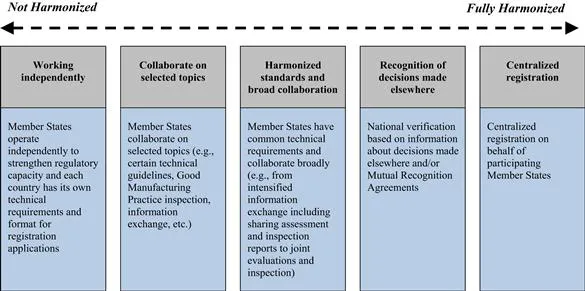
FIGURE 1 Levels of Harmonization. Source: New Partnership for Africa's Development (NEPAD) and WHO, “African Medicines Registration Harmonization (AMRH) Initiative: Summary, Status and Future Plans,” November 2009.
To facilitate cooperation, a Mutual Recognition Agreement (or Arrangement) (MRA) can be signed by one or more parties to mutually recognize or accept some or all aspects of one another’s requirements. They can be concluded at the technical level (e.g., the confidentiality arrangements between the US FDA and European Medicines Agency [EMA], or the MRA between EU and Australia) or at the government level (e.g., European Treaty).
I-1) Global Initiatives
These multilateral initiatives are major projects as they involve multiple organizations and countries and represent the highest degree of harmonization. The objective of this technical and scientific intergovernmental cooperation is to globally discuss scientific issues that support the decisions made by individual governments and international regulatory bodies in order to achieve global scientific consensus. The goal is to facilitate the development of new medicines and to make them available to the maximum number of people worldwide. There is no intent of full integration of systems and regulations. The main difficulty faced by these initiatives is the complexity and management of the structure due to the important number of participants (e.g., the World Health Organization [WHO] has 194 Member States) and the diversity of needs, challenges, and level of development of its members.
I-1.1) World Health Organization
The World Health Organization (WHO) was established in 1948 as a specialized agency of the United Nations (UN) [25]. It is accountable to its Member States and works closely with other entities of the UN system.
This agency has a very broad scope of responsibilities as it is the directing and coordinating authority for international health matters and public health within the UN system. WHO is well known for some of its work (e.g., the coordination of influenza surveillance and monitoring activities, emergency assistance to people affected by disasters, mass immunization campaigns or actions against Human Immunodeficiency Virus/Acquired Immunodeficiency Syndrome [HIV/AIDS], tuberculosis, and malaria). However, WHO undertakes many more activities because it is responsible for providing leadership on global health matters, shaping the health research agenda, setting norms and standards, articulating evidence-based policy options, providing technical support to countries, and monitoring and assessing health trends. Most of these core functions, as further defined in its “11th General Programme of Work,” [26] rely on cooperation and harmonization of standards.
This focus on regional and global collaboration, and especially aid from developed countries to developing countries, is aligned with the UN Millennium Development Goals (MDGs).a Indeed, the objective of these MDGs is that countries and development partners work together to improve the global situation and resolve major issues. A number of specific targets and indicators have been identified to monitor progress towards the goals. Goal 8 (“Develop a global partnership for development”) specifically recognizes the role of developed nations and addresses global cooperation and partnerships.
WHO has worked in the area of pharmaceuticals since its creation approximately 60 years ago. During this time, many products and services have been created that are widely recognized as core functions of WHO.
The role of WHO in pharmaceutical regulations is based on its constitutional mandate and various World Health Assembly (WHA) resolutions. This support is twofold. One aspect relates to the development of internationally recognized norms, standards, and guidelines. The second relates to providing guidance, technical assistance, and training in order to enable countries to implement global guidelines to meet their specific medicines regulatory environment and needs [27].
I-1.1.1) Membership
All countries that are members of the UN may become members of WHO by accepting its constitution. Other cou...
Table of contents
- Cover image
- Title page
- Table of Contents
- Copyright
- Dedication
- Preface
- About the Author
- Foreword by Professor Stuart Walker
- Introduction
- Part I. State of Play and Review of Major Cooperation Initiatives
- Part II. Value and Influencing Factors of the Cooperation, Convergence, and Harmonization in the Pharmaceutical Sector
- Part III. Recommendations to Support the Next Phase of International Cooperation, Convergence, and Harmonization in the Pharmaceutical Domain
- Conclusion
- Acronyms and Abbreviations
- List of Figures, Tables and Plates
- List of References
- Index
- Color Plates
Trusted by 375,005 students
Access to over 1.5 million titles for a fair monthly price.
Study more efficiently using our study tools.
Frequently asked questions
Yes, you can cancel anytime from the Subscription tab in your account settings on the Perlego website. Your subscription will stay active until the end of your current billing period. Learn how to cancel your subscription
No, books cannot be downloaded as external files, such as PDFs, for use outside of Perlego. However, you can download books within the Perlego app for offline reading on mobile or tablet. Learn how to download books offline
Perlego offers two plans: Essential and Complete
- Essential is ideal for learners and professionals who enjoy exploring a wide range of subjects. Access the Essential Library with 800,000+ trusted titles and best-sellers across business, personal growth, and the humanities. Includes unlimited reading time and Standard Read Aloud voice.
- Complete: Perfect for advanced learners and researchers needing full, unrestricted access. Unlock 1.5M+ books across hundreds of subjects, including academic and specialized titles. The Complete Plan also includes advanced features like Premium Read Aloud and Research Assistant.
We are an online textbook subscription service, where you can get access to an entire online library for less than the price of a single book per month. With over 1.5 million books across 990+ topics, we’ve got you covered! Learn about our mission
Look out for the read-aloud symbol on your next book to see if you can listen to it. The read-aloud tool reads text aloud for you, highlighting the text as it is being read. You can pause it, speed it up and slow it down. Learn more about Read Aloud
Yes! You can use the Perlego app on both iOS and Android devices to read anytime, anywhere — even offline. Perfect for commutes or when you’re on the go.
Please note we cannot support devices running on iOS 13 and Android 7 or earlier. Learn more about using the app
Please note we cannot support devices running on iOS 13 and Android 7 or earlier. Learn more about using the app
Yes, you can access International Cooperation, Convergence and Harmonization of Pharmaceutical Regulations by Pierre-Louis Lezotre in PDF and/or ePUB format, as well as other popular books in Medicine & Administrative Law. We have over 1.5 million books available in our catalogue for you to explore.