- 356 pages
- English
- ePUB (mobile friendly)
- Available on iOS & Android
eBook - ePub
About this book
Certifiable Software Applications 3: Downward Cycle describes the descending phase of the creation of a software application, detailing specification phases, architecture, design and coding, and important concepts on modeling and implementation. For coding, code generation and/or manual code production strategies are explored. As applications are coded, a presentation of programming languages and their impact on certifiability is included.
- Describes the descending phase of the creation of a software application, detailing specification phases, architecture, design and coding
- Presents valuable programming examples
- Includes a presentation of programming languages and their impact on certifiability
Information
1
Realization of a Software Application
Abstract
It should be recalled that this book (Volume 3) follows the first two volumes. In order to have an independent book, we will remember the key concepts and constraints of the implementation of a software application.
Keywords
Implementation; Parametrization; Plan hierarchy; Quality assurance plan; Quality control; Quality management system; Software Application; V-model
1.1 Introduction
It should be recalled that this book (Volume 3) follows the first two volumes [BOU 16, BOU 17]. In order to have an independent book, we will remember the key concepts and constraints of the implementation of a software application (see Definition 1.1).
The implementation of a software application involves the definition of a strategy, which is to be formalized within a software quality assurance plan (SQAP). This implementation strategy must be considered within the context of system implementation.

1.2 Implementation process
In Volume 1 [BOU 16], we discussed the fact that a software application could be parametrized by means of data. There are thus two processes (see Figure 1.2) that have to be put in place for the implementation of a software application.

In Figure 1.2, the first process aims to implement the software application (for more details, see Figure 1.3), which is then said to be generic, and the second process is designed to perform the parametrization process.

The parametrization process is set up on the basis of the knowledge of the generic software application and the identification of the characteristics that may change during system operation.
The implementation process of the software application may follow different cycles (waterfall, V-model, etc.) but as a general rule, it is the V-model (see Figure 1.3) that is chosen. It is worth noting that the V-model is not a monolithic cycle but a set of Vs in parallel where an iterative and/or incremental approach has to be taken into account (see Chapter 11 of Volume 2 [BOU 17]).
The parametrization process includes the implementation of parametrization means and the definition of the instantiation process of the generic software application for configuration. This process was discussed in Chapter 14 of Volume 2 [BOU 17].
1.3 Quality control
1.3.1 Introduction
The implementation process of a certifiable software application has to be formalized. To this end, a repository quality (quality management system) is first necessary within the company in which the processes being implemented are formalized through business processes (describing the means implemented and the method), models (describing the content of the different deliverables) and guides (which are generally necessary to explain the operation of a tool, the characteristics of the languages used, etc.). To learn more about quality assurance, see Volume 2 [BOU 17].

It is important to recall that in the context of software development, the minimum process to be implemented is the IOS 9001 through its specialization (International Organization for Standardization [ISO] 90003), and then a certain area proposes a standard, which is a superset of the ISO 9001 [ISO 15] + ISO 90003 [ISO 14]. In ISO 9126 [ISO 04], some main properties for software are presented and defined, such as maintainability, security and testability.
1.3.2 Software quality assurance plan
In order to build a software application, a SQAP has to be implemented. The quality of the software assurance plan defines the organization and the means that have to be implemented to design and develop the software application by specifying the role of each component involved.
The SQAP may be divided into several documents, as shown in Figure 1.5. The SQAP must also describe the management of changes and non-conformities that might appear during software production or operation.
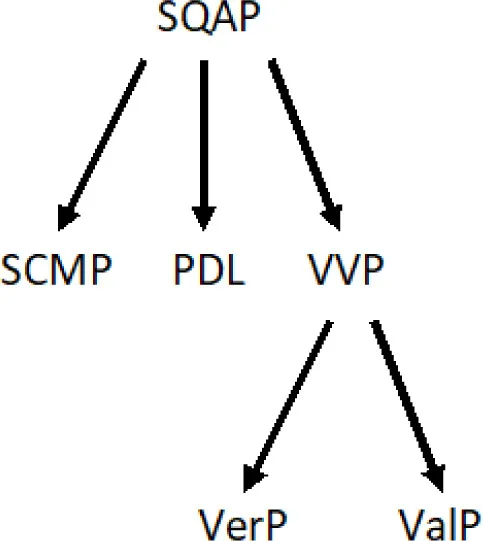
Topics to be covered are as follows:
- – Section 1: identification of standards and mandatory regulations. The purpose of this section is to identify the set of standards and regulations to be followed during software development. It is necessary to properly identify titles, references and versions of these documents. In this section, one can find the ISO 9001:2015 for quality control, depending on the International Electro-technical Commission (IEC) 61508:2010 standard, DO 178:C, ISO 26262 standard or the European Committee for Electro-technical Standardization (CENELEC) 50128:2011 standard, IEC 62279:2014, etc.
- – Section 2: the project organization (software aspects), the demonstration of independences and the justification of skills (which may rely on a process local to the project and on the company’s human resource management).
- – Section 3: a presentation of the perimeter of the software to be built.
- – Section 4: a presentation of quality mastery and control (metrics, control points, audit, etc.).
- – Section 5: a presentation of the software delivery cycle (V-model, etc.) and of each phase. For...
Table of contents
- Cover image
- Title page
- Table of Contents
- Dedication
- Copyright
- Introduction
- 1: Realization of a Software Application
- 2: Requirements Management
- 3: Documentation Structure
- 4: Requirements Specification of a Software Application
- 5: Modeling
- 6: Formalization
- 7: Software Specification Verification Stage
- 8: Component Versus Module
- 9: Software Application Architecture
- 10: Software Application Architecture Verification
- 11: Software Application Design
- 12: Software Application Component Design Phase Verification
- 13: Software Application Coding
- 14: Programming Rules
- 15: Coding Verification
- 16: Version Sheet of the Software Application
- Conclusion: Conclusion and Perspectives
- Glossary
- Bibliography
- Index
Trusted by 375,005 students
Access to over 1.5 million titles for a fair monthly price.
Study more efficiently using our study tools.
Frequently asked questions
Yes, you can cancel anytime from the Subscription tab in your account settings on the Perlego website. Your subscription will stay active until the end of your current billing period. Learn how to cancel your subscription
No, books cannot be downloaded as external files, such as PDFs, for use outside of Perlego. However, you can download books within the Perlego app for offline reading on mobile or tablet. Learn how to download books offline
Perlego offers two plans: Essential and Complete
- Essential is ideal for learners and professionals who enjoy exploring a wide range of subjects. Access the Essential Library with 800,000+ trusted titles and best-sellers across business, personal growth, and the humanities. Includes unlimited reading time and Standard Read Aloud voice.
- Complete: Perfect for advanced learners and researchers needing full, unrestricted access. Unlock 1.5M+ books across hundreds of subjects, including academic and specialized titles. The Complete Plan also includes advanced features like Premium Read Aloud and Research Assistant.
We are an online textbook subscription service, where you can get access to an entire online library for less than the price of a single book per month. With over 1.5 million books across 990+ topics, we’ve got you covered! Learn about our mission
Look out for the read-aloud symbol on your next book to see if you can listen to it. The read-aloud tool reads text aloud for you, highlighting the text as it is being read. You can pause it, speed it up and slow it down. Learn more about Read Aloud
Yes! You can use the Perlego app on both iOS and Android devices to read anytime, anywhere — even offline. Perfect for commutes or when you’re on the go.
Please note we cannot support devices running on iOS 13 and Android 7 or earlier. Learn more about using the app
Please note we cannot support devices running on iOS 13 and Android 7 or earlier. Learn more about using the app
Yes, you can access Certifiable Software Applications 3 by Jean-Louis Boulanger in PDF and/or ePUB format, as well as other popular books in Computer Science & Programming. We have over 1.5 million books available in our catalogue for you to explore.