- 384 pages
- English
- ePUB (mobile friendly)
- Available on iOS & Android
eBook - ePub
About this book
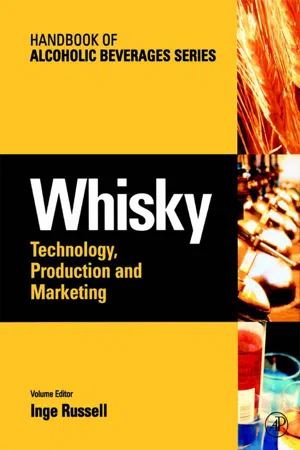
Whisky: Technology, Production and Marketing explains in technical terms, the science and technology of producing whisky, combined with information from industry experts on successfully marketing the product. World experts in Scotch whisky provide detailed insight into whisky production from the processing of raw materials, to the fermentation, distillation, maturation, blending, production of co-products and quality testing, as well as important information on the methodology used for packaging and marketing whisky in the twenty-first century. No other book covers the entire whisky process from raw material to delivery to the market in such a comprehensive manner and with such a high level of technical detail.* Only available work to cover the entire whisky process from raw material to delivery to the market in such a comprehensive manner* Includes a chapter on marketing and selling whisky* Foreword written by Alan Rutherford, former Chairman and Managing Director of United Malt and Grain Distillers Ltd.
Information
Topic
MedicineSubtopic
Nutrition, Dietics & BariatricsChapter 1 History of the development of whiskey distillation
Introduction
Nearly all distilled alcoholic beverages have similar generic roots depending on the basic raw material, whether grape, grain or sugar. Such distillates were in the past regarded as having great medicinal, almost mystical, properties and their recipes were entrusted to the religious clerics of their day and tradition. The generic Latin name given to these distilled products was aqua vitae (the water of life). This is certainly true in the case of whiskey, which is a corruption of the Gaelic uisge beatha (again, water of life). This appellation, spelled without an ‘e’ in Scotland but with an ‘e’ in Ireland and America, is the generic name for a distilled product made from saccharified and fermented cereal extracts. In some cases this definition is even more specific, in that the saccharification process is implemented only by the enzymes of malted barley. In other traditions, similar distillates from alternative sources of fermentable sugar were translated from Latin as l’eau de vie in France or aquavit in Scandinavia and so on. All these spirits were regarded as having remarkable restorative properties.
From its monastic roots in Ireland and Scotland, the distillation of whiskey developed over several centuries into a commercial enterprise in various continents. It is now well known that the first record of a commercial transaction involving the supply of whiskey (sic. aqua vitae) was between the Benedictine monastery at Lindores Abbey in Fife and the Court of King James IV at Holyrood, Edinburgh in the year 1494 (Anon, 1494). The distiller in charge at Lindores must have been a Father John Cor because the Exchequer Rolls of Scotland records the supply of ‘eight bolls of malt’ to the said Friar ‘to make aqua vitae’. As well as telling us that whiskey was even then consumed in the highest social circles, it also records that the whiskey was malt whiskey and that the malting of barley was probably a separate commercial enterprise.
The consumption of whiskey may have been partly for pleasure at the Royal Court of Scotland, but it was still regarded very much as a tonic. It would appear that the legitimate manufacture of whiskey for ‘medicinal purposes’ passed from the ecclesiastical world to the secular via the professional medical practitioners of the time, the Guild of Surgeon Barbers. For example, the City of Edinburgh granted a whiskey distilling monopoly to the Guild in 1505, and this was given Royal Approval by a Seal of Cause in 1506 (Scott-Moncrieff, 1916). From then on, not only in Scotland but also in every other country that has adopted the distillation of whiskey, a constant ‘war’ has been waged between state and private distillers for control of a very valuable commodity. There is no doubt that state control and, in particular, attempts to extract excise duty have played (and still play) a major role in the worldwide development of whiskey distilling.
This is not the only common impetus for the development of whiskey, and there is remarkable similarity in the development of international markets and brands. Drivers for development can be summarized as:
1. Existing technology to produce the distilled product locally
2. A national demand to consume the distilled product
3. The drive and initiative of a few strong entrepreneurs to realize emerging commercial and export marketing opportunities
4. A commitment to supply and maintain a product of consistent high quality.
How these events evolved in the five largest international whiskey distilling countries – Scotland, Ireland, the USA, Canada and Japan – is described in the following sections.
Scotch whiskey
Commercial development
Although it is commonly accepted that the art of distilling was brought to Scotland by Irish monks at the time of St Columbus and thereafter, domestic distilling of whiskey developed in parallel and was common practice by the middle of the sixteenth century. Indeed, brewing and distilling were by then regarded as staple requirements because the Scottish Parliament decreed, following a particularly bad harvest in the West of Scotland in 1555, that grain should only be used in the Burghs of Ayr, Irvine, Glasgow and Dumbarton for ‘baking bread and the brewing of ale and aqua vitae’ (Scott-Moncrieff, 1916). The said aqua vitae was therefore being distilled not only in farming communities but also in the burgeoning towns of Scotland.
The granting of monopolies to surgeons and apothecaries was an attempt to control whiskey distilling for use only for ‘medicinal purposes’, but this was not very successful because of ever-increasing commercial pressures. It is not surprising that historical records show that some of the good burghers of Edinburgh, such as one Besse Campbell, regularly broke these cartels. The Edinburgh Town Council Records of 1556 state that Besse should ‘desist and ceis fra ony forthir making of aqua vitae within this burgh in tyme cumyng or selling of ony therein except on the market day’ (author’s emphasis), and also ‘to conform to the privelge granted to the (surgeon) barbers under the Seill of Caus’ (Scott-Moncrieff, 1916). As well as showing us that the Town Clerk had some spelling difficulties, the record clearly demonstrates that while Besse was not allowed to distil whiskey, she was allowed to sell it in the town’s market as a sort of licensed grocer of the period. The other important conclusion to be drawn from this record is that there was a growing market, albeit a local one, since Besse felt obliged to distil her own whiskey to augment the ‘legal’ supply. Besse was therefore the first recorded entrepreneur of whiskey, and the first (but not the last!) female distiller to boot.
Government intervention continued into the next century, and following the outbreak of civil war in England in 1642, the Scottish Parliament imposed a series of excise levies. So began the age-old conflict between Customs & Excise (the Gaugers) and distillers, who were increasingly driven to hide in the hills and glens and the isles of the Inner Hebrides to carry on what they regarded as their legitimate trade, free from punitive government taxes. However, not all distilling was illicit. Following the restoration of the monarchy in 1660, the tax on ale, beer and whiskey (which was still referred to as aqua vitae in all statutes of the period) was essentially doubled, and it was estimated that this provision would yield £384 000 in revenue (Statute 1661, Car II, c.128). To raise this huge sum there must have been several large legitimate stills in existence, such as those of John Haig & Co., who claim that a Robert Haig established their business in 1627 (Anon., 1914). What is interesting, from a technical viewpoint, is the fact that these taxes were imposed not only on malted barley but also on spirit ‘not made of malt’. Other chronicles of this period similarly allude to spirit being made from a mixture of grains, such as oats, barley and wheat (Smith, 1776) as well as malt. So even from the earliest times some whiskey was being distilled from unmalted grain, and not all malt was made from barley. The malt tax introduced in 1701, for example, states that duty shall be paid: ‘upon all Malt, ground or unground, whether the same shall be made of Barley, or any other Corn or Grain whatsoever’ (Statute 1701, 12 & 13 William III, c.5).
After the Treaty of Union with England in 1707, the first London-based Parliament of the now United Kingdom of Great Britain and Ireland decreed that Scotland should pay the same high rates of duty as England. This was in direct contradiction to the Treaty of Union, and led to the infamous Malt Tax riots of 1725 (Devine, 1999). The government backed off from such universal revolt, and it took nearly another 100 years before excise duties were harmonized throughout the United Kingdom (Smith, 1980). Nevertheless, legitimate distilling continued to develop, particularly in the Lowlands of Scotland. By 1756 duty was paid on 433 811 gallons of spirit, nearly eight times the volume taxed the year after the Treaty of Union (Craig, 1994). Despite the public resistance to the Union and its effects on taxation, trade with England had been opened up and there was an increasing market for good quality whiskey. Following the Malt Tax riots, duty in Scotland was still only half the rate applied to English (particularly gin) distillers (Craig, 1994), and so Scottish traders could afford the additional transport costs and still make good margins on their product to the disadvantage of their English counterparts.
The story was somewhat different in the Highlands, where uisge beatha was historically used for family or local consumption and illicit stills numbered in the thousands (Craig, 1994). The tradition of distilling Highland whiskey in small stills, widely dispersed throughout the region, can be traced to these illegitimate roots. With ever-increasing demand from the south, smuggling of illicit Highland whiskey became highly organized and effective to the extent that, by the early nineteenth century, almost half the whiskey consumed in Scotland was duty free and, despite the hated Excise Gaugers confiscating up to 14 000 illicit stills every year, the illegal trade continued to prosper (Scotch Whiskey Association, 2002). The government had to compromise, and in 1784–1785 licensing acts were passed to allow illicit distillers to become legitimate in return for a fee and a reasonable rate of duty to be paid on fermenting wash.
Over the next twenty years the number of licensed distillers increased, but illegal distilling and smuggling still continued, despite several further compromises made to the excise laws. It was not until the Excise Act of 1823 was introduced to harmonize taxation in Scotland and Ireland that illicit distilling and smuggling were finally brought under control. Duty on distilled spirit was reduced to two shillings per proof gallon, and the separate tax on fermenting wash was abolished. A distiller could now, at long last, buy a license for £10 and develop his business without crippling taxation (Statute 1823, Geo. IV, c.94).
The rest of the nineteenth century witnessed the remarkable growth of Scotch whiskey to become the only truly international, generic brand of potable spirit. This was driven by a combination of opportunist entrepreneurs and fortuitous developments. The first technical development that assisted this phenomenal rise in exports was the differentiation of grain and malt whiskey distilling, and the subsequent blending of these two types of whiskey to produce consistent high quality products. Greater volumes of grain whiskey could also be produced following the introduction of continuous distilling in patented ‘Coffey’ stills (Coffey, 1830). Although mixed grists, i.e. malted barley and unmalted grain, had been used in both Highland and Lowland traditions, the latter half of the nineteenth century saw a gradual change until Highland whiskey was exclusively single malt and Lowland grain distilleries used only a small amount of malt to saccharify cooked unmalted grain.
The other technical innovation that helped to characterize Scotch whiskey and establish its commercial growth happened more by chance than by design. During the years of secretive distilling, whiskey had to be hidden and then moved surreptitiously from its place of concealment to the market. Virtually the only storage and transportation vessels available to both illicit and legitimate distillers alike were wine, sherry and port casks that had been imported from France, Spain and Portugal. Many of these casks were purloined for use in the ever-growing distilling trade after their original contents had been consumed. Even by the end of the eighteenth century, Highland whiskey had a reputation for being smoother and mellower than the fiery Lowland spirit. It was not long before astute distillers realized that the longer new-make spirit was kept in oak casks, the more it was appreciated by the consumer.
These innovations on their own helped to make Scotch whiskey unique, but they were not, per se, the reason for the huge expansion in whiskey distilling in the eighteenth century. Throughout the century several entrepreneurial families developed the legitimate marketing and selling of Scotch whiskey internationally. Some of these businessmen, such as John Walker, John Dewar, James Chivas, William Teacher and George Ballantine, started as small family grocers and wine merchants. They all selected good quality malts to blend with Lowland grain whiskey to sell into their local markets before venturing into exports, first to England and then increasingly to...
Table of contents
- Cover image
- Title page
- Table of Contents
- Copyright
- Series editors
- Contributors
- Foreword
- Preface
- Chapter 1: History of the development of whiskey distillation
- Chapter 2: Malt whiskies: raw materials and processing
- Chapter 3: Grain whisky: raw materials and processing
- Chapter 4: Yeast and fermentation
- Chapter 5: Batch distillation
- Chapter 6: Grain whisky distillation
- Chapter 7: Maturation and blending
- Chapter 8: Co-products
- Chapter 9: Whisky analysis
- Chapter 10: Marketing Scotch whisky
- Index
Trusted by 375,005 students
Access to over 1.5 million titles for a fair monthly price.
Study more efficiently using our study tools.
Frequently asked questions
Yes, you can cancel anytime from the Subscription tab in your account settings on the Perlego website. Your subscription will stay active until the end of your current billing period. Learn how to cancel your subscription
No, books cannot be downloaded as external files, such as PDFs, for use outside of Perlego. However, you can download books within the Perlego app for offline reading on mobile or tablet. Learn how to download books offline
Perlego offers two plans: Essential and Complete
- Essential is ideal for learners and professionals who enjoy exploring a wide range of subjects. Access the Essential Library with 800,000+ trusted titles and best-sellers across business, personal growth, and the humanities. Includes unlimited reading time and Standard Read Aloud voice.
- Complete: Perfect for advanced learners and researchers needing full, unrestricted access. Unlock 1.5M+ books across hundreds of subjects, including academic and specialized titles. The Complete Plan also includes advanced features like Premium Read Aloud and Research Assistant.
We are an online textbook subscription service, where you can get access to an entire online library for less than the price of a single book per month. With over 1.5 million books across 990+ topics, we’ve got you covered! Learn about our mission
Look out for the read-aloud symbol on your next book to see if you can listen to it. The read-aloud tool reads text aloud for you, highlighting the text as it is being read. You can pause it, speed it up and slow it down. Learn more about Read Aloud
Yes! You can use the Perlego app on both iOS and Android devices to read anytime, anywhere — even offline. Perfect for commutes or when you’re on the go.
Please note we cannot support devices running on iOS 13 and Android 7 or earlier. Learn more about using the app
Please note we cannot support devices running on iOS 13 and Android 7 or earlier. Learn more about using the app
Yes, you can access Whisky by Graham Stewart,Inge Russell in PDF and/or ePUB format, as well as other popular books in Medicine & Nutrition, Dietics & Bariatrics. We have over 1.5 million books available in our catalogue for you to explore.