- 384 pages
- English
- ePUB (mobile friendly)
- Available on iOS & Android
eBook - ePub
About this book
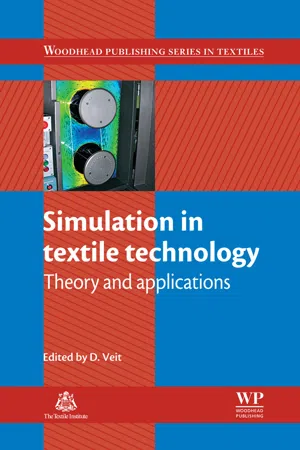
The use of mathematical modelling and computer simulation can vastly improve the quality, efficiency and economic success of textile technology. Simulation in textile technology provides a comprehensive review of the key principles, applications and benefits of modelling for textile production.After an introduction to modelling and simulation, Simulation in textile technology goes on to review the principles and applications of the main types of model. The book first discusses neural networks and their applications before going on to explore evolutionary methods and fuzzy logic. It then considers computational fluid dynamics and finite element modelling. The modelling of fibrous structures and yarns are considered in the following chapters, along with wound packages, woven, braided and knitted structures. The book concludes by reviewing the simulation of textile processes and machinery.With its distinguished editor and team of expert contributors, Simulation in textile technology is a valuable reference tool for all those involved in both developing models of textile processes and those applying them to improve process efficiency and product quality.
- Provides a comprehensive review of the key principles, applications and benefits of modelling for textile production
- Discusses neural networks and their applications before going on to explore evolutionary methods and fuzzy logic
- Considers the modelling of fibrous structures and yarns, along with wound packages, woven, braided and knitted structures
Information
1
Introduction to modelling and simulation in textile technology
D. Veit, RWTH Aachen University, Germany
Abstract:
This chapter introduces the concept of simulation both with and without computers. it then discusses the role of models, including white, black and grey box models. it concludes by considering expert and other knowledge-based systems and their applications.
Key words
simulation
models
expert systems
knowledge-based systems
textile technology
1.1 Introduction to simulation
Simulation is normally used to analyse systems that are hard or impossible to describe using systems of explicit equations. in particular, this applies to highly complex dynamic systems such as most textile machines and processes. By carrying out a simulation experiment, knowledge about the real system can be gathered comparatively easily in contrast to trials on the machine or during the actual process. This includes practical experiments as well as a simulation using a computer program.
There are several reasons for the application of simulations. investigating the real system can be:
• too time-consuming (e.g. changing the setting of a polymer production plant);
• too costly (e.g. crash trials);
• ethically questionable (e.g. medical trials of a new textile implant);
• too dangerous (e.g. reaction of new textile-based building materials on fire).
Systems that do not yet exist provide another field of application of simulations. this comprises the testing of new plant design concepts or, for example, the development of new aerospace or automotive vehicles using carbon textile reinforced composites. in some cases it is not possible to investigate the actual system directly. A simulation can then be used to gain valuable information which is otherwise unavailable. typical examples are the simulation of the molecular movement in a fluid and the movement of continental plates which takes place over a long time period and thus cannot be observed directly.
1.2 Simulation with and without computers
In general, simulation methods can be divided into those that use a computer and those that do not, as shown in Fig. 1.1. those simulations without computer can be separated into destructive and nondestructive methods. Simulations that use a computer can be based on technical models (e.g. finite element method (FEM), computational fluid dynamics (CFD)), on examples taken from nature (e.g. artificial neural networks, evolutionary algorithms), or on other methods, such as sociological models.

1.1 Simulation methods.
For each simulation, independent of whether it is carried out using a computer or not, it is absolutely crucial that the results can be reproduced every single time that the simulation is run. the use of a simulation must also make sense economically. thus, the model on which the simulation is based is normally simplified as much as possible, but still takes into account the relevant factors that have an influence on the results. This often results in a mathematical model which is valid only for a certain range of the respective values. Hence, it is very important to verify the results of a simulation by running actual trials, e.g. on a machine, in order to ensure that the simulation accurately represents the problem at hand. it must be noted, though, that measurements are never truly accurate, hence the measured results can deviate from reality to a certain extent.
1.2.1 Simulation without a computer
A typical example for a simulation without a computer is a car crash test. In this case the circumstances of an accident are simplified using crash test dummies. these are equipped with sensors that register the mechanical impact the crash would inflict on real persons. This can be achieved by making further simplifications. Experimental investigations of fluid flows also fall into this category when they are carried out, for example, in wind tunnels. Making flows in air visible by using another medium, e.g. water, by applying the theory of similarity, is another typical example for this kind of simulation.
1.2.2 Simulation with a computer
Most technical simulations belong to this kind. Typical examples are calculations of the stresses, e.g. in machine components or textile structures, applying FEM, fluid flow simulations using the CFD method and the simulation of machines and whole production lines, e.g. in a textile mill. Biological simulations such as evolutionary algorithms and neural networks also fall into this category.
1.3 Modelling: white, black and grey box models
Prior to carrying out the actual simulation, a model, in most cases based on equations, must be devised which describes the system with all relevant parameters. In order to find these equations, experiments, often applying experimental design, are normally carried out. Alternatively, the equations are derived from theoretical assumptions. this leads to an image of reality which is either representative of the whole range of parameters or a certain number of parameters. A model is hence an abstract image of the system which is representative of the real system. it is not important that the model exactly mirrors reality in all aspects, but is much more important that the model produces sufficiently accurate results to explain the real case. In general, models are divided into white, black and grey box models as shown in Fig. 1.2.

1.2 Different kinds of computer models.
In order to save time and hence money, most simulation models use a simplified description of the real process or machine. The following methods are commonly used:
• Components or parameters that are not of crucial importance are neglected. in order to determine these components or parameters, experiments applying factorial design can be helpful as the results normally clearly show the size of the effects when changing the settings of these components or parameters.
• Unimportant details are not considered.
• The system is divided into its components which are then investigated separately. However, possible interactions are then hard to determine.
• Combining several attributes into classes can reduce the complexity of a simulation considerably. A major drawback of this approach is that valuable information can also be lost. this method should therefore only be applied carefully and if other methods fail.
1.3.1 White box model
This kind of model is suitable if the inner structure of the system is known. This structure is then deliberately abstracted, modified and reduced to the most important influencing parameters. A typical example is the modelling of a weaving machine (see Chapter 9).
1.3.2 Black box model
If the inner structure of a system is unknown but its behaviour or its interaction...
Table of contents
- Cover image
- Title page
- Table of Contents
- Copyright
- Contributor contact details
- Woodhead Publishing Series in Textiles
- Acknowledgements
- Preface
- Chapter 1: Introduction to modelling and simulation in textile technology
- Chapter 2: Neural networks and their application to textile technology
- Chapter 3: Evolutionary methods and their application to textile technology
- Chapter 4: Fuzzy logic and its application to textile technology
- Chapter 5: Computational fluid dynamics (CFD) and its application to textile technology
- Chapter 6: The finite element method (FEM) and its application to textile technology
- Chapter 7: Simulation of fibrous structures and yarns
- Chapter 8: Simulation of wound packages, woven, braided and knitted structures
- Chapter 9: Simulation of textile machinery
- Index
Trusted by 375,005 students
Access to over 1.5 million titles for a fair monthly price.
Study more efficiently using our study tools.
Frequently asked questions
Yes, you can cancel anytime from the Subscription tab in your account settings on the Perlego website. Your subscription will stay active until the end of your current billing period. Learn how to cancel your subscription
No, books cannot be downloaded as external files, such as PDFs, for use outside of Perlego. However, you can download books within the Perlego app for offline reading on mobile or tablet. Learn how to download books offline
Perlego offers two plans: Essential and Complete
- Essential is ideal for learners and professionals who enjoy exploring a wide range of subjects. Access the Essential Library with 800,000+ trusted titles and best-sellers across business, personal growth, and the humanities. Includes unlimited reading time and Standard Read Aloud voice.
- Complete: Perfect for advanced learners and researchers needing full, unrestricted access. Unlock 1.5M+ books across hundreds of subjects, including academic and specialized titles. The Complete Plan also includes advanced features like Premium Read Aloud and Research Assistant.
We are an online textbook subscription service, where you can get access to an entire online library for less than the price of a single book per month. With over 1.5 million books across 990+ topics, we’ve got you covered! Learn about our mission
Look out for the read-aloud symbol on your next book to see if you can listen to it. The read-aloud tool reads text aloud for you, highlighting the text as it is being read. You can pause it, speed it up and slow it down. Learn more about Read Aloud
Yes! You can use the Perlego app on both iOS and Android devices to read anytime, anywhere — even offline. Perfect for commutes or when you’re on the go.
Please note we cannot support devices running on iOS 13 and Android 7 or earlier. Learn more about using the app
Please note we cannot support devices running on iOS 13 and Android 7 or earlier. Learn more about using the app
Yes, you can access Simulation in Textile Technology by D Veit in PDF and/or ePUB format, as well as other popular books in Technology & Engineering & Chemical & Biochemical Engineering. We have over 1.5 million books available in our catalogue for you to explore.