- 388 pages
- English
- ePUB (mobile friendly)
- Available on iOS & Android
eBook - ePub
Gene Activity in Early Development
About this book
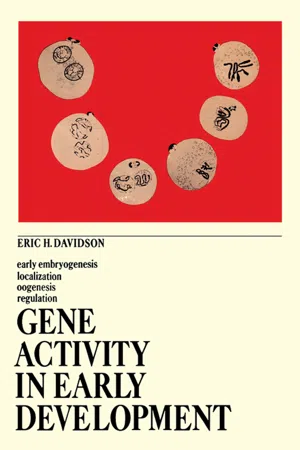
Gene Activity in Early Development reviews the state of knowledge regarding genomic function in the programming and operation of what Bonnet, in 1762, described as "the miracle of epigenesis." The book is divided into four sections. Section I is concerned with gene activity in early embryogenesis, with the time of onset and the nature of embryo genome control, and with recent attempts to analyze the shifting patterns of gene expression as development proceeds. Section II reviews various classic and recent studies relevant to the phenomenon of cytoplasmic localization of morphogenetic potential and discusses the significance, from a contemporary vantage point, of this often neglected area of developmental biology. Section III deals with genomic function in oogenesis, beginning with a general survey of what could be described loosely as the natural history of the oocyte nucleus, and proceeding to current attempts to understand the character and the ultimate function of the oocyte gene products. Section IV discusses various aspects of the general problem of gene regulation in animal cells.
Information
I
gene activity in early embryogenesis
Introduction to: gene activity in early embryogenesis
Cellular differentiation is at present interpreted in terms of the theory of variable gene activity, one of the most potent unifying theories to develop in the biological sciences during this century. This theory proposes that cell specialization results from the function of the appropriately selected group of genes in each specialized cell type, and the initial section of this book is devoted to consideration of early embryogenesis in relation to this concept and its corollaries. For several reasons the discussion is arbitrarily confined to early embryogenesis, by which one denotes development up through the immediate postgastrular period. These reasons include the relatively large amount of information we possess regarding gene activity and the fate of gene products in early embryogenesis, and the fact that later morphogenesis depends to a greater extent on complicated intertissue interactions than does early embryogenesis. Furthermore, the onset of cell differentiation early in development provides a unique set of opportunities for the study of genomic regulation in animal cells. The initial establishment of functional cell diversity and the appearance of spatially specified groupings of differentiated cell types where there were none before must depend basically on the de novo establishment of a mosaic of gene activity patterns in the nuclei of the differentiating cells, and this point of view leads directly to the problem of the gene regulation process by which these patterns are established.
Since the variable gene activity theory of differentiation is more or less to be taken for granted in what follows, it is useful to begin by noting briefly the logical structure of the argument upon which this theory now rests.
1
The variable gene activity theory of cell differentiation
Publisher Summary
This chapter presents the variable gene activity theory of cell differentiation. Several premises are required in arriving at the proposition that differentiation is a function of variable gene activity. First among these is the now well-understood molecular relationship between the genetic DNA and the structure of the various proteins found in the cell. The second premise of the argument for the variable gene activity theory is the proposition that every living cell nucleus in a metazoan organism contains the same complete [A1]
Incomplete and abrupt sentence… genome as was present in the zygote nucleus. An interesting experimental test of the idea that differentiated cells carry information normally expressed only in other cell types can be found in certain altered cell fate experiments, in which obviously differentiated cells are induced to change their specialized roles and to assume a new state of differentiation. A critical element of evidence relevant to the nature of the nuclear changes underlying cell differentiation is the presence of twice the haploid amount of DNA in the nucleus of every differentiated cell (certain particular exceptions aside), except for the gametes that contain half the somatic cell quantity.
Several premises are required in arriving at the proposition that differentiation is a function of variable gene activity. First among these is the now well-understood molecular relationship between the genetic DNA and the structure of the various proteins found in the cell. Since the cell owes its definitive characteristics to the characteristics and functional attributes of its proteins, the cell requires the expression of genetic information coding for protein structure in order for these characteristics to materialize. Thus, the differentiated state must ultimately depend on the transcription of genomic information.
early evidence for the informational equivalence of differentiated cell genomes
A second premise of the argument for the variable gene activity theory is the proposition that every living cell nucleus in a metazoan organism contains the same complete genome as was present in the zygote nucleus. Evidence for this has been accumulating ever since 1892, when experiments designed specifically to test this point were carried out by Driesch (1). Driesch, and later various other experimental embryologists (2), showed that at least in very early development (cleavage stages) given nuclei could be partitioned into cells other than those normally inheriting them without causing abnormal development. It was argued that since nuclei normally assigned to endoderm cells could also direct the development of mesoderm, and vice versa, these nuclei must contain the genes for mesoderm as well as the genes for endoderm properties. The evidence from these experiments implies that any cleavage-stage nucleus contains all the zygote genes. In these experiments the normal pattern of distribution of cleavage-stage nuclei into the diverse sectors of egg cytoplasm is transiently altered by forcing cleavage to occur under the pressure of a flat glass plate which is subsequently removed, and Driesch and his followers regarded the pressure plate experiment as a direct test of the 1883 qualitative nuclear division theory of Roux. The latter is in a sense a direct antagonist of today’s variable gene activity theory, since it supposes that differentiation of cell function results from the partition of qualitatively diverse genes into the cell nuclei. According to this theory each cell contains in its nucleus only those genes needed for the programming of its particular set of functional activities, and developmental specialization would thus stem from the progressive establishment of a mosaic of diverse partial genomes.
Though the pressure plate experiments of Driesch and later workers were taken to indicate that this view is incorrect (2, 3) it can be argued that these experiments demonstrate the genomic equality of nuclei only at a period of development long antecedent to the actual onset of cell differentiation, or even to the onset of demonstrable control over morphogenesis by these nuclei. That even highly differentiated cells contain a complete genome equal to that in the zygote nucleus is suggested by a variety of later observations, however. It was recognized very early that the cells of an organism are normally equal in the number of distinct chromosomes which they possess. A significant clue came from the study of insect polytene chromosomes, where it is possible to recognize the major banding patterns in the chromosomes of diverse cell types, and chromosomal abnormalities associated with mutations affecting the structural characteristics of one tissue can be observed in the chromosomes of another tissue. A well-known case in point is furnished by the Bar gene in Drosophila, which affects the morphogenesis of the eye. Bridges (4) showed that a duplication in a certain band complex is visible in the polytene chromosomes of salivary gland cells in flies bearing this mutation, though the salivary gland cells are evidently not responsible for the details of eye morphogenesis. Other examples concern wing structure in the same organism; here again intrachromosomal abnormalities are cytologically detectable in the nuclei of cells of the salivary gland. The differentiated cells of one tissue thus seem to bear genetic information for the structure of other tissues.
altered cell fate experiments
An interesting experimental test of the idea that differentiated cells carry information normally expressed only in other cell types can be found in certain altered cell fate experiments, in which obviously differentiated cells are induced to change their specialized roles and to assume a new state of differentiation. Thus in the regeneration of the newt eye, as was shown unequivocally by Stone (5), the regenerated neural retina cells derive directly from cells which were form...
Table of contents
- Cover image
- Title page
- Table of Contents
- Copyright
- Dedication
- preface
- I: gene activity in early embryogenesis
- II: cytoplasmic localization and the onset of differentiation
- III: gene function in oogenesis
- IV: immediacy of gene control and the regulation of gene activity
- Bibliography
- Author Index
- Subject Index
Trusted by 375,005 students
Access to over 1.5 million titles for a fair monthly price.
Study more efficiently using our study tools.
Frequently asked questions
Yes, you can cancel anytime from the Subscription tab in your account settings on the Perlego website. Your subscription will stay active until the end of your current billing period. Learn how to cancel your subscription
No, books cannot be downloaded as external files, such as PDFs, for use outside of Perlego. However, you can download books within the Perlego app for offline reading on mobile or tablet. Learn how to download books offline
Perlego offers two plans: Essential and Complete
- Essential is ideal for learners and professionals who enjoy exploring a wide range of subjects. Access the Essential Library with 800,000+ trusted titles and best-sellers across business, personal growth, and the humanities. Includes unlimited reading time and Standard Read Aloud voice.
- Complete: Perfect for advanced learners and researchers needing full, unrestricted access. Unlock 1.5M+ books across hundreds of subjects, including academic and specialized titles. The Complete Plan also includes advanced features like Premium Read Aloud and Research Assistant.
We are an online textbook subscription service, where you can get access to an entire online library for less than the price of a single book per month. With over 1.5 million books across 990+ topics, we’ve got you covered! Learn about our mission
Look out for the read-aloud symbol on your next book to see if you can listen to it. The read-aloud tool reads text aloud for you, highlighting the text as it is being read. You can pause it, speed it up and slow it down. Learn more about Read Aloud
Yes! You can use the Perlego app on both iOS and Android devices to read anytime, anywhere — even offline. Perfect for commutes or when you’re on the go.
Please note we cannot support devices running on iOS 13 and Android 7 or earlier. Learn more about using the app
Please note we cannot support devices running on iOS 13 and Android 7 or earlier. Learn more about using the app
Yes, you can access Gene Activity in Early Development by Eric H. Davidson in PDF and/or ePUB format, as well as other popular books in Biological Sciences & Biophysics. We have over 1.5 million books available in our catalogue for you to explore.