- 574 pages
- English
- ePUB (mobile friendly)
- Available on iOS & Android
eBook - ePub
Joining and Assembly of Medical Materials and Devices
About this book
As medical devices become more intricate, with an increasing number of components made from a wide range of materials, it is important that they meet stringent requirements to ensure that they are safe to be implanted and will not be rejected by the human body. Joining and assembly of medical materials and devices provides a comprehensive overview of joining techniques for a range of medical materials and applications.Part one provides an introduction to medical devices and joining methods with further specific chapters on microwelding methods in medical components and the effects of sterilization on medical materials and welded devices. Part two focuses on medical metals and includes chapters on the joining of shape memory alloys, platinum (Pt) alloys and stainless steel wires for implantable medical devices and evaluating the corrosion performance of metal medical device welds. Part three moves on to highlight the joining and assembly of medical plastics and discusses techniques including ultrasonic welding, transmission laser welding and radio frequency (RF)/dielectric welding. Finally, part four discusses the joining and assembly of biomaterial and tissue implants including metal-ceramic joining techniques for orthopaedic applications and tissue adhesives and sealants for surgical applications.Joining and assembly of medical materials and devices is a technical guide for engineers and researchers within the medical industry, professionals requiring an understanding of joining and assembly techniques in a medical setting, and academics interested in this field.
- Introduces joining methods in medical applications including microwelding and considers the effects of sterilization on the resulting joints and devices
- Considers the joining, assembly and corrosion performance of medical metals including shape memory alloys, platinum alloys and stainless steel wires
- Considers the joining and assembly of medical plastics including multiple welding methods, bonding strategies and adhesives
Information
Topic
MedicineSubtopic
Medical Technology & SuppliesPart I
Fundamentals of joining and assembly in medical materials and devices
1
Introduction to medical materials and devices
J.J. Ramsden, Collegium Basilea, Switzerland
Abstract:
This chapter introduces medical materials, especially from the viewpoint of their surface attributes and interactions with living matter, considered at various length scales ranging from molecular through cellular to tissular. The basic biophysical chemistry of interaction is covered in sufficient detail to allow the reader to estimate the interactions when appraising novel materials. Consideration is given to how welding and other forms of joining might affect the interactions. The metrology of biocompatibility is also covered in order to acquaint the reader with practical approaches to assessing the interactions, which are, of course, of crucial importance in determining the functional success of any artificial material in contact with living matter.
Key words
biocompatibility
interfacial energy
protein adsorption
1.1 Introduction
Medical materials are defined as materials used in medicine. Since medicine itself is defined as ‘the science and art concerned with the cure, alleviation, and prevention of disease, and with the restoration and preservation of health’ (Shorter Oxford English Dictionary), the compass of medical materials would appear to be rather wide: even the material used for tubing in a food-processing factory would fall into the definition, the material being specially designed to prevent colonization by pathogenic bacteria. The scientific issues underlying the application of materials in medicine are, however, clearly circumscribed and can be grouped under the heading of biocompatibility, which in turn is typically defined as ‘tolerant of life, or of biomolecular function’ (PAS 132, 2007). Regardless of the specific use to which the material is put, it must be biocompatible. The bactericidal or, more generally, biocidal surfaces that play a valuable role in keeping the walls, floor, furniture, etc. of a hospital free from infectious agents are not, of course, biocompatible – rather just the opposite – but the same principles that provide a framework for understanding biocompatibility apply to the biocidal surfaces. These principles may be collectively described as the science of the bio/nonbio interface. Thus, regardless of properties such as density, stiffness, etc. required for a particular application, it is essential to ensure that the surface of the material object is biocompatible. This implies that the special features of the science of medical materials are those associated with surfaces; properties such as density and stiffness are common to materials science as a whole. Hence, the specific focus of this chapter will be on the surface properties of materials relevant to medical applications that bring them into contact with biological matter.
Despite the acknowledgment above that materials used for production and packaging in the food and pharmaceutical industries and in water supply, etc. also have a bearing on health, in the remainder of this chapter medical materials will be defined more narrowly as the materials used for making medical devices. Nevertheless, it should be emphasized that the principles governing the bio/nonbio interface, which provide the theoretical framework for understanding biocompatibility, are also fully applicable to those other sectors.
1.1.1 An ontology for medical materials
Figure 1.1 gives the first three levels of a concept system for medical materials. From the viewpoint of surface properties, the division between the bulk materials and particles is of little consequence; particles are essentially all surface (Ramsden and Freeman, 2009). The key thing to note about the concepts appearing at the lowest level are that the objects constituting their extensions interact with both biofluids (e.g. blood) and tissues.
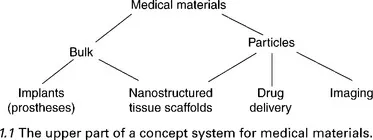
1.1 The upper part of a concept system for medical materials.
1.1.2 An ostensive definition of medical materials
Table 1.1 lists the 24 most abundant materials used in implanted medical devices. Note the dominance of titanium. Its surface is invariably coated with a thin film of titanium dioxide, which governs its biocompatibility. Titanium is attractive because of its combination of excellent biocompatibility (of its oxide) and mechanical properties (relatively lightweight and strong). Polymers of various kinds are also prominent. On the other hand, composites have as yet found little favour in clinical practice. This compilation does not include the (still mostly experimental) materials used to fabricate drug delivery particles.
Table 1.1
Relative importance (ranked by numbers of occurrences N of the listed words) of the materials used in implanted devicesa
| Rank | Material | N |
| 1 | Titanium | 2492 |
| 2 | Steel | 607 |
| 3 | Chromium | 391 |
| 4 | Polyethylene (PE), ultra-high molecular weight polyethylene (UHMWPE) | 389 |
| 5 | Silicone | 375 |
| 6 | Cobalt | 235 |
| 7 | Polytetrafluoroethylene (PTFE), Teflon, fluoroplastic | 220 |
| 8 | Molybdenum | 216 |
| 9 | Vitallium | 198 |
| 10 | Polypropylene (PP) | 160 |
| 11 | Polymethylmethacrylate (PMMA), acrylic | 111 |
| 12 | Polyester | 107 |
| 13 | NiTiNOL | 101 |
| 14 | Polyurethane (PU) | 72 |
| 15 | Platinum | 58 |
| 16 | Premilene (a lightweight polypropylene mesh) | 55 |
| 17 | Aluminium, alumina | 52 |
| 18 | Carbon | 51 |
| 19 | Rubber | 49 |
| 20 | Hydroxyapatite (HAp) | 45 |
| 21 | Silicon | 42 |
| 22 | Polylactic acid (PLLA) | 39 |
| 23 | Polyethyletherketone (PEEK) | 32 |
| 24 | Tantalum | 18 |
aWords are from the Prostheses List of the Australian Health Insurance Association (AHIA), 2005.
1.1.3 Surface attributes of medical materials
As a general rule, it can be stated that materials in contact with the bloodstream should not interact with blood; that is, with its proteins and cells. Materials of devices such as hypodermic needles and surgical knives, intended for very transient contact with the living substance, form a subcategory of non-interacting materials. Conversely, materials intended to remain in contact with solid tissue (e.g. a bone implant) for an indefinite duration should become assimilated with it (Kutsevlyak et al., 2008).
1.1.4 The nature of interaction
We are concerned with two materials, that of the artificial device (the medical material) and the biological tissue. They will sense each other’s presence through various forces. For example, if the materials have mass, the gravitational force will act between them (this is usually weak enough to be neglected, but even a single living cell will sediment when suspended in a fluid). Electrostatic forces are far stronger. Matter is, normally, electrostatically neutral but especially in a medium such as water, which has a high dielectric constant, atoms may separate from each other, becoming ions, as in

and the ions may adsorb onto a neutral surface, electrifying it; water itself is also weakly ionized:

but at neutral (physiological) pH the concentration of each ion is only 100 nM. The surfaces of metal oxides such as titanium dioxide are typically hydroxylated through reaction with water and the hydroxyl groups can themselves ionize:

The small, mobile h...
Table of contents
- Cover image
- Title page
- Table of Contents
- Copyright
- Contributor contact details
- Woodhead Publishing Series in Biomaterials
- Part I: Fundamentals of joining and assembly in medical materials and devices
- Part II: Joining and assembly of medical metals
- Part III: Joining and assembly of medical plastics
- Part IV: Joining and assembly of biomaterial and tissue implants
- Index
Trusted by 375,005 students
Access to over 1.5 million titles for a fair monthly price.
Study more efficiently using our study tools.
Frequently asked questions
Yes, you can cancel anytime from the Subscription tab in your account settings on the Perlego website. Your subscription will stay active until the end of your current billing period. Learn how to cancel your subscription
No, books cannot be downloaded as external files, such as PDFs, for use outside of Perlego. However, you can download books within the Perlego app for offline reading on mobile or tablet. Learn how to download books offline
Perlego offers two plans: Essential and Complete
- Essential is ideal for learners and professionals who enjoy exploring a wide range of subjects. Access the Essential Library with 800,000+ trusted titles and best-sellers across business, personal growth, and the humanities. Includes unlimited reading time and Standard Read Aloud voice.
- Complete: Perfect for advanced learners and researchers needing full, unrestricted access. Unlock 1.5M+ books across hundreds of subjects, including academic and specialized titles. The Complete Plan also includes advanced features like Premium Read Aloud and Research Assistant.
We are an online textbook subscription service, where you can get access to an entire online library for less than the price of a single book per month. With over 1.5 million books across 990+ topics, we’ve got you covered! Learn about our mission
Look out for the read-aloud symbol on your next book to see if you can listen to it. The read-aloud tool reads text aloud for you, highlighting the text as it is being read. You can pause it, speed it up and slow it down. Learn more about Read Aloud
Yes! You can use the Perlego app on both iOS and Android devices to read anytime, anywhere — even offline. Perfect for commutes or when you’re on the go.
Please note we cannot support devices running on iOS 13 and Android 7 or earlier. Learn more about using the app
Please note we cannot support devices running on iOS 13 and Android 7 or earlier. Learn more about using the app
Yes, you can access Joining and Assembly of Medical Materials and Devices by Y N Zhou,M D Breyen in PDF and/or ePUB format, as well as other popular books in Medicine & Medical Technology & Supplies. We have over 1.5 million books available in our catalogue for you to explore.