- 562 pages
- English
- ePUB (mobile friendly)
- Available on iOS & Android
eBook - ePub
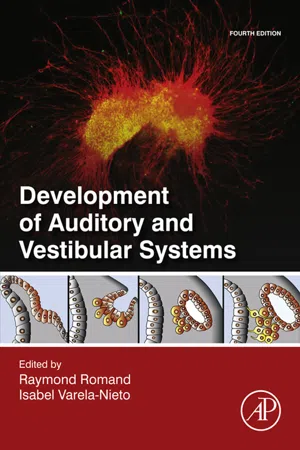
Development of Auditory and Vestibular Systems
About this book
Development of Auditory and Vestibular Systems fourth edition presents a global and synthetic view of the main aspects of the development of the stato-acoustic system. Unique to this volume is the joint discussion of two sensory systems that, although close at the embryological stage, present divergences during development and later reveal conspicuous functional differences at the adult stage. This work covers the development of auditory receptors up to the central auditory system from several animal models, including humans. Coverage of the vestibular system, spanning amphibians to effects of altered gravity during development in different species, offers examples of the diversity and complexity of life at all levels, from genes through anatomical form and function to, ultimately, behavior.
The new edition of Development of Auditory and Vestibular Systems will continue to be an indispensable resource for beginning scientists in this area and experienced researchers alike.
- Full-color figures illustrate the development of the stato-acoustic system pathway
- Covers a broad range of species, from drosophila to humans, demonstrating the diversity of morphological development despite similarities in molecular processes involved at the cellular level
- Discusses a variety of approaches, from genetic-molecular biology to psychophysics, enabling the investigation of ontogenesis and functional development
Information
Chapter 1
Early Development of the Vertebrate Inner Ear
, , and 1 Instituto de Investigaciones Biomédicas ‘Alberto Sols’, Consejo Superior de Investigaciones Científicas-Universidad Autónoma de Madrid, Madrid, Spain 2 Centro de Investigacion Biomedica en Red de Enfermedades Raras, Instituto de Salud Carlos III, Madrid, Spain 3 Departamento de Biologia, Universidad Autonoma de Madrid, Madrid, Spain 4 Facultad de Veterinaria, Universidad Complutense de Madrid, Madrid, Spain 5 IdiPAZ, Madrid, Spain
Abstract
The auditory and vestibular receptors of vertebrates are located in the inner ear and connected to the brain by the VIIIth cranial nerve. The inner ear is a complex and integrated system, damage to which causes hearing and/or balance impairment. Understanding the genetic, cellular, and molecular bases of inner ear development will enhance our understanding of adult inner ear physiology and pathology. Cells of the sensory receptors have a common embryonic origin in the ectodermal otic placode. The three main otic lineages of sensory hair cells, non-sensory support cells, and spiral and vestibular neurons have common otic progenitors. Apoptosis, proliferation, autophagy, and cell differentiation processes interact during early otic development to generate the structures and functionally distinct cell types of the adult inner ear. Groundbreaking work has begun to delineate the signaling networks that regulate early inner ear development, and this will be discussed in detail in this chapter.
Keywords
acoustic-vestibular ganglion ; AKT ; apoptosis ; autophagy ; IGF signaling ; otic progenitors ; otic vesicleSummary
The auditory and vestibular receptors of vertebrates are located in the inner ear and connected to the brain by the VIIIth cranial nerve. The inner ear is a complex and integrated system, damage to which causes hearing and/or balance impairment. Understanding the genetic, cellular, and molecular bases of inner ear development will enhance our understanding of adult inner ear physiology and pathology. Cells of the sensory receptors have a common embryonic origin in the ectodermal otic placode. The three main otic lineages of sensory hair cells, non-sensory support cells, and spiral and vestibular neurons have common otic progenitors. Apoptosis, proliferation, autophagy, and cell differentiation processes interact during early otic development to generate the structures and functionally distinct cell types of the adult inner ear. Groundbreaking work has begun to delineate the signaling networks that regulate early inner ear development, and this will be discussed in detail in this chapter.
1. The Adult Inner Ear
1.1. Anatomy of the Adult Inner Ear
The mammalian inner ear is formed by fluid-filled canals and cavities, named the membranous labyrinth, that are encased within the bony labyrinth and located inside the temporal bone (Fig. 1.1 A). The auditory (hearing) and vestibular (balance) organs are located in the inner ear, and they are connected to the brain by the fibers of the VIIIth cranial nerve. The cochlear, or hearing part, is divided into the three parallel helical scalas, tympanic, vestibular, and media, filled with lymph (Fig. 1.1A–C). The organ of Corti is located inside the scala media. This is the sensory receptor, where the hair cells transform the mechanical input elicited by sounds into an electrochemical signal (Hudspeth, 2008). The organ of Corti is formed by two main types of functional cells: sensory hair cells and non-sensory support cells (Fig. 1.1D–F). The hair cells are the sensory receptor cells and possess a set of sterocilia in their apical surface that allow mechanotransduction. There are two types of hair cells that exhibit specific functions: the inner hair cells (IHC) and the outer hair cells (OHC), which are arranged in one and three rows, respectively. IHC and OHC rows are separated by support pillar cells that form the tunnel of Corti. Deiters’, Hensen’s, and Claudius’s cells are other specialized non-sensory support cells that participate in ionic and metabolic cochlear homeostasis (Forge and Wright, 2002; Lefebvre and Van De Water, 2000).
The bipolar auditory neurons of the spiral ganglion are connected to the hair cells and convey the encoded sound information to the central nervous system (Nayagam et al., 2011; Raphael and Altschuler, 2003) (Fig. 1.1G–I). The dendritic ends of type I neurons connect to the IHCs, whereas those of the type II innervate the OHCs. The axons of the spiral neurons leave the spiral ganglion and pass through the base of the modiolus to form the cochlear division of the cochleo-vestibular nerve toward the cochlear nuclei in the brainstem. Sound information progresses in a complex, multisynaptic, parallel, and ascendant pathway from the cochlea through the brainstem nuclei to the auditory cortex (Webster et al., 1992). The tonotopic organization present in the cochlea is maintained along the pathway up to the auditory cortex. Neurons from the superior olivary complex at the brainstem also contact hair cells in a centrifugal control mechanism of the auditory pathway.
The spiral ligament and the stria vascularis form the lateral wall, and both are central to hearing physiopathology (Fig. 1.1J–L). The stria vascularis is a three-layered vascular epithelium that regulates intracochlear ion transport and maintains the endocochlear potential. The intermediate cells of the stria vascularis are melanocyte-like cells (Murillo-Cuesta et al., 2010; Patuzzi,...
Table of contents
- Cover image
- Title page
- Table of Contents
- Copyright
- Contributors
- Chapter 1. Early Development of the Vertebrate Inner Ear
- Chapter 2. Development of the Auditory Organ (Johnston’s Organ) in Drosophila
- Chapter 3. Zebrafish Inner Ear Development and Function
- Chapter 4. Human Gene Discovery for Understanding Development of the Inner Ear and Hearing Loss
- Chapter 5. Planar Cell Polarity in the Cochlea
- Chapter 6. Functional Development of Hair Cells in the Mammalian Inner Ear
- Chapter 7. Neuronal Circuitries During Inner Ear Development
- Chapter 8. Recapitulating Inner Ear Development with Pluripotent Stem Cells: Biology and Translation
- Chapter 9. Development of Mammalian Primary Sound Localization Circuits
- Chapter 10. Development of Fundamental Aspects of Human Auditory Perception
- Chapter 11. Developmental Plasticity of the Central Auditory System: Evidence from Deaf Children Fitted with Cochlear Implants
- Chapter 12. Development of the Mammalian ‘Vestibular’ System: Evolution of Form to Detect Angular and Gravity Acceleration
- Chapter 13. Development of the Statoacoustic System of Amphibians
- Chapter 14. Development of the Central Vestibular System
- Chapter 15. Functional Development of the Vestibular System: Sensorimotor Pathways for Stabilization of Gaze and Posture
- Chapter 16. Development of Vestibular Systems in Altered Gravity
- Index
Trusted by 375,005 students
Access to over 1.5 million titles for a fair monthly price.
Study more efficiently using our study tools.
Frequently asked questions
Yes, you can cancel anytime from the Subscription tab in your account settings on the Perlego website. Your subscription will stay active until the end of your current billing period. Learn how to cancel your subscription
No, books cannot be downloaded as external files, such as PDFs, for use outside of Perlego. However, you can download books within the Perlego app for offline reading on mobile or tablet. Learn how to download books offline
Perlego offers two plans: Essential and Complete
- Essential is ideal for learners and professionals who enjoy exploring a wide range of subjects. Access the Essential Library with 800,000+ trusted titles and best-sellers across business, personal growth, and the humanities. Includes unlimited reading time and Standard Read Aloud voice.
- Complete: Perfect for advanced learners and researchers needing full, unrestricted access. Unlock 1.5M+ books across hundreds of subjects, including academic and specialized titles. The Complete Plan also includes advanced features like Premium Read Aloud and Research Assistant.
We are an online textbook subscription service, where you can get access to an entire online library for less than the price of a single book per month. With over 1.5 million books across 990+ topics, we’ve got you covered! Learn about our mission
Look out for the read-aloud symbol on your next book to see if you can listen to it. The read-aloud tool reads text aloud for you, highlighting the text as it is being read. You can pause it, speed it up and slow it down. Learn more about Read Aloud
Yes! You can use the Perlego app on both iOS and Android devices to read anytime, anywhere — even offline. Perfect for commutes or when you’re on the go.
Please note we cannot support devices running on iOS 13 and Android 7 or earlier. Learn more about using the app
Please note we cannot support devices running on iOS 13 and Android 7 or earlier. Learn more about using the app
Yes, you can access Development of Auditory and Vestibular Systems by Raymond Romand,Isabel Varela-Nieto in PDF and/or ePUB format, as well as other popular books in Biological Sciences & Biology. We have over 1.5 million books available in our catalogue for you to explore.