- 306 pages
- English
- ePUB (mobile friendly)
- Available on iOS & Android
eBook - ePub
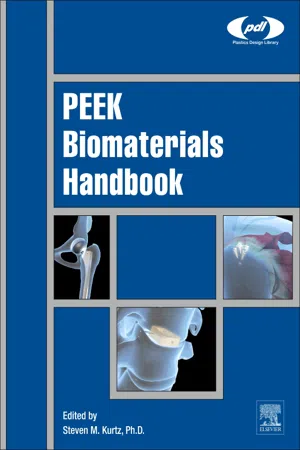
PEEK Biomaterials Handbook
About this book
PEEK biomaterials are currently used in thousands of spinal fusion patients around the world every year. Durability, biocompatibility and excellent resistance to aggressive sterilization procedures make PEEK a polymer of choice, replacing metal in orthopedic implants, from spinal implants and hip replacements to finger joints and dental implants.
This Handbook brings together experts in many different facets related to PEEK clinical performance as well as in the areas of materials science, tribology, and biology to provide a complete reference for specialists in the field of plastics, biomaterials, medical device design and surgical applications.
Steven Kurtz, author of the well respected UHMWPE Biomaterials Handbook and Director of the Implant Research Center at Drexel University, has developed a one-stop reference covering the processing and blending of PEEK, its properties and biotribology, and the expanding range of medical implants using PEEK: spinal implants, hip and knee replacement, etc.
- Covering materials science, tribology and applications
- Provides a complete reference for specialists in the field of plastics, biomaterials, biomedical engineering and medical device design and surgical applications
Information
Subtopic
Materials ScienceChapter 1. An Overview of PEEK Biomaterials
Steven M. Kurtz, Ph.D.
1.1. Introduction
Following confirmation of its biocompatibility two decades ago [1], polyaryletherketone polymers (PAEKs) have been increasingly employed as biomaterials for orthopedic, trauma, and spinal implants. Polyaryletheretherketone, commonly referred to as PEEK, is a member of the PAEK polymer family that has been used for orthopedic and spinal implants. Historically, the availability of PEEK arrived at a time when there was growing interest in the development of “isoelastic” hip stems and fracture fixation plates, with stiffnesses comparable with bone [2]. Although neat (unfilled) PEEK biomaterials can exhibit an elastic modulus ranging between 3 and 4 GPa, the modulus can be tailored to closely match cortical bone (18 GPa) or titanium alloy (110 GPa) by preparing carbon fiber-reinforced (CFR) composites with varying fiber length and orientation [2]. In the 1990s, researchers characterized the biocompatibility and in vivo stability of various PAEK materials, along with other “high-performance” engineering polymers, such as polysulfones and polybutylene terephthalate [3]. However, concerns were raised about the stress-induced cracking of polysulfones by lipids [4] and the use of these polymers in implants was subsequently abandoned.
By the late 1990s, PEEK had emerged as the leading high-performance thermoplastic candidate for replacing metal implant components, especially in orthopedics [5] and [6] and trauma [7] and [8]. Not only was the material resistant to simulated in vivo degradation, including damage caused by lipid exposure, but starting in April 1998, PEEK was offered commercially as a biomaterial for implants (Invibio Ltd., Thornton Cleveleys, United Kingdom) [9]. Facilitated by a stable supply, research on PEEK biomaterials flourished and is expected to continue to advance in the future [10].
Numerous studies documenting the successful clinical performance of PAEKs in orthopedic and spine patients continue to emerge in the literature [11], [12], [13], [14], [15] and [16]. Recent research has also investigated the biotribology of PEEK composites as bearing materials and flexible implants used for joint arthroplasty [17], [18], [19] and [20]. Because of the interest in further improving implant fixation, PEEK biomaterials research has also focused on compatibility of the polymer with bioactive materials, including hydroxyapatite, either as a composite filler or as a surface coating [21], [22], [23], [24] and [25]. As a result of ongoing biomaterials research, PEEK and related composites can be engineered today with a wide range of physical, mechanical, and surface properties, depending upon their implant application.
The purpose of this Handbook is to introduce PEEK as an established member of the biomaterials armamentarium to students, engineers, and surgeons. Our aim is to cover the terminology, history, and recent advances related to its use in implantable devices for trauma, spine, and orthopedics. We hope that this monograph will serve two useful purposes. Our primary objective is to provide biomaterials researchers with a timely synthesis of the existing literature for PEEK, to help stimulate further studies to fill existing gaps in knowledge and experience. Our second goal is to provide the surgical community with state-of-the-art information about PEEK to facilitate accurate communications with patients.
In this introductory chapter, we begin with the basics about polymers and PEEK. This chapter reviews basic information about polymers in general and describes the structure and composition of PEEK. The concepts of crystallinity and thermal transitions are introduced at a basic level. Readers familiar with these basic polymer concepts may want to consider skipping ahead to the next chapter.
1.2. What Is a Polymer?
PEEK belongs to a class of materials known as polymers or in lay terms more simply as plastics. More specifically, PEEK is classified as a linear homopolymer. Before proceeding to a definition of PEEK, it is helpful to first understand the significance of these italicized terms.
The definition of polymer has its origins in the Greek, polumerēs, meaning “having many parts.” The repeating units, or monomer segments, of a polymer can all be the same. In such a case, we have a homopolymer (Fig. 1.1).
 |
| Figure 1.1 Schematic representation of a homopolymer. |
When two or more different monomers are used, the resulting material is classified as a copolymer. However, PEEK is a homopolymer, and so throughout this chapter we will focus our attention on polymers having only a single monomer.
Polymers may be linear or branched (Fig. 1.2). The tendency for branching in a homopolymer depends strongly on its synthesis conditions. The distinguishing feature of a polymer—as compared with a metal or ceramic—is its molecular size. In a polymer such as PEEK, the molecule is a linear chain of 100 monomer units with an average molecular weight of 80,000–120,000 g/mol.
 |
| Figure 1.2 Schematic representation of linear and branched homopolymers. |
In general, the length and composition of the molecular chain result in many unique attributes for polymers, most notably the dependence of its properties on the temperature and rate at which deformations are applied. The rate and temperature sensitivity of polymers are strongly dependent on their chemical composition and structure. In other words, certain polymers are more rate and temperature sensitive than others.
As we shall see in subsequent sections and chapters of this Handbook, when used for implants under clinically relevant conditions, PEEK is relatively insensitive to changes in rate and temperature. Further explanation of general polymer concepts can be found in the excellent textbook by Rodriguez [26].
1.3. What Is PEEK?
Commercialized for industry in the 1980s, PAEK is a family of high-performance thermoplastic polymers, consisting of an aromatic backbone molecular chain, interconnected by ketone and ether functional groups [27]. Thus, PEEK belongs to a larger family of PAEK polymers, sometimes referred to as polyetherketones (PEKs) or more simply as “polyketones.” Th...
Table of contents
- Cover image
- Table of Contents
- Dedication
- Front Matter
- Copyright
- Foreword
- List of Contributors
- Chapter 1. An Overview of PEEK Biomaterials
- Chapter 2. Synthesis and Processing of PEEK for Surgical Implants
- Chapter 3. Compounds and Composite Materials
- Chapter 4. Morphology and Crystalline Architecture of Polyaryletherketones
- Chapter 5. Fracture, Fatigue, and Notch Behavior of PEEK
- Chapter 6. Chemical and Radiation Stability of PEEK
- Chapter 7. Biocompatibility of Polyaryletheretherketone Polymers
- Chapter 8. Bacterial Interactions with Polyaryletheretherketone
- Chapter 9. Thermal Plasma Spray Deposition of Titanium and Hydroxyapatite on Polyaryletheretherketone Implants
- Chapter 10. Surface Modification Techniques of Polyetheretherketone, Including Plasma Surface Treatment
- Chapter 11. Bioactive Polyaryletherketone Composites
- Chapter 12. Porosity in Polyaryletheretherketone
- Chapter 13. Applications of Polyaryletheretherketone in Spinal Implants
- Chapter 14. Isoelastic Polyaryletheretherketone Implants for Total Joint Replacement
- Chapter 15. Applications of Polyetheretherketone in Trauma, Arthroscopy, and Cranial Defect Repair
- Chapter 16. Arthroplasty Bearing Surfaces
- Chapter 17. FDA Regulation of Polyaryletheretherketone Implants
- Index
Trusted by 375,005 students
Access to over 1.5 million titles for a fair monthly price.
Study more efficiently using our study tools.
Frequently asked questions
Yes, you can cancel anytime from the Subscription tab in your account settings on the Perlego website. Your subscription will stay active until the end of your current billing period. Learn how to cancel your subscription
No, books cannot be downloaded as external files, such as PDFs, for use outside of Perlego. However, you can download books within the Perlego app for offline reading on mobile or tablet. Learn how to download books offline
Perlego offers two plans: Essential and Complete
- Essential is ideal for learners and professionals who enjoy exploring a wide range of subjects. Access the Essential Library with 800,000+ trusted titles and best-sellers across business, personal growth, and the humanities. Includes unlimited reading time and Standard Read Aloud voice.
- Complete: Perfect for advanced learners and researchers needing full, unrestricted access. Unlock 1.5M+ books across hundreds of subjects, including academic and specialized titles. The Complete Plan also includes advanced features like Premium Read Aloud and Research Assistant.
We are an online textbook subscription service, where you can get access to an entire online library for less than the price of a single book per month. With over 1.5 million books across 990+ topics, we’ve got you covered! Learn about our mission
Look out for the read-aloud symbol on your next book to see if you can listen to it. The read-aloud tool reads text aloud for you, highlighting the text as it is being read. You can pause it, speed it up and slow it down. Learn more about Read Aloud
Yes! You can use the Perlego app on both iOS and Android devices to read anytime, anywhere — even offline. Perfect for commutes or when you’re on the go.
Please note we cannot support devices running on iOS 13 and Android 7 or earlier. Learn more about using the app
Please note we cannot support devices running on iOS 13 and Android 7 or earlier. Learn more about using the app
Yes, you can access PEEK Biomaterials Handbook by Steven M. Kurtz in PDF and/or ePUB format, as well as other popular books in Technology & Engineering & Materials Science. We have over 1.5 million books available in our catalogue for you to explore.