- 350 pages
- English
- ePUB (mobile friendly)
- Available on iOS & Android
eBook - ePub
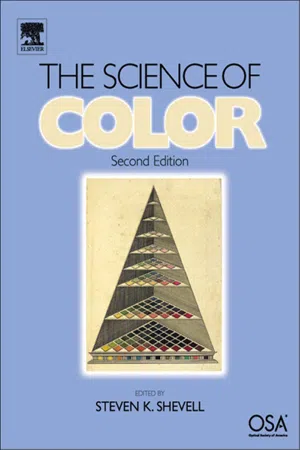
The Science of Color
About this book
The Science of Color focuses on the principles and observations that are foundations of modern color science. Written for a general scientific audience, the book broadly covers essential topics in the interdisciplinary field of color, drawing from physics, physiology and psychology. This book comprises eight chapters and begins by tracing scientific thinking about color since the seventeenth century. This historical perspective provides an introduction to the fundamental questions in color science, by following advances as well as misconceptions over more than 300 years. The next chapters then discuss the relationship between light, the retinal image, and photoreceptors, followed by a focus on concepts such as color matching and color discrimination; color appearance and color difference specification; the physiology of color vision; the 15 mechanisms of the physics and chemistry of color; and digital color reproduction. Each chapter begins with a short outline that summarizes the organization and breadth of its material. The outlines are valuable guides to chapter structure, and worth scanning even by readers who may not care to go through a chapter from start to finish. This book will be of interest to scientists, artists, manufacturers, and students.
Information
1 The Origins of Modern Color Science
CHAPTER CONTENTS
1.1. Newton
1.2. The trichromacy of color mixture
1.2.1. Trichromacy and the development of three-color reproduction
1.2.2. Trichromacy in opposition to Newtonian optics
1.2.3. The missing concept of a sensory transducer
1.2.3.1. George Palmer
1.2.3.2. John Elliot MD
1.2.3.3. Thomas Young
1.3. Interference colors
1.4. The ultra-violet, the infra-red, and the spectral sensitivity of the eye
1.5. Color constancy, color contrast, and color harmony
1.6. Color deficiency
1.6.1. Inherited color deficiency
1.6.2. Acquired deficiencies of color perception
1.7. The golden age (1850–1931)
1.7.1. Color mixture
1.7.2. The spectral sensitivities of the receptors
1.7.3. Anomalous trichromacy
1.7.4. Tests for color deficiency
1.7.5. Color and evolution
1.8. Nerves and sensations
Further reading
References
Jove’s wondrous bow, of three celestial dyes, Placed as a sign to man amid the skies
Pope, Iliad, xi: 37
Each newcomer to the mysteries of color science must pass through a series of conceptual insights. In this, he or she recapitulates the history of the subject. For the history of color science is as much the history of misconception and insight as it is of experimental refinement. The errors that have held back our field have most often been category errors, that is, errors with regard to the domain of knowledge within which a given observation is to be explained. For over a century, for example, the results of mixing colored lights were explained in terms of physics rather than in terms of the properties of human photoreceptors. Similarly, in our own time, we remain uncertain whether the phenomenological purity of certain hues should be explained in terms of hard-wired properties of our visual system or in terms of properties of the world in which we live.
1.1 NEWTON
Modern color science finds its birth in the seventeenth century. Before that time, it was commonly thought that white light represented light in its pure form and that colors were modifications of white light. It was already well known that colors could be produced by passing white light through triangular glass prisms, and indeed the long thin prisms sold at fairs had knobs on the end so that they could be suspended close to a source of light. In his first published account of his ‘New Theory of Colors,’ Isaac Newton describes how he bought a prism ‘to try therewith the celebrated Phaenomena of colours’ (Newton, 1671). In the seventeenth century, one of the great trade fairs of Europe was held annually on Stourbridge Common, near the head of navigation of the river Cam. The fair was only two kilometers from Trinity College, Cambridge, where Newton was a student and later, a Fellow. In his old age, Newton told John Conduitt that he had bought his first prism at Stourbridge Fair in 1665 and had to wait until the next fair to buy a second prism to prove his ‘Hypothesis of colours’. Whatever the accuracy of this account and its dates – the fair in fact was cancelled in 1665 and 1666, owing to the plague (Hall, 1992) – the story emphasizes that Newton did not discover the prismatic spectrum: His contribution lies in his analytic use of further prisms.
Allowing sunlight to enter a small round hole in the window shutters of his darkened chamber, Newton placed a prism at the aperture and refracted the beam on to the opposite wall. A spectrum of vivid and lively colors was produced. He observed, however, that the colored spectrum was not circular as he expected from the received laws of refraction, but was oblong, with semi-circular ends.
Once equipped with a second prism, Newton was led to what he was to call his Experimentum Crucis. As before, he allowed sunlight to enter the chamber through a hole in the shutter and fall on a triangular prism. He took two boards, each pierced by a small hole. He placed one immediately behind the prism, so its aperture passed a narrow beam; and he placed the second about 4 meters beyond, in a position that allowed him to pass a selected portion of the spectrum through its aperture. Behind the second aperture, he placed a second prism, so that the beam was refracted a second time before it reached the wall (Figure 1.1). By rotating the first prism around its long axis, Newton was able to pass different portions of the spectrum through the second aperture. What he observed was that the part of the beam that was more refracted by the first prism was also more refracted by the second prism.

Figure 1.1 An eighteenth-century representation of Newton’s Experimentum crucis. As the left-hand prism is rotated around its long axis, the beam selected by the two diaphragms is constant in its angle of incidence at the second prism. Yet the beam is refracted to different degrees at the second prism according to the degree to which it is refracted at the first.
(From Nollet’s Leçons de Physique Expérimentale).
Moreover, a particular hue was associated with each degree of refrangibility: The least refrangible rays exhibited a red color and the most refrangible exhibited a deep violet color. Between these two extremes, there was a continuous series of intermediate colors corresponding to rays of intermediate refrangibility. Once a ray of a particular refrangibility has been isolated in variants of the Experimentum Crucis, there was no experimental manipulation that would then change its refrangibility or its color: Newton tried refracting the ray with further prisms, reflecting it from various colored surfaces, and transmitting it through colored mediums, but such operations never changed its hue. Today we should call such a beam ‘monochromatic’: It contains only a narrow band of wavelengths – but that was not to be known until the nineteenth century.
Yet there was no individual ray, no single refrangibility, corresponding to white. White light is not homogeneous, Newton argued, but is a ‘Heterogeneous mixture of differently refrangible Rays.’ The prism does not modify sunlight to yield colors: Rather it separates out the rays of different refrangibility that are promiscuously intermingled in the white light of a source such as the sun. If the rays of the spectrum are subsequently recombined, then a white is again produced.
In ordinary discourse, we most often use the word ‘color’ to refer to the hues of natural surfaces. The color of a natural body, Newton argued, is merely its disposition to reflect lights of some refrangibilities more than others. Today we should speak of the ‘spectral reflectance’ of a surface – the proportion of the incident light that is reflected at each wavelength. As Newton observed, an object that normally appears red in broadband, white light will appear blue if it is illuminated by blue light, that is, by light from the more refrangible end of the spectrum.
The mixing of colors, however, presented Newton with problems that he never fully resolved. Even in his first published paper, he had to allow that a mixture of two rays of different refrangibility could match the color produced by homogeneous light, light of a single refrangibility. Thus a mixture of red and yellow make orange; orange and yellowish green make yellow; and mixtures of other pairs of spectral colors will similarly match an intermediate color, provided that the components of the pair are not too separated in the spectrum. ‘For in such mixtures, the component colours appear not, but, by their mutual allaying each other, constitute a midling colour’(Newton, 1671). So colors that looked the same to the eye might be ‘original and simple’ or might be compound, and the only way to distinguish them was to resolve them with a prism. Needless to say, this complication was to give difficulties for his contemporaries and successors (Shapiro, 1980).
White presented an especial difficulty. In his first paper, Newton wrote of white: ‘There is no one sort of Rays which alone can exhibit this. ‘Tis ever compounded, and to its composition are requisite all the aforesaid primary colours’ (Newton, 1671). The last part of this claim was quickly challenged by Christian Huygens, who suggested that two colors alone (yellow and blue) might be sufficient to yield white (Huygens, 1673). There do, in fact, exist pairs of monochromatic lights that can be mixed to match white (they are now called ‘complementary wa...
Table of contents
- Cover image
- Title page
- Table of Contents
- DEDICATED TO OUR MENTORS:
- Copyright
- Preface
- Contributors
- Chapter 1: The Origins of Modern Color Science
- Chapter 2: Light, the Retinal Image, and Photoreceptors
- Chapter 3: Color Matching and Color Discrimination
- Chapter 4: Color Appearance
- Chapter 5: Color Appearance and Color Difference Specification
- Chapter 6: The Physiology of Color Vision
- Chapter 7: The Physics and Chemistry of Color: the 15 Mechanisms
- Chapter 8: Digital Color Reproduction
- Author Index
- Subject Index
Trusted by 375,005 students
Access to over 1.5 million titles for a fair monthly price.
Study more efficiently using our study tools.
Frequently asked questions
Yes, you can cancel anytime from the Subscription tab in your account settings on the Perlego website. Your subscription will stay active until the end of your current billing period. Learn how to cancel your subscription
No, books cannot be downloaded as external files, such as PDFs, for use outside of Perlego. However, you can download books within the Perlego app for offline reading on mobile or tablet. Learn how to download books offline
Perlego offers two plans: Essential and Complete
- Essential is ideal for learners and professionals who enjoy exploring a wide range of subjects. Access the Essential Library with 800,000+ trusted titles and best-sellers across business, personal growth, and the humanities. Includes unlimited reading time and Standard Read Aloud voice.
- Complete: Perfect for advanced learners and researchers needing full, unrestricted access. Unlock 1.5M+ books across hundreds of subjects, including academic and specialized titles. The Complete Plan also includes advanced features like Premium Read Aloud and Research Assistant.
We are an online textbook subscription service, where you can get access to an entire online library for less than the price of a single book per month. With over 1.5 million books across 990+ topics, we’ve got you covered! Learn about our mission
Look out for the read-aloud symbol on your next book to see if you can listen to it. The read-aloud tool reads text aloud for you, highlighting the text as it is being read. You can pause it, speed it up and slow it down. Learn more about Read Aloud
Yes! You can use the Perlego app on both iOS and Android devices to read anytime, anywhere — even offline. Perfect for commutes or when you’re on the go.
Please note we cannot support devices running on iOS 13 and Android 7 or earlier. Learn more about using the app
Please note we cannot support devices running on iOS 13 and Android 7 or earlier. Learn more about using the app
Yes, you can access The Science of Color by Steven K. Shevell in PDF and/or ePUB format, as well as other popular books in Biological Sciences & Neuroscience. We have over 1.5 million books available in our catalogue for you to explore.