eBook - ePub
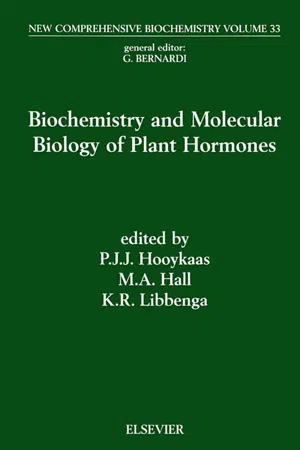
Biochemistry and Molecular Biology of Plant Hormones
- 538 pages
- English
- ePUB (mobile friendly)
- Available on iOS & Android
eBook - ePub
Biochemistry and Molecular Biology of Plant Hormones
About this book
This book provides up-to-date coverage at an advanced level of a range of topics in the biochemistry and molecular biology of plant hormones, with particular emphasis on biosynthesis, metabolism and mechanisms of action. Each contribution is written by acknowledged experts in the field, providing definitive coverage of the field.No other modern book covers this subject matter at such an advanced level so comprehensively. It will be invaluable to university libraries and scientists in the plant biotechnology industries.
Information
III – Hormone Perception and Transduction
Chapter 14
Molecular characteristics and cellular roles of guanine nucleotide binding proteins in plant cells
P.A. Millner and T.H. Carr, School of Biochemistry and Molecular Biology, University of Leeds, Leeds LS2 9JT, UK
List of Abbreviations
ABP auxin binding protein
BSA bovine serum albumin
CTx cholera toxin
GNP guanine nucleoside phosphate
GTP7S guanosine 5′-0-(3-thiotriphosphate)
GppNHp β:γ-imidoguanosine diphosphate
GNRP guanine nucleotide regulatory protein
GAP GTPase activating protein
PLC phospholipase C
IP3 inositol 1,4,5-trisphosphate
PI phosphatidyl inositol
PTx pertussis toxin
AC adenylate cyclase
7TMS seven transmembrane span
1. Signal transducing GTPases within animal and fungal cells
1.1. Major subclasses
Monomeric/small G-proteins: The archetypal small G-protein is that encoded by the ras gene which, in animal cells at least, is a highly conserved 21 kDa monomeric protein, rasp21 (p21ras). The ras proteins were discovered initially because of their transforming ability in the Harvey and Kirsten strains of rat sarcoma virus. All members of the ras family bind and hydrolyse GTP, becoming “active” in the presence of the triphosphate and “inactive” upon hydrolysis of it. Interestingly, ras proteins possess extremely low intrinsic hydrolysis rates (<0.01 min–1) as compared to their distant cousins, the heterotrimeric G-proteins (3–5 min–1). Thus the ras proteins are dependent on several types of “partner” proteins: GAPs (GTPase activating proteins), GNRPs (guanine nucleotide release proteins) and GDIs (guanine nucleotide dissociation inhibitors) to regulate GTP hydrolysis, nucleotide exchange and release [20,93]. A vital prerequisite for the signalling role of the ras proteins is lipid modification, with an acyl or prenyl group being attached at a C-terminal cysteine residue, allowing anchorage to the inner face of the plasma membrane [29,59].
Ras is known to be involved in the regulation of cellular proliferation and terminal differentiation [7,40]. In mammals, ras is activated by growth-factor-receptor tyrosine kinases and other tyrosine kinases. Some of these kinases phosphorylate the Shc protein and phosphorylated Shc plus autophosphorylated receptor proteins bind the SH2 domain of Grb2. The resulting complex recruits Sos, a guanine nucleotide dissociation stimulator, to the plasma membrane and Sos promotes release of GDP from inactive Ras, allowing GTP to bind. The now active Ras can directly stimulate effector proteins further down the transduction cascade (see reference [93]) and references therein). Some of the downstream proteins are believed to include the mitogen-activated protein kinases (MAPKs) and other serine/threonine protein kinases such as Raf [21,93]. In S. cerevisiae the two RAS proteins, which at approximately 40 kDa are somewhat larger than their mammalian counterparts [121], regulate cAMP levels by stimulating an adenylate cyclase, possibly directly, [147] though this is not the case in all other eukaryotes studied thus far.
Many other proteins closely related to ras are now known and are considered as members of the “ras superfamily” which numbers > 100 members. Within this superfamily are several subgroups, with Ras being joined by the Ran/Rac, Ypt/Rab and Rho proteins. The cellular functions of these proteins are exceedingly diverse including such processes as vesicular trafficking, cytoskeletal control and NADPH oxidase function. Clearly, such important proteins have plant homologues which will be discussed later.
Heterotrimeric G-proteins: A number of excellent reviews are already extant concerning the heterotrimeric G-protein family covering topic areas on their structure, molecular connections and functions [16,23,24,33,34,37,44,49,53,73,87,107,125,140]. In the present review we shall only attempt to give an overview.
The heterotrimeric G-proteins are comprised of a trio of distinct subunits, termed α, β and γ respectively. The α subunit, which is usually within the Mr range 35–45 kDa or so, is responsible for coupling to the respective receptor (see Section 1.4) after the latter has bound its cognate ligand. The same subunit is also responsible for subsequent interaction with its effector or effector systems. Structurally, the α subunits, which now number more than 80 determined sequences, display a high degree of conservation within certain domains, e.g. the γ-phosphate binding domain. This attribute has been utilised in a number of cases to develop antibodies, directed against synthetic peptides whose sequences correspond to these domains, as probes for specific G-protein subtypes [60,104]. Such antisera have also found use in identifying candidate plant G-proteins (Section 2.3). Other regions within the primary amino acid sequence are less conserved. Via a panoply of techniques these regions have been identified as specifying interaction of Gα with its receptor or effector(s). Amongst these efforts have been the construction of chimaeric Gα subunits which incorporate portions of the Gsα and Giα sequences [11,94,160] and of coupling defective mutants [145]. Other work involved ADP-ribosylation by cholera [72,150] and pertussis toxins [149,155]. In the latter cases, for example, the ADP-ribose moiety was known to be attached to a near C-terminal cysteine and was shown to decrease the interaction of various Giα subtypes with the cognate receptor. Finally, a number of studies have shown that synthetic peptides corresponding in sequences to regions of the Gtα and Gsα respectively [31,61,114,115] are effective at modulating either receptor/Gα coupling or Gα/effector coupling. This body of work, taken together has led to the indication that the extreme C-terminal portion contributes substantially to receptor/Gα coupling whilst interaction of the G-protein with its effector is defined by regions of sequence which are more internal, although still within the C-terminal half of the protein [37]. Finally, in the past few years, many of the predictions made on the basis of biochemical and molecular genetic approaches have been borne out by the determination, to high resolution of the crystal structures of the Gα-subunit [84,137] and the Gaαβγ heterotrimer [85].
With respect to the other G-protein subunits, the relatively small number of Gβ found so far have been found to be extremely highly conserved [52,54,144] whilst Gγ subunits are somewhat diverse in structure [55,68,127]. In vivo, and in vitro the Gβ and Gγ subunits are always found tightly associated as a complex, whose existence may be important to the stabili...
Table of contents
- Cover image
- Title page
- Table of Contents
- New Comprehensive Biochemistry
- Copyright page
- Preface
- List of contributors*
- Other volumes in the series
- I – Introduction and Methodology
- II – Control of Hormone Synthesis and Metabolism
- III – Hormone Perception and Transduction
Trusted by 375,005 students
Access to over 1.5 million titles for a fair monthly price.
Study more efficiently using our study tools.
Frequently asked questions
Yes, you can cancel anytime from the Subscription tab in your account settings on the Perlego website. Your subscription will stay active until the end of your current billing period. Learn how to cancel your subscription
No, books cannot be downloaded as external files, such as PDFs, for use outside of Perlego. However, you can download books within the Perlego app for offline reading on mobile or tablet. Learn how to download books offline
Perlego offers two plans: Essential and Complete
- Essential is ideal for learners and professionals who enjoy exploring a wide range of subjects. Access the Essential Library with 800,000+ trusted titles and best-sellers across business, personal growth, and the humanities. Includes unlimited reading time and Standard Read Aloud voice.
- Complete: Perfect for advanced learners and researchers needing full, unrestricted access. Unlock 1.5M+ books across hundreds of subjects, including academic and specialized titles. The Complete Plan also includes advanced features like Premium Read Aloud and Research Assistant.
We are an online textbook subscription service, where you can get access to an entire online library for less than the price of a single book per month. With over 1.5 million books across 990+ topics, we’ve got you covered! Learn about our mission
Look out for the read-aloud symbol on your next book to see if you can listen to it. The read-aloud tool reads text aloud for you, highlighting the text as it is being read. You can pause it, speed it up and slow it down. Learn more about Read Aloud
Yes! You can use the Perlego app on both iOS and Android devices to read anytime, anywhere — even offline. Perfect for commutes or when you’re on the go.
Please note we cannot support devices running on iOS 13 and Android 7 or earlier. Learn more about using the app
Please note we cannot support devices running on iOS 13 and Android 7 or earlier. Learn more about using the app
Yes, you can access Biochemistry and Molecular Biology of Plant Hormones by P.J.J. Hooykaas,M.A. Hall,K.R. Libbenga in PDF and/or ePUB format, as well as other popular books in Biological Sciences & Biochemistry. We have over 1.5 million books available in our catalogue for you to explore.