- 90 pages
- English
- ePUB (mobile friendly)
- Available on iOS & Android
eBook - ePub
About this book
A Guide to Medical Computing aims to present an account of both the clinical applications and the computer science aspects of computing in medicine. It is intended to serve as a guide to medical computing first by introducing the reader to computers themselves and then by outlining to him the processes involved in applying them in a particular instance. It attempts to explain subject without excessive use of technical terminology. This book is organized into nine chapters. These chapters include an introduction to the hardware and software of computers along with a useful glossary of terms. There are also sections that deal the planning of computer-based projects and the introduction to the writing of computer programs that will be valuable for doctors who are new to computing techniques but need to make use of them in their clinical or research work. This book will be of interest to persons dealing with studies on medical computing and to medical students and practicing doctors.
Information
Topic
MedicineChapter 1
Historical Outline
Publisher Summary
This chapter provides an overview of the history of the development of today’s computers, which can be traced back to three roots. The first of these was the development of systems of numbering and of calculation and the search for techniques to automate this, the second was the development of formal logic, and the third was the development of the electronic and mechanical technology without which the construction of computers would not have been possible. The development of electromechanical and then of electronic technology was the thing that finally made the construction of computers possible. The first machine to be built that would qualify as a computer by today’s definitions was the Electronic Numerical Integrator and Calculator (ENIAC). Valve computers are known as the first generation computers and the early transistor computers are known as the second generation machines. Printed circuits, the reduction in size of transistors and diodes, and the development of families of similar computers of varying power heralded a third generation of computers.
The history of the development of today’s computers can be traced back to three roots. The first of these was the development of systems of numbering and of calculation and the search for techniques to automate this. The second was the development of formal logic, and the third was the development of the electronic and mechanical technology without which the construction of computers would not have been possible.
EASIER CALCULATION
‘VII plus XXI’ or ‘three-fifths of VL’ are extremely awkward operations if the only notation available for manipulating the quantities is the Roman numerical system. The adoption of our present day numbering system, in which each digit has a constant relationship to that on each side of it, was necessary before advances were made in mathematics, commerce and taxation. In 1642 Blaise Pascal, son of a French tax collector invented a device to perform mechanically addition and subtraction and, by repeated additions and subtractions, multiplication and division.
Charles Babbage (1792–1872) was an English mathematician who conceived of a mechanical device which could, by reason of the property of fixed differences, compute tables of mathematical functions, such as logarithms, tangents of angles and astronomical tables. He built a pilot model of this ‘difference engine’ which worked quite well, but before he had finished constructing a larger version of it he conceived of a grander idea, that of an ‘analytical engine’ which would have worked on a more fundamental set of principles and would have had a much wider set of operations. In 1842 the Italian, L. S. Menabrea wrote a paper based on a series of lectures given by Babbage in Turin. Lord Byron’s daughter, Lady Lovelace, translated this paper into English, adding to it extensive notes. In this we have the first exposition of many of the principles which underlie today’s electronic digital computers. Lady Lovelace became Babbage’s ‘senior programmer’ and was the most perceptive interpreter of his ideas (Babbage himself exasperated his friends by his inability to explain his thoughts to them). The construction of the difference engine and of the analytical engine on the scale envisaged by Babbage was beyond the engineering techniques of the day and although he made a number of significant advances in these, he died an embittered man after the support of the British Government for his difference engine had been withdrawn and he had spent much of his own personal fortune on the analytical engine.
Babbage wrote: ‘If, unwarned by my example any man shall succeed in constructing an engine embodying the whole of the executive of mathematical analysis… I have no fear of leaving my reputation in his charge, for he alone will be fully able to appreciate the nature of my efforts and the value of their results.’ When this was read by Professor Howard Aiken of Harvard University many years later in 1939 it appeared to him ‘like a voice from the past’, as he was then involved in the design of the first machine which worked by using the principles of Babbage’s analytical engine. In one of her many explanatory notes on Menabrea’s paper Lady Lovelace described the potential functions of the analytical engine in the following words.
It is desirable to guard against the possibility of exaggerated ideas that might arise as to the powers of the Analytical Engine. In considering any new subject, there is frequently a tendency, first to overrate what we find to be already interesting or remarkable; and, secondly by a sort of natural reaction, to undervalue the true state of the case, when we do discover that our notions have surpassed those that were really tenable.
The Analytical Engine has no pretentions whatever to originate anything. It can do whatever we know how to order it to perform. It can follow analysis; but has no power of anticipating analytical relations or truths. Its province is to assist us in making available what we are already acquainted with.*
These sentiments are as appropriate to current computers as they were to Babbage’s analytical engine. Well intentioned but ignorant over-enthusiasm for computers is often followed by disillusionment when it is discovered that the apparent failure of a computer to solve a problem is in fact a failure to specify to it an adequate method for that problem’s solution.
In 1909 an Irish accountant named Percy Ludgate described, in a paper published in the Scientific Proceedings of the Royal Dublin Society, an analytical machine of his own conception. This device was never constructed, Ludgate dying of pneumonia in 1922 at the age of 39. He paid tribute to Babbage although he did not discover his work until his own initial design was complete. Unlike Babbage’s machine Ludgate’s machine did not perform multiplication by repeated addition, but by the use of the properties of a set of ‘index numbers’ which are similar to those of logarithms. Similarly, Ludgate had a novel method of automating division.
Some twenty years before this time, Dr Herman Hollerith and his assistant, James Powers, were developing machines which manipulated data by using holes punched in cards. The first use of punched cards was by a Frenchman, Jacquard, to control the complex sequence of operations involved in weaving a pattern on a silk loom. Babbage also used punched cards as a means of putting instructions and data into his machines. Hollerith started work on automatic processing of data in 1889 for the American census of the following year and his inventions started a whole new industry. Punched card data processing machines are still in use today, but it was not for some time after the first computers were working that the principles of automatic data processing using punched card machines and those of numerical computing were brought together in the first truly general purpose computers.
FORMALIZED LOGIC
A further set of developments which were essential to the development of computers was the formalization of logic. The logic of philosophers over the centuries and the logic of mathematicians, pioneered by the English mathematician George Boole, were brought together in the first decade of this century by Bertrand Russell and Professor A. N. Whitehead in their magnum opus, Principia Mathematica. This shows that all of mathematics can be derived from a very few logical processes, which are recognized as being fundamental to philosophy as well. Thus, the validity of a form of reasoning known as a syllogism may be determined by knowing the properties of ‘conjunction’, the ‘AND’ relationship of Boolean algebra. The following are two syllogisms:
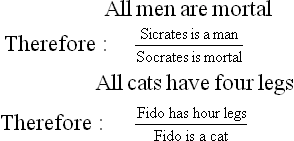
The two propositions above the line are the two premises and the proposition below the line is the conclusion. A valid syllogism is one in which the conclusion is true if both of the premises are true and the conclusion is false if either one of the premises or both of them are false. ‘Conjunction’, the relationship ‘AND’ states precisely the same thing. This is often expressed in a ‘truth table’, thus for the relationship ‘A AND B’ the following table applies.
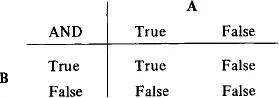
Thus the expression ‘A AND B’ is true if, and only if, ‘A’ is true and ‘B’ is true.
In the second of the two syllogisms given above it is possible for both of the premises to be true and for the conclusion to be false. This syllogism does not, therefore, correspond to the required relationship of truth values of a valid syllogism, that is the relationship ‘AND’ between the first two and the conclusion, and the syllogism is therefore invalid. This form of invalid syllogism is known as the Fallacy of the Undistributed Middle.
Russell and Whitehead showed that ‘AND’ and a few other similar relationships could be used to describe the operations of mathematics. Computers embody these principles in their circuitry and they can therefore perform both logical and arithmetical operations. It is this fact which gives them great power in both data processing and computational operations.
TECHNOLOGICAL ADVANCES
The development of electromechanical and then of electronic technology was the thing which finally made the construction of computers possible. The first machine to be built which would qualify as a computer by today’s definitions was the Electronic Numerical Integrator and Calculator (ENIAC) built by Professor Howard Aiken and International Business Machines in the mid-1940s. By the 1950s the advent of the transistor allowed the commercial development of computers. The early computers had operated using thermionic valves, which meant that they were of massive size, produced vast quantities of heat and were extremely prone to failure. Valve computers later became known as first generation computers and the early transistor computers as the second generation machines. In the early 1960s, printed circuits, the reduction in size of transistors and diodes and the development of families of similar computers of varying power each of which could, by means of a standard interface connection, be equipped with a variety of different peripheral units, heralded a third generation of computers. Since then electronic components have become smaller, more powerful, cheaper and more reliable with the development of integrated circuits, but the broad architecture of computers has not changed a great deal. By far the most significant advances in computing in recent years have been those in the programs that control the computers.
*Taken from Taylor’s Scientific Memoirs, volume III as reprinted in Faster Than Thought – A Symposium on Digital Computing Machines. Edited by B. V. Bowden (1963). London: Pitman.
Chapter 2
Some Basic Concepts and Terminology
Publisher Summary
This chapter presents some basic concepts and terminology concerning computer systems. The four relationships AND, OR, NEQ, and NOT can be used to define all the logical and arithmetical operations of digital computers. The binary system is the name given to the two state systems, and it is as much the natural system for electronic digital computers as the decimal system is for humans with 10 digits on their hands. The physical units of a computer system, also known as hardware, consist of two main types of units: (1) central units and (2) peripheral units. The central units of a computer include the control unit that controls the other units, the arithmetic unit, which ...
Table of contents
- Cover image
- Title page
- Table of Contents
- Computers in Medicine Series
- Copyright
- Editor’s Foreword
- Preface
- Chapter 1: Historical Outline
- Chapter 2: Some Basic Concepts and Terminology
- Chapter 3: Representation of Information
- Chapter 4: The Computer – Central Units
- Chapter 5: The Computer – Input and Output Peripherals
- Chapter 6: The Computer – File Storage Peripherals
- Chapter 7: Systems Analysis and Design
- Chapter 8: Programming
- Chapter 9: Implementing a Computer System
- Glossary
- Index
Trusted by 375,005 students
Access to over 1.5 million titles for a fair monthly price.
Study more efficiently using our study tools.
Frequently asked questions
Yes, you can cancel anytime from the Subscription tab in your account settings on the Perlego website. Your subscription will stay active until the end of your current billing period. Learn how to cancel your subscription
No, books cannot be downloaded as external files, such as PDFs, for use outside of Perlego. However, you can download books within the Perlego app for offline reading on mobile or tablet. Learn how to download books offline
Perlego offers two plans: Essential and Complete
- Essential is ideal for learners and professionals who enjoy exploring a wide range of subjects. Access the Essential Library with 800,000+ trusted titles and best-sellers across business, personal growth, and the humanities. Includes unlimited reading time and Standard Read Aloud voice.
- Complete: Perfect for advanced learners and researchers needing full, unrestricted access. Unlock 1.5M+ books across hundreds of subjects, including academic and specialized titles. The Complete Plan also includes advanced features like Premium Read Aloud and Research Assistant.
We are an online textbook subscription service, where you can get access to an entire online library for less than the price of a single book per month. With over 1.5 million books across 990+ topics, we’ve got you covered! Learn about our mission
Look out for the read-aloud symbol on your next book to see if you can listen to it. The read-aloud tool reads text aloud for you, highlighting the text as it is being read. You can pause it, speed it up and slow it down. Learn more about Read Aloud
Yes! You can use the Perlego app on both iOS and Android devices to read anytime, anywhere — even offline. Perfect for commutes or when you’re on the go.
Please note we cannot support devices running on iOS 13 and Android 7 or earlier. Learn more about using the app
Please note we cannot support devices running on iOS 13 and Android 7 or earlier. Learn more about using the app
Yes, you can access A Guide to Medical Computing by E. C. Coles, D. W. Hill in PDF and/or ePUB format, as well as other popular books in Medicine & Alternative & Complementary Medicine. We have over 1.5 million books available in our catalogue for you to explore.