eBook - ePub
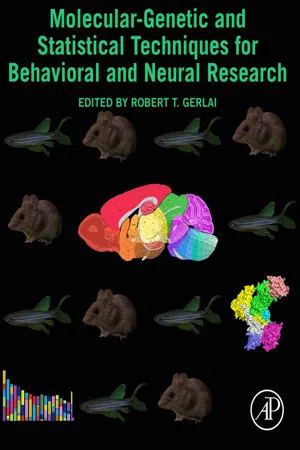
Molecular-Genetic and Statistical Techniques for Behavioral and Neural Research
- 708 pages
- English
- ePUB (mobile friendly)
- Available on iOS & Android
eBook - ePub
Molecular-Genetic and Statistical Techniques for Behavioral and Neural Research
About this book
Molecular-Genetic and Statistical Techniques for Behavioral and Neural Research presents the most exciting molecular and recombinant DNA techniques used in the analysis of brain function and behavior, a critical piece of the puzzle for clinicians, scientists, course instructors and advanced undergraduate and graduate students. Chapters examine neuroinformatics, genetic and neurobehavioral databases and data mining, also providing an analysis of natural genetic variation and principles and applications of forward (mutagenesis) and reverse genetics (gene targeting). In addition, the book discusses gene expression and its role in brain function and behavior, along with ethical issues in the use of animals in genetics testing.
Written and edited by leading international experts, this book provides a clear presentation of the frontiers of basic research as well as translationally relevant techniques that are used by neurobehavioral geneticists.
- Focuses on new techniques, including electrocorticography, functional mapping, stereo EEG, motor evoked potentials, optical coherence tomography, magnetoencephalography, laser evoked potentials, transmagnetic stimulation, and motor evoked potentials
- Presents the most exciting molecular and recombinant DNA techniques used in the analysis of brain function and behavior
- Written and edited by leading international experts
Information
Topic
Scienze biologicheSubtopic
FisiologiaSection V
Manipulating Known Genes to Understand Biological Function: Reverse Genetics
Chapter 18
Molecular Techniques Used to Explore Glutamate Receptors in Synaptic Plasticity and Memory
Celeste Leung1,2, and Zhengping Jia1,2 1The Hospital for Sick Children, Toronto, ON, Canada 2University of Toronto, Toronto, ON, Canada
Abstract
Over the past 3 decades, genetic manipulations in mice have been used in neuroscience as a major approach to investigate the function of ionotropic glutamate receptors in synaptic transmission and plasticity, and learning and memory. In particular, traditional and novel tools that result in the genetic deletion, insertion, or modification of a specific receptor subunit gene sequence have revealed a functional role for each subunit of α-amino-3-hydroxy-5-methyl-4-isoxazolepropionate (AMPA) and N-methyl-D-aspartate (NMDA) receptors. In this chapter, we will discuss the evolution of a number of well-characterized techniques, including RNA interference, global knockout, conditional knockout, knock-in, and CRISPR/Cas9 techniques, that have been at the forefront in the generation of mouse models to study individual or a combination of glutamate receptor subunits. We will outline the principles guiding the design and application of these approaches and discuss the key phenotypes and deficits obtained from mice generated through each method. Ultimately, this review aims to discuss the broad spectrum of genetic approaches that have been employed in uncovering the role of glutamate receptors in synaptic plasticity.
Keywords
AMPAR; Conditional knockout; CRISPR/Cas9; Glutamate receptors; Knock-in; Knockout; NMDAR; RNAi; shRNA; siRNA
Introduction
Prior to the advent of genomic manipulation, pharmacological studies have provided most of the initial insight into the function of excitatory synapses in the mammalian central nervous system. In particular, the use of agonists and antagonists specific to glutamate receptors have established the role of α-amino-3-hydroxy-5-methyl-4-isoxazolepropionate (AMPA) and N-methyl-D-aspartate (NMDA) receptors in synaptic transmission and plasticity, and learning and memory.1,2 In the past 30 years, the use of molecular genetic approaches in mice have dramatically increased our ability to specifically manipulate individual genes, allowing detailed analyses of synaptic proteins. Perhaps, one of the earliest and simplest approaches is the use of single-stranded antisense oligonucleotides and the subsequent emergence of RNA interference that allows for the knockdown of protein expression through the inhibition of gene expression and translation. However, this approach rarely eliminates the protein of interest completely, making it difficult to determine whether any residual function can give rise to unrelated processes. The introduction of pluripotent embryonic stem (ES) cells carrying targeted genomic changes has allowed for the production of mice harboring global deletions (knockout) or insertions (knock-in) of specific genes. However, the widespread knockout of a particular gene from conception may result in lethality and possible compensation that advanced the field to an approach that limits the deletion or insertion of the gene in a spatial- and temporal-dependent manner. These newer studies combined the knockout technique with site-directed mutagenesis and the bacteriophage Cre/loxP system and the tetracycline inducible transactivator system, which together have allowed for unprecedented control and precise manipulations of diverse genes of interest. With recent technical advances, innovative genome-editing tools have been developed to further circumvent the issues associated with traditional techniques involving homologous recombination and RNA interference. Specifically, clustered regularly interspaced short palindromic repeats (CRISPR) along with the expression of a Cas9 nuclease is an approach that can target and edit DNA sequences at specific locations with high efficiencies. In this review, we will discuss a number of molecular-genetic techniques, including RNA interference, knockout, conditional knockout, knock-in, and CRISPR/Cas9, that have been used to study the role of synaptic proteins in the regulation of synaptic transmission and plasticity with a specific focus on two types of ionotropic glutamate receptors, AMPARs and NMDARs, in mice (Table 18.1).
AMPARs are hetero-tetrameric complexes composed of four subunits, GluA1-GluA4. Each subunit contains a large extracellular N-terminal ligand-binding domain, three full transmembrane domains, an intracellular reentrant loop, and a cytoplasmic carboxyl terminal (C-terminal) domain. Whereas GluA1 and 4 possess predominantly long C-terminal tails, GluA2 and GluA3 have relatively shorter cytoplasmic C-terminals.3 Prior to birth and within the first postnatal week, the GluA4 subtype is predominantly expressed in excitatory hippocampal and cortical neurons.4,5 However, GluA4 levels decline following birth, contributing to the developmental switch to the GluA2 receptor subtype. Gradually with age, hippocampal Schaffer collateral CA3-CA1 synapses are largely comprised of GluA1/2 and GluA2/3 heteromers, where GluA1/2 receptors are inserted into the synapse following activity and eventually replaced by GluA2/3 receptors over time in an activity-independent manner.6,7 Importantly, the presence of the GluA2 subunit in AMPARs renders the channel impermeable to calcium, resulting in a linear current-voltage relationship. Thus, in the absence of GluA2, AMPARs are permeable to calcium and exhibit a strong inward rectification at positive potentials.8 Numerous studies have shown that AMPARs play an important role in mediating fast synaptic transmission in the central nervous system and are critical for synaptic plasticity, including long-term potentiation (LTP) and depression (LTD).2,9–12 The other key ionotropic glutamate receptor essential for the induction of synaptic plasticity is the NMDAR. NMDARs are also tetramers composed of two obligatory GluN1 subunits and two GluN2 or GluN3 subunits that determine the properties and kinetics of the receptor. The topology of each subunit is similar to that of AMPARs consisting of the N-terminal domain for binding by allosteric modulators, the agonist-binding domain (for agonists such as glycine/D-serine or glutamate), the pore domain, and the C-terminal domain that binds to various intracellular protein partners. The expression of GluN2A-D subunits varies across develop...
Table of contents
- Cover image
- Title page
- Table of Contents
- Copyright
- Dedication
- Contributors
- Preface
- Acknowledgments
- Why Should We Use Genetics in the Analysis of Brain Function and Behavior? Practical and Theoretical Considerations
- Section I. Neuroinformatics, Computational Models and Data Analysis
- Section II. Searching for New Genes: Natural Genetic Variation
- Section III. Discovery of New Genes and New Functions of Genes Using Gene Expression Analyses
- Section IV. Discovery of Genes and Biological Mechanisms: Forward Genetics and Other Screening-Based Methods
- Section V. Manipulating Known Genes to Understand Biological Function: Reverse Genetics
- Section VI. Ethical Considerations
- Index
Trusted by 375,005 students
Access to over 1.5 million titles for a fair monthly price.
Study more efficiently using our study tools.
Frequently asked questions
Yes, you can cancel anytime from the Subscription tab in your account settings on the Perlego website. Your subscription will stay active until the end of your current billing period. Learn how to cancel your subscription
No, books cannot be downloaded as external files, such as PDFs, for use outside of Perlego. However, you can download books within the Perlego app for offline reading on mobile or tablet. Learn how to download books offline
Perlego offers two plans: Essential and Complete
- Essential is ideal for learners and professionals who enjoy exploring a wide range of subjects. Access the Essential Library with 800,000+ trusted titles and best-sellers across business, personal growth, and the humanities. Includes unlimited reading time and Standard Read Aloud voice.
- Complete: Perfect for advanced learners and researchers needing full, unrestricted access. Unlock 1.5M+ books across hundreds of subjects, including academic and specialized titles. The Complete Plan also includes advanced features like Premium Read Aloud and Research Assistant.
We are an online textbook subscription service, where you can get access to an entire online library for less than the price of a single book per month. With over 1.5 million books across 990+ topics, we’ve got you covered! Learn about our mission
Look out for the read-aloud symbol on your next book to see if you can listen to it. The read-aloud tool reads text aloud for you, highlighting the text as it is being read. You can pause it, speed it up and slow it down. Learn more about Read Aloud
Yes! You can use the Perlego app on both iOS and Android devices to read anytime, anywhere — even offline. Perfect for commutes or when you’re on the go.
Please note we cannot support devices running on iOS 13 and Android 7 or earlier. Learn more about using the app
Please note we cannot support devices running on iOS 13 and Android 7 or earlier. Learn more about using the app
Yes, you can access Molecular-Genetic and Statistical Techniques for Behavioral and Neural Research by Robert T. Gerlai in PDF and/or ePUB format, as well as other popular books in Scienze biologiche & Fisiologia. We have over 1.5 million books available in our catalogue for you to explore.