- 464 pages
- English
- ePUB (mobile friendly)
- Available on iOS & Android
eBook - ePub
About this book
This edited volume in the Theoretical Ecology series addresses the historical development and evolution of theoretical ideas in the field of ecology. Not only does Ecological Paradigms Lost recount the history of the discipline by practitioners of the science of ecology, it includes commentary on these historical reflections by philosophers of science. Even though the theories discussed are, in many cases, are at the forefront of research, the language and approach make this material accessible to non-theoreticians. The book is structured in 5 major sections including population ecology, epidemiology, community ecology, evolutionary biology and ecosystem ecology. In each section a chapter by an eminent, experienced ecologist is complemented by analysis from a newer, cutting-edge researcher.
- Reflection on the past and future of ecology
- A historical overview of major ideas in the field of ecology
- Pairing of historical views by ecologists along with a philosophical commentary directed at the practicing scientists' views by a philosopher of science
- Historical analysis by practicing ecologists including anectodal experiences that are rarely recorded
- Based on a very popular symposium at the 2002 Ecological Society of America annual meeting in Tucson, AZ
Information
Subtopic
EcologyIndex
Biological Sciences1
WHY A HISTORY OF ECOLOGY? AN INTRODUCTION
Beatrix E. Beisner and Kim Cuddington
What is the use of knowing the history of a discipline? Why should ecologists, in particular, be concerned with how ideas have developed? At a recent Ecological Society of America meeting, we were dismayed by a graduate student’s complete lack of knowledge of early ecological theory. Anything published before online journals and indexes did not exist for this and many other students we met that year. We wondered whether we were just becoming curmudgeons before our time or whether there was some scientific and philosophical value in a thorough historical grounding in our discipline. There might be value in the argument that we are better off if we ignore our history. For example, in social science many battles were fought as a result of profound historical examination. On the other hand, fields such as physics have traditionally had little focus on history outside of a morbid curiosity of outdated ideas. What is the appropriate mix of current research with older ideas in the discipline of ecology? It seems to us that no one has yet answered this fundamentally philosophical question.
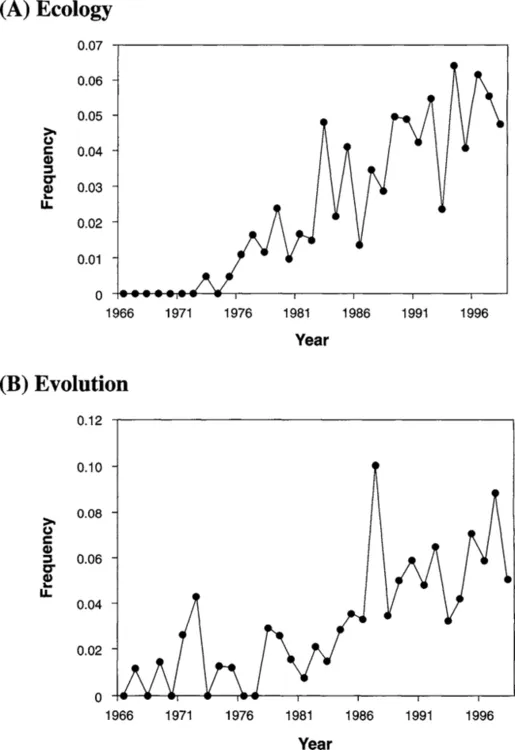
When ecologists turn to the philosophy of science, one of the most commonly cited works is Thomas Kuhn’s classic thesis The Structure of Scientific Revolutions (1962). Kuhn’s ideas emerged mainly from the study of theory development in physics, which he argued occurred by revolution in which an outdated paradigm was replaced by another paradigm. Use of similar language, through which theory changes are described as paradigm shifts, may imply many ecologists accept that scientific development occurs in such revolutionary shifts. If this is the case, then ecologists can ignore the older history of their discipline. Such language use may also indicate that ecologists believe a paradigm shift is something other than what Kuhn described, perhaps simply a change in commonly used models, without any accompanying change in conceptual framework. In any event, it is clear that the use of Kuhnian language has increased dramatically in the last 30 years (Fig. 1.1).
The trend of using philosophical language has had a recent dénouement in a special issue of Ecology (Volume 83, Issue 6), where several aspects of ecological theory were painted in the colours of Kuhnian philosophy. Graham and Dayton (2002) led off by claiming that Kuhnian paradigms are a useful way to describe the change in ecological ideas. Their description of the history of ecology, however, is only Kuhnian in that they describe different schools of thought as paradigms. Although Kuhn’s views may have changed in later years, invoking early Kuhn to describe conceptual change that proceeds along evolutionary lines, as these authors do, stretches this philosophy of science to a breaking point. Revolutions do not apply when one describes theory change as evolutionary, and neither is it clear to what extent incommensurability does. On the other hand, we think that Graham and Dayton, and the other authors in this special feature, do excellent work in describing the development of several aspects of theory, and there are many other models of evolutionary theory change in the philosophical literature (see Chapter 18). To this end, the use of the Kuhnian conception of paradigm provides a jumping-off point for the understanding of scientific development.
There are two major goals to this book. Both emerge from an examination of the history and development of some major theoretical ideas in ecology. The first goal is to provide an overview of the history of some traditional subdisciplines of ecology by asking eminent ecologists to review theory change in the field. The second goal is to determine whether the development of these ideas is one of paradigm shifts or one of more gradual buildup from simple to complex. For this second goal we not only have asked scientists for commentary and opinion but also have included analyses by philosophers of science.
There are some important practical reasons ecologists should pay more attention to the history of ideas and theories in our field. First, a familiarity with older ideas will help prevent “reinvention of the wheel”. A rediscovery of old ideas is a largely unproductive use of research dollars and time, especially given the incredible responsibility we now have to come up with meaningful predictions and prescriptions for threatened natural ecosystems. An ethical use of public research funds would therefore require a good knowledge of what has come before in the discipline, so that useful progress can be made. Second, a good knowledge of history provides perspective in research programmes. By seeing how various researchers have dealt with different issues, we can develop a good toolbox of approaches to the discipline. Finally, knowledge of what has come before allows us to better pinpoint important key questions and defermine where missing data or knowledge may be missing. In this way, faster progress can be made.
How do we take history of our discipline into account? Luckily, the science of ecology is still young enough that most practitioners are only two to three academic generations removed from those who first laid down the major theories upon which much of ecology rests. This means there is not as much history to learn as there is in older sciences. In terms of the history in ecology, Daniel Haydon (now at the University of Glasgow) hit upon a useful analogy in a debate during the late 1990s at a retreat of the ecologists of the University of British Columbia. We (Beisner, Haydon, and Ferguson) were to argue that there had been no significant new ideas in ecology since the 1960s. Haydon’s analogy was that of a chess game in which the major ideas of how ecological systems work, developed in the early days of the discipline, were represented by the chess pieces and their different ways of moving across the board. In the intervening decades, Haydon argued, ecological research has been about figuring out the different ways of playing the game using these rules. If we accept this analogy, it is easy to see that understanding the roles of the pieces and their movements is essential to understanding the discipline. Incidentally, Haydon stumbled across a different chess analogy used by Richard Feynman several years later for the laws of physics (Feynman, Leighton, & Sands 1963). Feynman argued that studying physics was like trying to learn the rules of chess just by studying chess games, which could also be applied to ecology. If these analogies hold, it is imperative that any serious ecologist become familiar with the rules of the game, which are mostly laid down in the classics of the field. There already are some excellent resources available, including Foundations of Ecology, edited by Les Real and James Brown (1991), and various reissues of other classics in ecology such as Charles Elton’s books. Important historical perspectives on theory in ecology include Sharon Kingsland’s Modeling Nature (1995) and Robert McIntosh’s The Background of Ecology (1985).
Our goal with this volume is to add another layer to a historical perspective. In this work, we provide philosophical analyses rather than just historical perspectives and attempt to address whether a paradigmatic view (sensu Kuhn) can apply to ecology. In addition to a historical overview of major areas of ecological research, we have asked both practicing scientists and philosophers of science to provide analyses of the development of the field. Our hope is that this book will provide new perspective on the ideas in ecology. To accomplish these goals, we structured the book in an unusual way. For each category of ecological research (population, epidemiological, community, evolutionary, and ecosystem ecology) we have asked eminent ecologists of both the younger and more weathered variety to provide historical overviews of and opinion on a major issue in their field. We have then paired these “science” chapters with commentary by a practicing philosopher of science.
The chapters that follow cover the development of theory in the major traditional disciplines of ecology. In the section on population ecology, Alan Hastings provides an overview of the major types of unstructured population models, from nonspatial and deterministic to spatial and stochastic types, and describes how they emerged. The complementary chapter by André De Roos and Lennart Persson examines in detail some important theoretical developments that have arisen from simple structured models. Analysis of these contributions is provided in the chapter by Jay Odenbaugh. Hans Heesterbeek covers unstructured epidemiological models, and Matt Keeling outlines the extension of these models to allow for spatial considerations. Philosophical analysis in the epidemiological ecology section is covered by James Koopman. In the community ecology section, chapters by Anthony Ives and Kevin McCann provide two perspectives on the stability-diversity debate in ecology that has been a subject of vigorous research for several decades. A commentary is provided by philosopher of science David Castle. Part V covers evolutionary ecology and includes excellent chapters with opinion, perspective, and an overview of model types by Robert Holt and Troy Day, with commentary by Kim Sterelny. Included are reflections on the genius and influence of Robert MacArthur by Eric Pianka and Henry Horn, without which any book considering the recent history of theory change in ecology would be incomplete. Finally, in a section on ecosystem ecology, Timothy Allen and his colleagues and Garry Peterson provide overviews of major questions and approaches in this field and describe how these have been used in management questions. In their chapters, there is a strong focus on how philosophical perspectives may be limiting the implementation of ecological knowledge in management practices. Kevin de Laplante provides a philosophical perspective on these issues.
It is our hope that this book will provide interesting reading and perspective to both young ecologists and older ones. As with any viewpoint, a historical one will always be tainted by the perspective of the person telling the story. That is why we have sought several perspectives on each topic and allowed the expression of personal opinion in these chapters. In the end, we hope that this book will be a catalyst for others to pause periodically to review assumptions, goals, and methods in the busy day-to-day world of research so that we can all practice a better science.
Part I
Population ecology
2
UNSTRUCTURED MODELS IN ECOLOGY: PAST, PRESENT, AND FUTURE
Alan Hastings
ACKNOWLEDGEMENTS
This research has been supported by grants from the National Science Foundation. I thank Kim Cuddington and an anonymous referee for helpful comments.
2.1 INTRODUCTION
The use of mathematical models in ecology was greatly advanced by work in the early twentieth century (e.g., by Lotka 1926, 1932; Volterra 1926, 1931; Kermack & McKend...
Table of contents
- Cover image
- Title page
- Table of Contents
- Foreword
- PREFACE
- LIST OF CONTRIBUTORS
- Chapter 1: WHY A HISTORY OF ECOLOGY? AN INTRODUCTION
- Part I: Population ecology
- Part II: Epidemiological ecology
- Part III: Community ecology
- Part IV: Historical reflection
- Part V: Evolutionary ecology
- Part VI: Ecosystem ecology
- Part VII: Conclusion
- INDEX
Trusted by 375,005 students
Access to over 1.5 million titles for a fair monthly price.
Study more efficiently using our study tools.
Frequently asked questions
Yes, you can cancel anytime from the Subscription tab in your account settings on the Perlego website. Your subscription will stay active until the end of your current billing period. Learn how to cancel your subscription
No, books cannot be downloaded as external files, such as PDFs, for use outside of Perlego. However, you can download books within the Perlego app for offline reading on mobile or tablet. Learn how to download books offline
Perlego offers two plans: Essential and Complete
- Essential is ideal for learners and professionals who enjoy exploring a wide range of subjects. Access the Essential Library with 800,000+ trusted titles and best-sellers across business, personal growth, and the humanities. Includes unlimited reading time and Standard Read Aloud voice.
- Complete: Perfect for advanced learners and researchers needing full, unrestricted access. Unlock 1.5M+ books across hundreds of subjects, including academic and specialized titles. The Complete Plan also includes advanced features like Premium Read Aloud and Research Assistant.
We are an online textbook subscription service, where you can get access to an entire online library for less than the price of a single book per month. With over 1.5 million books across 990+ topics, we’ve got you covered! Learn about our mission
Look out for the read-aloud symbol on your next book to see if you can listen to it. The read-aloud tool reads text aloud for you, highlighting the text as it is being read. You can pause it, speed it up and slow it down. Learn more about Read Aloud
Yes! You can use the Perlego app on both iOS and Android devices to read anytime, anywhere — even offline. Perfect for commutes or when you’re on the go.
Please note we cannot support devices running on iOS 13 and Android 7 or earlier. Learn more about using the app
Please note we cannot support devices running on iOS 13 and Android 7 or earlier. Learn more about using the app
Yes, you can access Ecological Paradigms Lost by Beatrix Beisner, Kim Cuddington in PDF and/or ePUB format, as well as other popular books in Biological Sciences & Ecology. We have over 1.5 million books available in our catalogue for you to explore.