Vapour permeation and membrane distillation are two emerging membrane technologies for the production of vapour as permeate, which, in addition to well-established pervaporation technology, are of increasing interest to academia and industry. As efficient separation and concentration processes, they have high potential for use in the energy, water, chemical, food and pharmaceutical sectors.
Part One begins by covering the fundamentals, preparation and characterization of pervaporation, before going on to outline the associated systems and applications. State of the art uses, future trends and next generation pervaporation are then discussed. Part Two then explores the preparation, characterization, systems and applications of membranes for vapour permeation, followed by modelling and the new generation of vapour permeation membranes. Finally, Part Three outlines the fundamentals of membrane distillation and its applications in integrated systems, before the book concludes with a view of the next generation.
- Explores three emerging membrane technologies that produce vapour as a permeate.
- Looks at the fundamentals, applications, state of the art uses and next generation of each technology.
- Provides an authoritative guide for chemical engineers and academic researchers interested in membrane technologies for desalination, process water/steam treatment, water purification, VOCs removal and other aspects of pollution control, industrial process chemistry, renewable energy production or separation and concentration in the food/pharmaceutical industries.
J.G. Crespo, and C. Brazinha Universidade Nova de Lisboa, Caparica, Portugal
Abstract
Pervaporation is a membrane separation process that allows for the selective transport of solutes present in liquid mixtures. This process has particularly unique and adequate features to remove volatile compounds present in liquid mixtures at trace levels. This chapter discusses the fundamental aspects of transport phenomena in pervaporation processes by describing the mass transport mechanism involved, commonly explained by the sorption–diffusion model. This chapter also addresses fundamental problems that should be considered when designing a pervaporation process and when defining its operating conditions.
Keywords
Dense membranes; Permeability; Pervaporation; Process design; Sorption–diffusion model
1.1. Introduction
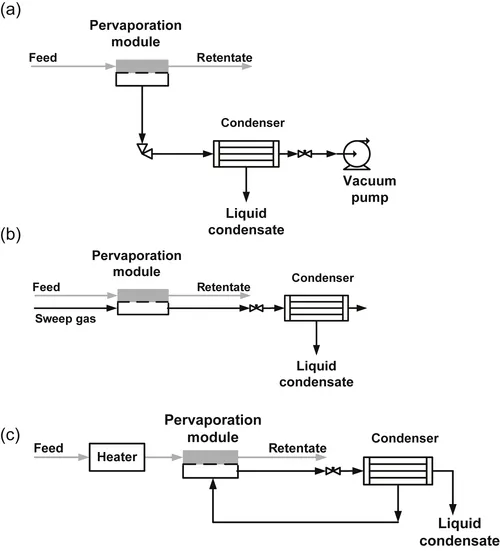
Pervaporation is a membrane separation process where solute transport occurs through dense membranes. The mass transport is based on compound–membrane interactions and, therefore, the chemical nature and structure of the membrane material are key factors that determine membrane performance. In this process, the feed stream is a liquid mixture and the permeate is recovered as a vapour due to vacuum or sweeping gas conditions applied (low density media), as can be seen in Figure 1.1. Such downstream operating conditions ensure an efficient removal of compounds from the membrane downstream surface, by maintaining the partial pressures of the permeating species close to zero. In order to increase the driving force for transport, the feed stream may be preheated ensuring a higher partial pressure of the feed constituents (see Figure 1.1(c) for a thermopervaporation procedure). In most cases, the permeating compounds are recovered by condensation, as represented in Figure 1.1, although liquid absorption in liquid ring pumps and also integrated adsorptive procedures have been also proposed.
1.2. Fundamentals of mass and heat transfer in pervaporation
Pervaporation involves not only mass transport through the membranes but also heat transfer. The change of physical state from a liquid solution to a vapour solution requires energy (the enthalpy of vaporisation), which is ensured by the liquid feed stream. Consequently, a reduction of the feed temperature takes place. This effect is more pronounced in the case of highly permeable compounds and thin membranes (Favre, 2003). At an industrial scale, heat exchangers are frequently added to the system on the feed side, in order to keep the temperature constant.
The driving force of pervaporation (as well as vapour permeation and gas separation) is the gradient of chemical potential of compound i present, μi [J/mol], which describes the general energetic state of a compound within its environment, represented in Eqn (1.1) considering no electrical field:
(1.1)
Figure 1.1 Scheme of pervaporation processes: vacuum pervaporation (a), sweep gas pervaporation (b), and thermopervaporation (c).
(1.1′)
where R is the ideal gas constant 8.314 J/(K mol), ci [–] is the molar fraction of compound i, ai [–] is the activity of compound i, γi [–] is the activity coefficient of compound i that represents the interaction of i with the environment, Vi [m3/mol] is the molar volume of compound i, p [Pa] is the pressure, Si [J/(mol K)] is the molar entropy of compound I, and T [K] is the temperature. The gradient of chemical potential of compound i, at constant temperature, with no electrical field and in the case of pervaporation at constant pressure inside the membrane, is simplified to
(1.1″)
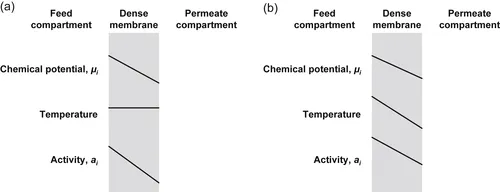
The driving forces involved in the different types of pervaporation are shown in Figure 1.2.
Figure 1.2 Scheme of the driving force profiles (inside the membrane) of the different types of pervaporation processes: vacuum and sweep gas pervaporation (a) and thermopervaporation (b).
The chemical potential of compound i is referred to a reference state, which is pure i at the reference pressure, in this case the saturated vapour pressure of i, pvi. The chemical potential of compound i inside the membrane or in the feed solution (uncompressible media) is obtained by integrating Eqn (1.1) at constant temperature:
(1.2)
where
is the chemical potential of pure i. At constant temperature and with no electrical field applied, the driving force of the pervaporation (inside the pervaporation membrane, at constant pressure) may be the difference of concentrations at the feed and permeate surfaces of the membrane, which is simpler and more useful to consider than the chemical potential gradient.
1.2.1. Characterisation of pervaporation processes
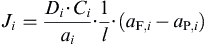
In order to characterise the performance of pervaporation processes, several parameters should be taken into account. Using a general approach of mass transport through membranes, the flux (expressed as compound i in volume, moles, or mass divided by the permeating time and the membrane area) is related to the driving force through a coefficient of proportionality or inverse of the mass resistance,...
Table of contents
Cover image
Title page
Table of Contents
Related titles
Copyright
List of contributors
Woodhead Publishing Series in Energy
Preface
Part One. Pervaporation
Part Two. Vapour permeation
Part Three. Membrane distillation
Index
Trusted by 375,005 students
Access to over 1.5 million titles for a fair monthly price.
Study more efficiently using our study tools.
Frequently asked questions
Yes, you can cancel anytime from the Subscription tab in your account settings on the Perlego website. Your subscription will stay active until the end of your current billing period. Learn how to cancel your subscription
No, books cannot be downloaded as external files, such as PDFs, for use outside of Perlego. However, you can download books within the Perlego app for offline reading on mobile or tablet. Learn how to download books offline
Perlego offers two plans: Essential and Complete
Essential is ideal for learners and professionals who enjoy exploring a wide range of subjects. Access the Essential Library with 800,000+ trusted titles and best-sellers across business, personal growth, and the humanities. Includes unlimited reading time and Standard Read Aloud voice.
Complete: Perfect for advanced learners and researchers needing full, unrestricted access. Unlock 1.5M+ books across hundreds of subjects, including academic and specialized titles. The Complete Plan also includes advanced features like Premium Read Aloud and Research Assistant.
Both plans are available with monthly, semester, or annual billing cycles.
We are an online textbook subscription service, where you can get access to an entire online library for less than the price of a single book per month. With over 1.5 million books across 990+ topics, we’ve got you covered! Learn about our mission
Look out for the read-aloud symbol on your next book to see if you can listen to it. The read-aloud tool reads text aloud for you, highlighting the text as it is being read. You can pause it, speed it up and slow it down. Learn more about Read Aloud
Yes! You can use the Perlego app on both iOS and Android devices to read anytime, anywhere — even offline. Perfect for commutes or when you’re on the go. Please note we cannot support devices running on iOS 13 and Android 7 or earlier. Learn more about using the app
Yes, you can access Pervaporation, Vapour Permeation and Membrane Distillation by Angelo Basile,Alberto Figoli,Mohamed Khayet in PDF and/or ePUB format, as well as other popular books in Technology & Engineering & Power Resources. We have over 1.5 million books available in our catalogue for you to explore.