eBook - ePub
Coal Bed Methane
From Prospect to Pipeline
- 440 pages
- English
- ePUB (mobile friendly)
- Available on iOS & Android
eBook - ePub
About this book
Coal Bed Methane: From Prospect to Pipeline is the proceedings of the 25th anniversary of the North American Coal Bed Methane Forum. It provides the latest advancements in the production of coal bed methane covering a variety of topics, from exploration to gas processing, for commercial utilization. Additionally, it presents the origin of gas in coal, reservoir engineering, control of methane in coal mines, production techniques, water management, and gas processing.
The vast coal resources in the United States continue to produce tremendous amounts of natural gas, contributing to a diverse range energy assets. Following a rapid advancement and subsequent plateau in technological developments, this book captures the full life cycle of a well and offers petroleum geologists and engineers a single source of a broad range of coal bed methane applications. This book addresses crucial technical topics, including exploration and evaluation of coal bed reservoirs; hydraulic fracturing of CBM wells; coal seam degasification; and production engineering and processing, among others. It also covers legal issues, permitting, and economic analysis of CBM projects.
- Edited by a team of coal bed methane experts from industry, academia and government who have more than 75 years of combined experience in the field
- Authored by well-recognized members of the gas and coal industry, universities, US government departments, such as the Department of Energy and the National Institute of Occupational Safety and Health (NIOSH)
- More than 200 figures, photographs, and illustrations aid in the understanding of the fundamental concepts
- Presents the full scope of improvements in US energy independence, coal mine safety, and greenhouse gas emissions
Information
Topic
Physical SciencesSubtopic
Geology & Earth SciencesChapter 1
Coalbed Methane
A Miner’s Curse and a Valuable Resource
, , and 1U.S. Department of Energy (retired); Now managing a mineral title/leasing company: ArthurHenry, LLC, 2CBM consultant, 3Coalbed Methane Consulting, Pittsburgh, PA, USA
Abstract
The chapter provides a brief history of coal mine explosions. Recorded number of explosions is 624 but it is estimated that these were more than 300 unrecorded explosions. Total number of death in US exceeds 8000. The commercial exploitation of coal mine methane is briefly described. Enhanced gas production by carbon dioxide flooding is also discussed.
Keywords
Appalachian basin; Coalbed methane; Greenhouse gasThe US coal industry has been challenged over the years by the explosive coalbed methane (CBM) gas. It permeates most coalbeds, rendering mining process dangerous. Indeed, CBM was nicknamed the “miner’s curse”, because it escaped from mineable coal seams and exploded when mixed with air if a source of ignition was present.
The “miner’s curse” is also an energy source—and possibly an environmental problem. Since the 1830s gas explosions in US coal mines have killed thousands of miners. Among the worst US mine disasters of the twentieth century was one that occurred in Northern Appalachia—362 miners perished in a gas and dust explosion at Monongah, West Virginia in 1907 (Figure 1.1). Over 600 mine explosions in US coal mines have been documented in the various coal fields (Table 1.1). Mine safety has come a long way since then. Methane in coal mines will always be a hazard, but the risk of explosion has been greatly minimized by increased safety regulations, sensitive gas detectors, improved ventilation, and methane drainage.
And therein lies an opportunity to utilize an energy source and further improve mine safety and possibly improve regional environments. Although venting gas into the atmosphere has helped to reduce underground explosions to infrequent events, it also discards potentially valuable fuel and adds “methane” (a classified greenhouse gas) to our regional atmosphere. Thus, the large volumes of CBM vented by mines represent both an economic loss and an environmental challenge.
In the 1990s, up to 300 US billion cubic feet of methane were vented from US coal mines (mostly underground operations). This was 15% of all global methane emissions from coal mining, and less than 1% of all methane released into the atmosphere by mankind.
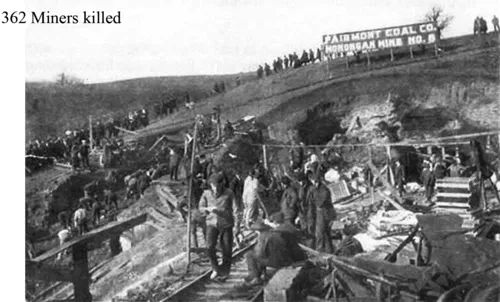
TABLE 1.1
Coal Mine Disasters in US Since 1839
| Time Period | Coal Mine Disasters |
| Through 1875 | 19 |
| 1876–1900 | 101 |
| 1901–1925 | 305 |
| 1926–1947 | 147 |
| 1951–1975 | 35 |
| 1976–2003 | 15 |
| 2004–2013 | 2 |
| Total | 624 |
| Undocumented | >300 |
| Estimated total US Coal mine deaths | >8000 |
Methane’s “greenhouse gas” potential has been stated to be many times greater than CO2, so its release during coal mining and processing is a concern. Currently, the atmospheric methane concentration is a lesser problem than CO2, simply because methane is much scarcer in the atmosphere, with only 1/200th the concentration of CO2. But this may be changing: the methane percentage is slowly increasing worldwide, at a faster rate than the CO2 percentage. The US Geological Survey has been forecasting methane to surpass CO2 as the dominant greenhouse in the second half of the twenty-first century—if its concentration continues to grow at the present rate.
1.1. Abundance of Methane in Most Coalbeds
As coal forms slowly from decaying plants over eons of years, methane forms along with it. Thus, most coalbeds are permeated with methane, so much so that a cubic foot of coal can contain six or seven times the methane that exists in a cubic foot of a conventional sandstone gas reservoir. However, the methane content in coal is highly variable, varying widely over short distances (a few hundred feet, for example). The higher grades of coal are richer in gas, and deeper coalbeds are for the most part “gassier” because they can store more gas on its internal surface.
The gas often occurs in concentrated pockets as well, creating a major mining hazard. When the mining of coal breaks open these pockets, or when coal is pulverized during mining and processing, methane is released into the mine and the atmosphere. In addition to ventilating the operating areas in mines, methane often is removed from the virgin coal in advance of mining by drilling extraction wells into the coal seam and capturing the gas or venting the gas into the atmosphere.
Recent estimates are that 400–700 trillion cubic feet (Tcf) of methane exist in US coalbeds, although only 90–100 Tcf may be economically recoverable with the current technology. This equates to a 4-year supply of natural gas for USA More realistically, it can be viewed as a 25-year supply for one sixth of US population. The world CBM resource spans all continents and is estimated at 4000–7500 Tcf. So CBM is an extremely large potential energy resource.
The energy (Btu) in CBM amounts to a very small percent of the energy in the coal itself. The amount varies widely, from little gas in a ton of coal, up to 1000 cubic feet per ton. As a general example, burning a ton of bituminous coal can release 21–30 million Btu of heat energy, depending on the coal’s rank. The methane within that ton of coal—typically 250–500 cubic feet of the methane gas—can provide 250,000–500,000 Btu when burned. In many cases, this amount of energy potential can make the gas worth recovering as a fuel.
1.2. CBM: Already a Commercial Success
CBM has strong economic potential. It can be used to generate electricity, either at mine sites or can be piped to commercial utilities. It can be “cofired” with coal at power plants to reduce SOX and NOX emissions. It can fuel gas turbines or fuel cells to generate power. At mines, it can fire drying units that remove moisture from washed coal. And it can be pipelined for utility and industrial use. Some of this potential is already being realized.
During the 1930s, the Big Run gas field in northern West Virginia began producing coalbed gas from the thick Pittsburgh coal seam and continues producing at a reduced rate to this day, demonstrating a common characteristic of coalbed wells: they tend to produce much longer than conventional reservoirs. By the late 1970s, some CBM was being produced commercially from coalbeds in Alabama. In northern New Mexico, over 40 US billion cubic feet of CBM has been produced from nearly 1700 wells. Self-supporting CBM projects also exist in Pennsylvania, West Virginia, Colorado, and Virginia. Currently, pipeline-quality coal mine methane (CMM) is being sold to distribution systems in the Appalachian coal basin. Today, the annual US demand for natural gas is over 21 Tcf, with 1.8 Tcf being produced from coal mines and unmined coalbeds, or over 8%—quite a success story for what was once a waste product and solely a “miner’s curse”. And this production is projected to increase as demand rises, as technology improves, and as mining companies cooperate with gas producers to utilize gas.
1.3. CMM: Pros and Cons
CBM produced in conjunction with coal mining is called coal mine methane (CMM). Coal mines can simultaneously produce methane and consume it by generating electricity on site. This on-site capability is valuable because the mining operation needs electrical power to operate machinery and ventilation fans, coal cleaning plants, coal dryers to remove moisture, and other surface facilities. An underground mine’s ...
Table of contents
- Cover image
- Title page
- Table of Contents
- Copyright
- Contributors
- Preface
- Chapter 1. Coalbed Methane: A Miner’s Curse and a Valuable Resource
- Chapter 2. The Origin of Coalbed Methane
- Chapter 3. Geology of North American Coalbed Methane Reservoirs
- Chapter 4. Evaluation of Coalbed Methane Reservoirs
- Chapter 5. Wireline Logs for Coalbed Evaluation
- Chapter 6. Vertical Well Construction and Hydraulic Fracturing for CBM Completions
- Chapter 7. Horizontal Coalbed Methane Wells Drilled from Surface
- Chapter 8. Coal Seam Degasification
- Chapter 9. Gas Outbursts in Coal Seams
- Chapter 10. Production Engineering Design
- Chapter 11. Coalbed and Coal Mine Methane Gas Purification
- Chapter 12. Current and Emerging Practices for Managing Coalbed Methane Produced Water in the United States
- Chapter 13. Plugging In-Mine Boreholes and CBM Wells Drilled from Surface
- Chapter 14. Economic Analysis of Coalbed Methane Projects
- Chapter 15. Legal Issues Associated with Coalbed Methane Development
- Chapter 16. Permitting Coalbed Methane Wells
- Chapter 17. United States Lower 48 Coalbed Methane—Benchmark (2010)
- Chapter 18. Worldwide Coal Mine Methane and Coalbed Methane Activities
- Index
Trusted by 375,005 students
Access to over 1.5 million titles for a fair monthly price.
Study more efficiently using our study tools.
Frequently asked questions
Yes, you can cancel anytime from the Subscription tab in your account settings on the Perlego website. Your subscription will stay active until the end of your current billing period. Learn how to cancel your subscription
No, books cannot be downloaded as external files, such as PDFs, for use outside of Perlego. However, you can download books within the Perlego app for offline reading on mobile or tablet. Learn how to download books offline
Perlego offers two plans: Essential and Complete
- Essential is ideal for learners and professionals who enjoy exploring a wide range of subjects. Access the Essential Library with 800,000+ trusted titles and best-sellers across business, personal growth, and the humanities. Includes unlimited reading time and Standard Read Aloud voice.
- Complete: Perfect for advanced learners and researchers needing full, unrestricted access. Unlock 1.5M+ books across hundreds of subjects, including academic and specialized titles. The Complete Plan also includes advanced features like Premium Read Aloud and Research Assistant.
We are an online textbook subscription service, where you can get access to an entire online library for less than the price of a single book per month. With over 1.5 million books across 990+ topics, we’ve got you covered! Learn about our mission
Look out for the read-aloud symbol on your next book to see if you can listen to it. The read-aloud tool reads text aloud for you, highlighting the text as it is being read. You can pause it, speed it up and slow it down. Learn more about Read Aloud
Yes! You can use the Perlego app on both iOS and Android devices to read anytime, anywhere — even offline. Perfect for commutes or when you’re on the go.
Please note we cannot support devices running on iOS 13 and Android 7 or earlier. Learn more about using the app
Please note we cannot support devices running on iOS 13 and Android 7 or earlier. Learn more about using the app
Yes, you can access Coal Bed Methane by Pramod Thakur,Steven J. Schatzel,Kashy Aminian in PDF and/or ePUB format, as well as other popular books in Physical Sciences & Geology & Earth Sciences. We have over 1.5 million books available in our catalogue for you to explore.