- 512 pages
- English
- ePUB (mobile friendly)
- Available on iOS & Android
eBook - ePub
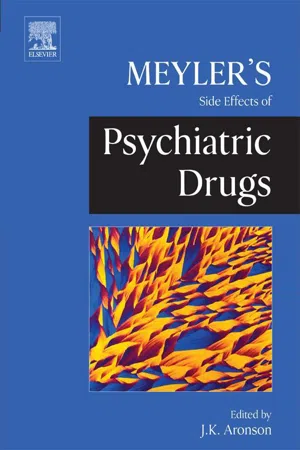
Meyler's Side Effects of Psychiatric Drugs
About this book
Elsevier now offers a series of derivative works based on the acclaimed Meylers Side Effect of Drugs, 15th Edition. These individual volumes are grouped by specialty to benefit the practicing physician or health care clinician. The unwarranted effects of medications used in psychiatry can adversely affect a treatment plan. This book is critical in helping psychiatrists and mental health professionals assess the adverse effects of drugs such as antidepressants, mood stabilizers, hypnosedatives, and antipsychotic drugs.The material is drawn from the 15th edition of the internationally renowned encyclopedia, Meyler's Side Effects of Drugs, and the latest volumes in the companion series, Side Effects of Drugs Annuals. Drug names have usually been designated by their recommended or proposed International Non-proprietary Names (rINN or pINN); when those are not available, clinical names have been used. In some cases, brand names have been used.This volume is critical for any health professional involved in the administration of psychiatric mediations.
- Surpasses the Physician's Desk Reference © by including clinical case studies and independent expert analysis
- Complete index of drug names
- Most complete cross referencing of drug-drug interactions available
- Extensive references to primary and secondary literature
- Also includes information on adverse effects in pregnancy
The book is divided into six sections:
- Antidepressants – A general introduction to their adverse effects, followed by monographs on individual drugs and groups of drugs (including lithium)
- Neuroleptic drugs – A general introduction to their adverse effects, followed by monographs on individual drugs
- Hypnosedatives - A general introduction to their adverse effects, followed by monographs on individual drugs
- Drugs of abuse
- Drugs used to treat Alzheimer's disease
- Psychological and psychiatric adverse effects of non-psychoactive drugs
Information
Topic
Physical SciencesSubtopic
PharmacologyNEUROLEPTIC DRUGS
General Information
Since the introduction of chlorpromazine in the early 1950s, a large number of phenothiazines with neuroleptic properties have been discovered; they include fluphenazine, perphenazine, prochlorperazine, and thioridazine. Several other chemical structures with similar therapeutic properties have also been introduced, including the butyrophenones (such as haloperidol and droperidol) and the thioxanthenes (such as flupenthixol). In recent years the so-called atypical neuroleptic drugs (such as clozapine, olanzapine, and risperidone) have also become available. They have less affinity for dopamine receptors in the basal ganglia than the typical neuroleptic drugs, and therefore cause fewer extrapyramidal adverse effects. The range of usefulness of these agents includes the treatment of schizophrenia (to treat acute episodes and in long-term maintenance treatment), mania, certain organic psychoses, certain depressive states, and a variety of lesser indications. They have also been used to treat autism
Equipotent doses of neuroleptic drugs are listed in Table 1.
Table 1. Equipotent doses of neuroleptic drugs (all rINNs)
| Drug | Dose (mg) |
| Typical neuroleptic drugs | |
| Chlorpromazine | 100 |
| Chlorprothixene | 100 |
| Fluphenazine hydrochloride | 2 |
| Haloperidol | 2 |
| Loxapine | 10 |
| Mesoridazine | 50 |
| Molindone | 10 |
| Perphenazine | 10 |
| Prochlorperazine | 15 |
| Pimozide | 1 |
| Thioridazine | 100 |
| Tiotixene | 5 |
| Trifluoperazine | 5 |
| Trifluoperazine | 25 |
| Atypical neuroleptic drugs | |
| Aripiprazole | 6 |
| Clozapine | 50 |
| Olanzapine | 4 |
| Quetiapine | 80 |
| Risperidone | 1 |
| Ziprasidone | 20 |
New updated treatment recommendations have been issued by the Schizophrenia Patient Outcomes Research Team (3). There is no definitive evidence that the atypical drugs differ from the typical ones for the treatment of acute positive symptoms; there are no data to support a change to a second-generation neuroleptic drug for patients who have adequate symptom control and minimal adverse effects with first-generation neuroleptic drug therapy. For haloperidol, a maintenance dosage of 6–12 mg is recommended; this dosage is lower than that previously recommended by the same panel (6–20 mg) (4). In fact, the optimal daily dose remains a topic of controversy.
General adverse reactions
Neuroleptic drugs can produce a variety of adverse effects in several organ systems. Extrapyramidal reactions and sedation are common; less common are seizures, unwanted behavioral effects, and tardive dyskinesia. Most neuroleptic drugs have anticholinergic effects and commonly produce dry mouth, blurred vision, and constipation. Postural hypotension is common. These effects usually disappear when the drug is stopped or the dosage is reduced.
Non-specific, usually reversible, cardiographic changes have been reported, but their relation to myocardial toxicity has not been confirmed. Sudden death related to cardiac arrest cannot be fully explained on the basis of the administration of neuroleptic drugs. Weight gain is a common adverse effect. Breast engorgement and galac-torrhea can occur in women and even in men. Amenorrhea, gynecomastia, hyperglycemia, hypoglycemia, raised growth hormone, inappropriate ADH secretion, and disturbance of sex hormones have been reliably documented, although they are unusual.
The contraindications to neuroleptic drug therapy include coma, the presence or withdrawal of high doses of other CNS depressants (alcohol, barbiturates, narcotics, etc.), serious hematological conditions (for example bone-marrow suppression), and a previous history of hypersensitivity reactions for example jaundice or severe photosensitivity. Since neuroleptic drugs cause sedation, they can impair mental or physical abilities (including reaction times), especially during the first few days of therapy. A large number of substances can interact with neuroleptic drugs (SED-14, 153) (5).
Hypersusceptibility reactions
Neuroleptic drugs infrequently produce allergic reactions. There are no reports of anaphylactic reactions, but various skin reactions, for example rashes, photosensitivity, and dermatitis, can be viewed as delayed forms of hypersensitivity. Jaundice and blood dyscrasias (hemolytic anemia, agranulocytosis) are rare and may be types of allergic reactions.
Tumorigenicity
Since neuroleptic drugs raise prolactin concentrations, there is concern that this may increase the risk of breast cancer. Although studies have failed to show an association, it would be best to avoid neuroleptic drugs in a patient with a hormone-dependent breast tumor.
Effects on fertility
Amenorrhea and infertility were consequences of the effects of typical neuroleptic drugs and of risperidone. Clinicians should be aware that patients changed from these agents to drugs like olanzapine, quetiapine, or clo-zapine are therefore at risk of pregnancy (6).
A project group at the Swedish Council on Technology Assessment in Health Care has analysed more than 2000 published manuscripts about neuroleptic drugs (7). They concluded that neuroleptic drug therapy is often accompanied by serious, sometimes permanent, adverse effects. Hence, neuroleptic drugs should be reserved for patients with severe psychoses. Agitated and demented elderly patients should not be treated with neuroleptic drugs unless they have pronounced psychotic symptoms. Nor should neuroleptic drugs be used in young mentally retarded patients and other children and adolescents, except in those with severe autism, Tourette’s syndrome, or schizophrenia. In fact, in patients with schizophrenia there is increased mortality, and the involvement of neuroleptic drug treatment has been investigated (8).
Severe adverse events associated with neuroleptic drug treatment are epileptic seizures, QT interval prolongation, myocarditis associated with clozapine, neuroleptic malignant syndrome, hypothermia, respiratory arrest, and pulmonary embolism associated with clozapine. To minimize these potential risks, practical prescribing guidelines have recently been proposed (SEDA-21, 42); they recommend careful titration of therapy, checking for a history of cardiac disorders, seizures, neuroleptic malignant syndrome, and hypotension, and regular monitoring for known adverse effects.
Further comparisons of the main features of typical and atypical neuroleptic drugs have emerged (SEDA-22, 45) (9). The review by the Collaborative Working Group on Clinical Trial Evaluations has addressed adverse effects extensively (10). The authors stressed that atypical neu-roleptic drugs cause fewer extrapyramidal signs and may have a lower risk of causing tardive dyskinesia than typical neuroleptic drugs. The adverse effects of the atypical drugs of which one should be aware are the following (listed with the drug(s) most likely to cause them):
(a) orthostatic hypotension (clozapine, olanzapine, que-tiapine);
(b) myocarditis (clozapine);
(c) pulmonary embolism (clozapine);
(d) seizures (clozapine);
(e) anticholinergic effects (clozapine, olanzapine);
(f) increased prolactin (risperidone);
(g) weight gain (clozapine, olanzapine);
(h) hepatic changes (clozapine, risperidone);
(i) agranulocytosis (clozapine).
Drug interactions can be dangerous or fatal and should be avoided. Patients’ individual concerns and health needs must be taken into account when selecting a drug. The atypical drugs, it is said, would be better first-line drugs for patients with specific health concerns.
The Collaborative Working Group has also drawn attention to the interpretation of certain results from clinical trials with novel neuroleptic drugs (10). It has been stated, for instance, that when extrapyramidal signs are not significantly different from those with placebo, it does not necessarily mean that a new neuroleptic drug absolutely lacks extrapyramidal effects. Patients who enter studies of new neuroleptic drugs may have been previously treated with traditional neuroleptic drugs, and extrapyramidal symptoms may have persisted from this prior drug treatment.
A comparison of patients’ and prescribers’ beliefs about the adverse effects of neuroleptic drugs has been carried out (11). Psychiatrists’ estimates of prevalence, but not of distress, correlated significantly with patients’ reports. The authors concluded that the apparent lack of understanding of which adverse effects are most likely to cause distress to patients can adversely affect the therapeutic alliance between prescribers and patients.
Patients with good adherence to therapy have a higher incidence of adverse effects (12). Logistic regression analysis identified four factors that discriminate adherent (n = 48) from non-adherent (n = 30) patients: the course of the illness, the employment status of a key relative, age at onset of the illness, and the presence or absence of adverse effects.
Several atypical neuroleptic drugs are currently considered to be first-line therapies for schizophrenia. However, choosing one can be difficult, because head-to-head comparisons are just beginning to appear and most published trials are comparisons with typical neuroleptic drugs, particularly haloperidol. Several reviews (13,14) and clinical comparisons (15,16) of atypical neuroleptic drugs have been published; a meta-analysis of the efficacy and extra-pyramidal effects of the new neuroleptic drugs olanzapine, quetiapine, and risperidone, compared with typical neuroleptic drugs and placebo, deserves particular attention (17). Only randomized, double-blind, controlled trials in patients with schizophrenia or schizophrenia-like psychoses were selected. Combining all Brief Psychiatric Rating Scale (BPRS) comparisons between all neuroleptic drugs and placebo resulted in a mean effect size of 0.25 (CI = 0.22, 0.28; n = 2477), which is only a moderate treatment effect. Quetiapine (six studies; n = 1414) was as effective as haloperidol. Risperidone (nine studies; n = 2215) and olanzapine (four studies; n = 2914) were statistically superior to haloperidol. However, the latter two effect sizes (0.06 and 0.07) were very small. The new neuroleptic drugs and placebo were associated with similar use of antiparkinsonian medications, and all were clearly superior to haloperidol in this respect; risperidone had the weakest effect (effect size 0.09 versus placebo and 0.12 versus haloperidol). Ma...
Table of contents
- Cover Image
- Contents
- Title
- Copyright
- Preface
- ANTIDEPRESSANTS
- NEUROLEPTIC DRUGS
- HYPNOSEDATIVES
- DRUGS OF ABUSE
- DRUGS USED IN ALZHEIMER'S DISEASE
- PSYCHOLOGICAL AND PSYCHIATRIC ADVERSE EFFECTS OF NON-PSYCHOACTIVE DRUGS
- Index of drug names
Trusted by 375,005 students
Access to over 1.5 million titles for a fair monthly price.
Study more efficiently using our study tools.
Frequently asked questions
Yes, you can cancel anytime from the Subscription tab in your account settings on the Perlego website. Your subscription will stay active until the end of your current billing period. Learn how to cancel your subscription
No, books cannot be downloaded as external files, such as PDFs, for use outside of Perlego. However, you can download books within the Perlego app for offline reading on mobile or tablet. Learn how to download books offline
Perlego offers two plans: Essential and Complete
- Essential is ideal for learners and professionals who enjoy exploring a wide range of subjects. Access the Essential Library with 800,000+ trusted titles and best-sellers across business, personal growth, and the humanities. Includes unlimited reading time and Standard Read Aloud voice.
- Complete: Perfect for advanced learners and researchers needing full, unrestricted access. Unlock 1.5M+ books across hundreds of subjects, including academic and specialized titles. The Complete Plan also includes advanced features like Premium Read Aloud and Research Assistant.
We are an online textbook subscription service, where you can get access to an entire online library for less than the price of a single book per month. With over 1.5 million books across 990+ topics, we’ve got you covered! Learn about our mission
Look out for the read-aloud symbol on your next book to see if you can listen to it. The read-aloud tool reads text aloud for you, highlighting the text as it is being read. You can pause it, speed it up and slow it down. Learn more about Read Aloud
Yes! You can use the Perlego app on both iOS and Android devices to read anytime, anywhere — even offline. Perfect for commutes or when you’re on the go.
Please note we cannot support devices running on iOS 13 and Android 7 or earlier. Learn more about using the app
Please note we cannot support devices running on iOS 13 and Android 7 or earlier. Learn more about using the app
Yes, you can access Meyler's Side Effects of Psychiatric Drugs by Jeffrey K. Aronson in PDF and/or ePUB format, as well as other popular books in Physical Sciences & Pharmacology. We have over 1.5 million books available in our catalogue for you to explore.