- 702 pages
- English
- ePUB (mobile friendly)
- Available on iOS & Android
eBook - ePub
Enzymology Primer for Recombinant DNA Technology
About this book
Enzymes are indispensable tools in recombinant DNA technology and genetic engineering. This book not only provides information for enzymologists, but does so in a manner that will also aid nonenymologists in making proper use of these biocatalysts in their research. The Enzymology Primer for Recombinant DNA Technology includes information not usually found in the brief descriptions given in most books on recombinant DNA methodology and gene cloning.
- Provides essential basics as well as up-to-date information on enzymes most commonly used in recombinant DNA technology
- Presents information in an easily accessible format to serve as a quick reference source
- Leads to a better understanding of the role of biocatalysts in recombinant DNA techniques
Information
1
Enzymes and Nucleic Acids
General Principles
I. STRUCTURE AND FUNCTION OF ENZYMES
Enzymes are bioreactors that run all biochemical reactions of a living cell in a steady, controlled manner with extraordinary efficiency and specificity. Efficiency means high and widely ranging levels of rate acceleration; specificity means a specific molecular recognition between enzymes and their substrates. The catalytic function is harnessed in a three-dimensional (3-D) protein structure that is simple yet sophisticated and stable yet dynamic. Physiologically, an enzyme is an essential, life-sustaining biocatalyst. Many chemical and biochemical reactions in vitro require enzymes to proceed at reasonable rates under mild conditions of temperature, pH, and in aqueous solutions. Enzymes are thus an indispensable tool not only in recombinant DNA technology, but also in many other areas related to biochemical conversions. As a result, enzymology continues to expand and enzymological techniques are used by workers in a number of disciplines.
By a classical definition, an enzyme is a protein endowed with catalytic functions. As a catalyst, it can only promote a reaction in a thermodynamically favorable direction–it does not change the direction of a reaction. Certain RNA species have been found to possess catalytic functions either alone or in combination with tightly binding protein components. Such catalytic RNAs are referred to as ribozymes. Ribozymes are an exciting new category of enzymes (see Section II,D,4 in this chapter) making an impact on recombinant DNA technology (see Section I,B Chapter 7).
Despite the time-honored recognition of enzymes and their catalytic abilities, the detailed mechanism of enzymatic catalysis has been studied in only a few cases. However, our understanding of how an enzyme works is now entering a new era ushered in by burgeoning recombinant DNA technology. Protein and genetic engineering techniques are now applied to modify and redesign enzymes not only to decipher their structure–function relationships, but also to create novel substrate and reaction specificities and to improve stability and catalytic efficiency. The application of enzymatic principles to the production of antibody has given rise to enzyme-mimicking catalytic antibodies called abzymes. The abzymes, which for the time being “stand at the crossroads of chemistry and immunology” (1), are potentially valuable enzymological tools having tailor-made reaction and substrate specificities. Understanding the intricate inner workings of enzymes offers opportunities to discover novel-concept enzymes and to find innovative and broader uses for biocatalysts.
This volume focuses on the “classical” enzymes only, simply because they are the present-day workhorses in recombinant DNA technology. Starting from some molecular biological and genetic aspects of protein biosynthesis, we will briefly review the fundamental concepts of enzymology–the physicochemical bases of protein structure and catalytic function. This chapter also provides a background for relating the fundamental knowledge of protein biosynthesis, structure, and function to recombinant DNA technology.
A. Biosynthesis of Proteins
1. FLOW OF GENETIC INFORMATION
Proteins are translational products of the genetic information encoded in nucleotide sequences of RNA and/or DNA. The genetic code specifying each amino acid consists of three nucleotide units called codons. Among the possible 64 codons arising from the combination of four natural nucleotides, 61 codons specify amino acids, and the remaining 3 codons code for translation “stop” (Table 1.1). Since there are only 20 natural amino acids used as building blocks for proteins, many amino acids are specified by more than one codon, a phenomenon known as codon degeneracy.
TABLE 1.1
The Genetic Codea
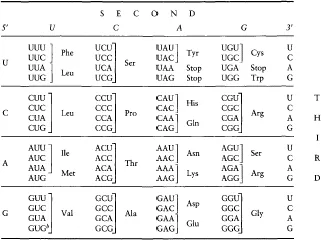
aNotable exceptions to the “universal” genetic code include UGA (stop) for Trp in vertebrate mitochondria, UAA (stop) and UAG (stop) for Gln in ciliated protozoa, CUN (leu) for Thr in yeast mitochondria, and AUA (Ile) for Met in vertebrate mitochondria. In some bacterial and mammalian genes, the UGA (stop) codon is used in part for selenocysteine (SeCys).
bCodes for fMet if in the initiator position.
Conventionally, the DNA sequences that code for functional RNA chains or proteins are termed genes. The RNA that carries the message for translation into a protein is called a messenger RNA (mRNA) and is derived from DNA by a process called transcription. This flow of information from DNA to RNA to protein was once the “central dogma” of molecular biology, but it is now known that the information can also flow in the reverse direction from RNA to DNA, a process called reverse transcription. Among various biological systems, viruses constitute the simplest one which displays diverse modes of genetic information flow. For example, DNA viruses usually express their genes according to the DNA–RNA–protein pathway, whereas some RNA viruses (retroviruses) first reverse-transcribe their genomic RNA into DNA and then follow the “central dogma.” Certain other RNA viruses replicate through an RNA intermediate of opposite sense and do not involve a message conversion to or from DNA at all. Within this group of RNA viruses, some have positive-sense genomic RNAs that can be directly translated into proteins, whereas others have negative-sense genomic RNAs that cannot be directly translated.
2. PROTEIN BIOSYNTHESIS
Protein biosynthesis occurs in ribosomes, the cellular assembly factory where amino acids are covalently linked into a polypeptide chain along the template mRNA. The amino acids are transported into the ribosome in an activated state via coupling to specific carriers known as transfer RNAs (tRNA). The selection of specific amino acids from the cellular pool of amino acids (Tables 1.2 and 1.3) and the task of “charging” to cognate tRNAs are performed by specific aminoacyl-tRNA synthetases. Transfer RNAs contain anticodons, the nucleotide triplets serving as the counterpart of codons. The repertoire of anticodons is substantially smaller than that of codons. This apparent discrepancy is resolved by the fact that anticodons often contain, especially at the first (5′ end) base known as wobble base, noncomplementary bases or inosine which allow nonstandard (or wobble) base pairing with codons. Thus codon degeneracy in mRNA is adequately matched by anticodon wobbling in tRNA. The general process of protein biosynthesis can be divided into three phases of translation: initiation, elongation, and termination.
TABLE 1.2
Common Amino Acids
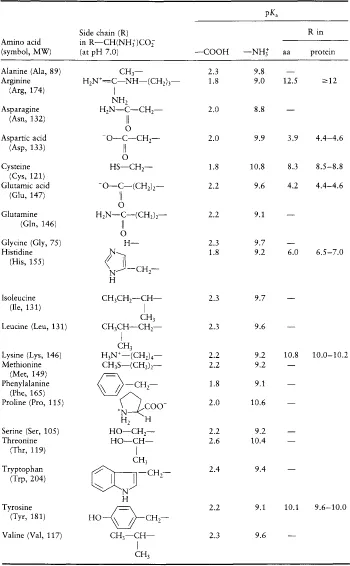
TABLE 1.3
One-Letter Notation of Amino Acidsa
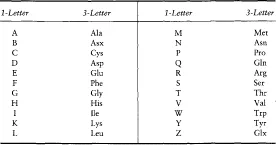
aAs recommended by the lUPAC-IUB Commission on Biochemical Nomenclature [BJ (1969) 113, 1–4].
a.: Initiation of translation
i.: Translation in prokaryotes. The start of a prokaryotic mRNA translatio...
Table of contents
- Cover image
- Title page
- Table of Contents
- Copyright
- Dedication
- Preface
- Acknowledgments
- List of Abbreviations and Symbols
- List of Journal Abbreviations
- Chapter 1: Enzymes and Nucleic Acids: General Principles
- Chapter 2: Ligases
- Chapter 3: Nucleases
- Chapter 4: Restriction Endonucleases and Modification Methylases
- Chapter 5: Phosphatases and Polynucleotide Kinase
- Chapter 6: DNA Polymerases
- Chapter 7: RNA Polymerases
- Chapter 8: Marker/Reporter Enzymes
- Appendix A: Important Molecular Biological Methods
- Appendix B: Genotypes of Escherichia coli Strains
- Appendix C: Practical Guide for Enzyme Handling
- Index
Trusted by 375,005 students
Access to over 1.5 million titles for a fair monthly price.
Study more efficiently using our study tools.
Frequently asked questions
Yes, you can cancel anytime from the Subscription tab in your account settings on the Perlego website. Your subscription will stay active until the end of your current billing period. Learn how to cancel your subscription
No, books cannot be downloaded as external files, such as PDFs, for use outside of Perlego. However, you can download books within the Perlego app for offline reading on mobile or tablet. Learn how to download books offline
Perlego offers two plans: Essential and Complete
- Essential is ideal for learners and professionals who enjoy exploring a wide range of subjects. Access the Essential Library with 800,000+ trusted titles and best-sellers across business, personal growth, and the humanities. Includes unlimited reading time and Standard Read Aloud voice.
- Complete: Perfect for advanced learners and researchers needing full, unrestricted access. Unlock 1.5M+ books across hundreds of subjects, including academic and specialized titles. The Complete Plan also includes advanced features like Premium Read Aloud and Research Assistant.
We are an online textbook subscription service, where you can get access to an entire online library for less than the price of a single book per month. With over 1.5 million books across 990+ topics, we’ve got you covered! Learn about our mission
Look out for the read-aloud symbol on your next book to see if you can listen to it. The read-aloud tool reads text aloud for you, highlighting the text as it is being read. You can pause it, speed it up and slow it down. Learn more about Read Aloud
Yes! You can use the Perlego app on both iOS and Android devices to read anytime, anywhere — even offline. Perfect for commutes or when you’re on the go.
Please note we cannot support devices running on iOS 13 and Android 7 or earlier. Learn more about using the app
Please note we cannot support devices running on iOS 13 and Android 7 or earlier. Learn more about using the app
Yes, you can access Enzymology Primer for Recombinant DNA Technology by Hyone-Myong Eun in PDF and/or ePUB format, as well as other popular books in Biological Sciences & Biochemistry. We have over 1.5 million books available in our catalogue for you to explore.