- 390 pages
- English
- ePUB (mobile friendly)
- Available on iOS & Android
eBook - ePub
Practical Ship Hydrodynamics
About this book
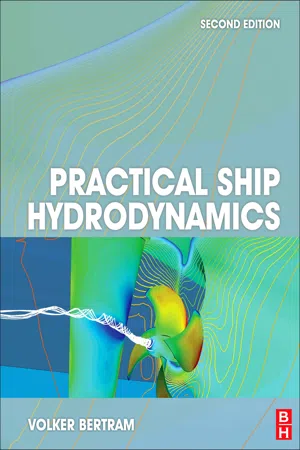
Practical Ship Hydrodynamics, Second Edition, introduces the reader to modern ship hydrodynamics. It describes experimental and numerical methods for ship resistance and propulsion, maneuvering, seakeeping, hydrodynamic aspects of ship vibrations, and hydrodynamic options for fuel efficiency, as well as new developments in computational methods and model testing techniques relating to marine design and development.Organized into six chapters, the book begins with an overview of problems and approaches, including the basics of modeling and full-scale testing, prediction of ship hydrodynamic performance, and viscous flow computations. It proceeds with a discussion of the marine applications of computational fluid dynamics and boundary element methods, factors affecting ship hydrodynamics, and simple design estimates of hydrodynamic quantities such as resistance and wake fraction. Seakeeping of ships is investigated with respect to issues such as maximum speed in a seaway, route optimization (routing), structural design of the ship with respect to loads in seaways, and habitation comfort and safety of people on board. Exercises and solutions, formula derivations, and texts are included to support teaching or self-studies.This book is suitable for marine engineering students in design and hydrodynamics courses, professors teaching a course in general fluid dynamics, practicing marine engineers and naval architects, and consulting marine engineers.
- Combines otherwise disparate information on the factors affecting ship hydrodynamics into one practical, go-to resource for successful design, development and construction.
- Updated throughout to cover the developments in computational methods and modeling techniques since the first edition published more than 10 years ago.
- New chapters on hydrodynamic aspects of ship vibrations and hydrodynamic options for fuel efficiency, and increased coverage of simple design estimates of hydrodynamic quantities such as resistance and wake fraction.
- Companion site featuring exercises and solutions, formula derivations and texts: http://booksite.elsevier.com/9780080971506/
Information
Chapter 1
Introduction
Chapter Outline
1.1. Overview of Problems and Approaches
1.2. Model Tests – Similarity Laws
1.3. Full-Scale Trials
1.4. Numerical Approaches (Computational Fluid Dynamics)
1.4.1. Basic Equations
1.4.2. Basic CFD Techniques
1.4.3. Applications
1.4.4. Cost and Value Aspects of CFD
1.5. Viscous Flow Computations
1.5.1. Turbulence Models
1.5.2. Boundary Conditions
1.5.3. Free-Surface Treatment
1.5.4. Further Details
1.5.5. Multigrid Methods
1.5.6. Numerical Approximations
1.5.7. Grid Generation
Models now in tanks we tow.
All of that to Froude we owe.
Will computers, fast and new,
Make us alter Euler’s view?
Marshall Tulin
1.1. Overview of Problems and Approaches
The prediction of ship hydrodynamic performance can be broken down into the general areas of:
• resistance and propulsion;
• seakeeping and ship vibrations;
• maneuvring.
Propeller flows and propeller design can be seen as a subtopic of resistance and propulsion, but it is so important and features special techniques that it is treated as a separate topic in its own right. Morgan and Lin (1998) give a good short introduction to the historical development of these techniques to the state of the art in the late 1990s.
The basic approaches can be roughly classified into:
• Empirical/statistical approaches. Design engineers need simple and reasonably accurate estimates, e.g. of the power requirements of a ship. Common approaches combine a rather simple physical model and regression analysis to determine required coefficients either from one parent ship or from a set of ships. The coefficients may be given in the form of constants, formulae, or curves. Because of the success with model testing, experimental series of hull forms have been developed for varying hull parameters. Extensive series were tested in the 1940s and the subsequent two decades. These series were created around a ‘good’ hull form as the parent form. The effect of essential hull parameters, e.g. block coefficient, was determined by systematic variations of these parameters. Because of the expense of model construction and testing, there are no recent comparable series tested of modern hull forms and the traditional ship series must be considered as outdated by now. Rather than using model tests, today computational fluid dynamics could be used to create data for systematic series varying certain parameters for a ship type (Harries and Tillig 2011). Once such a dedicated ‘numerical hull series’ is set up, designers can rapidly interpolate within such a database.
• Experimental approaches, either in model tests or in full-scale trials. The basic idea of model testing is to experiment with a scale model to extract information that can be scaled (transformed) to the full-scale ship. Despite continuing research and standardization efforts, a certain degree of empiricism is still necessary, particularly in the model-to-ship correlation, which is a method to enhance the prediction accuracy of ship resistance by empirical means. The total resistance can be decomposed in various ways. Traditionally, model basins tend to adopt approaches that seem most appropriate to their respective organization’s corporate experience and accumulated databases. Unfortunately, this makes various approaches and related aggregated empirical data incompatible. Although there has been little change in the basic methodology of ship resistance since the days of Froude (1874), various aspects of the techniques have progressed. We now understand better the flow around three-dimensional, appended ships, especially the boundary layer effects. Also non-intrusive experimental techniques like laser-Doppler velocimetry (LDV) or particle image velocimetry (PIV) allow the measurement of the velocity field in the ship wake to improve propeller design. Another more recent experimental technique is wave pattern analysis to determine the wave-making resistance. In propulsion tests, measurements include towing speed and propeller quantities such as thrust, torque, and rpm. Normally, open-water tests on the propeller alone are run to aid the analysis process as certain coefficients are necessary for the propeller design. Strictly, open-water tests are not essential for power prediction. The model propeller is usually a stock propeller (taken from a large selection (= stock) of propellers) that approximates the actual design propeller. Propulsion tests determine important input parameters for the actual detailed propeller design, e.g. wake fraction and thrust deduction. The wake distribution, also needed for propeller design, is measured behind the ship model using pitot tubes or laser-Doppler velocimetry (LDV). For propeller design, measured nominal wakes (for the ship without a propeller) for the model must be transformed to effective wakes (for the ship with a working propeller) for the full-scale ship. While semi-empirical methods for this transformation apparently work well for most hull forms, for those with considerable flow separation at the stern, i.e. typically full hulls, there are significant scale effects on the wake between model and full scale. To some extent, computational fluid dynamics can help here in estimating the scale effects. Although the procedures for predicting full-scale resistance from model tests are well accepted, full-scale data available for validation purposes are extremely limited and difficult to obtain. The powering performance of a ship is validated by actual ship trials, ideally conducted in calm seas. The parameters usually measured are torque, rpm, and speed. Thrust is measured only as a special requirement because of the difficulty and extra expense involved in obtaining accurate thrust data. Whenever possible and appropriate, corrections are made for the effects of waves, current, wind, and shallow water. Since the 1990s, the Global Positioning System (GPS) and computer-based data acquisition systems have considerably increased the accuracy and economy of full-scale trials. The GPS has eliminated the need for ‘measured miles’ trials near the shore with the possible contamination of data due to shallow-water effects. Today trials are usually conducted far away from the shore. Model tests for seakeeping are often used only for validation purposes. However, for open-top container ships and ro-ro ships model tests are often performed as part of the regular design process, as IMO regulations require certain investigations for ship safety which may be documented using model tests. Most large model basins have a maneuvring model basin. The favored method to determine the coefficients for the equations of motion is through a planar motion mechanism. However, scaling the model test results to full scale using the coefficients derived in this manner is problematic, because vortex shedding and flow separation are not similar between model and full scale. Appendages generally make scaling more difficult. Also, maneuvering tests have been carried out with radio-controlled models in lakes and large reservoirs. These tests introduce additional scale effects, since the model propeller operates in a different self-propulsion point than the full-scale ship propeller. Despite these concerns, the maneuvering characteristics of ships seem generally to be predicted with sufficient accuracy by experimental approaches.
• Numerical approaches, either rather analytical or using computational fluid dynamics (CFD). For ship resistance and powering, CFD has become increasingly important and is now an indispensable part of the design process. Typically inviscid free-surface methods based on the boundary element approach are used to analyze the forebody, especially the interaction of bulbous bow and forward shoulder. Viscous flow codes focus on the aftbody or appendages. Flow codes modeling both viscosity and the wave-making are widely applied for flows involving breaking waves. CFD is still considered by industry as too inaccurate for resistance or power predictions. So far CFD has been used to gain insight into local flow details and derive recommendation on how to improve a given design or select a most promising candidate design for model testing. However, numerical power prediction with good accuracy has been demonstrated in research applications by 2010 for realistic ship geometries. It is e...
Table of contents
- Cover Image
- Table of Contents
- Title
- copyright
- Preface
- Chapter 1. Introduction
- Chapter 2. Propellers
- Chapter 3. Resistance and Propulsion
- Chapter 4. Ship Seakeeping
- Chapter 5. Vibrations
- Chapter 6. Ship Maneuvering
- APPENDIX A. Boundary Element Methods
- APPENDIX B. Numerical Examples for BEM
- References
- Index
Trusted by 375,005 students
Access to over 1.5 million titles for a fair monthly price.
Study more efficiently using our study tools.
Frequently asked questions
Yes, you can cancel anytime from the Subscription tab in your account settings on the Perlego website. Your subscription will stay active until the end of your current billing period. Learn how to cancel your subscription
No, books cannot be downloaded as external files, such as PDFs, for use outside of Perlego. However, you can download books within the Perlego app for offline reading on mobile or tablet. Learn how to download books offline
Perlego offers two plans: Essential and Complete
- Essential is ideal for learners and professionals who enjoy exploring a wide range of subjects. Access the Essential Library with 800,000+ trusted titles and best-sellers across business, personal growth, and the humanities. Includes unlimited reading time and Standard Read Aloud voice.
- Complete: Perfect for advanced learners and researchers needing full, unrestricted access. Unlock 1.5M+ books across hundreds of subjects, including academic and specialized titles. The Complete Plan also includes advanced features like Premium Read Aloud and Research Assistant.
We are an online textbook subscription service, where you can get access to an entire online library for less than the price of a single book per month. With over 1.5 million books across 990+ topics, we’ve got you covered! Learn about our mission
Look out for the read-aloud symbol on your next book to see if you can listen to it. The read-aloud tool reads text aloud for you, highlighting the text as it is being read. You can pause it, speed it up and slow it down. Learn more about Read Aloud
Yes! You can use the Perlego app on both iOS and Android devices to read anytime, anywhere — even offline. Perfect for commutes or when you’re on the go.
Please note we cannot support devices running on iOS 13 and Android 7 or earlier. Learn more about using the app
Please note we cannot support devices running on iOS 13 and Android 7 or earlier. Learn more about using the app
Yes, you can access Practical Ship Hydrodynamics by Volker Bertram in PDF and/or ePUB format, as well as other popular books in Technology & Engineering & Engineering General. We have over 1.5 million books available in our catalogue for you to explore.