- 176 pages
- English
- ePUB (mobile friendly)
- Available on iOS & Android
eBook - ePub
Reaction Mechanisms of Metal Complexes
About this book
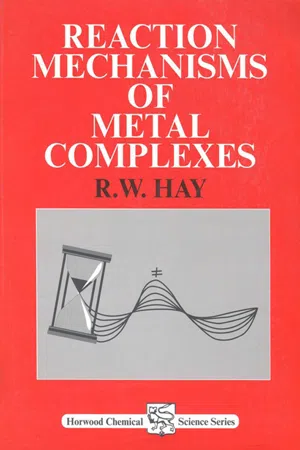
This text provides a general background as a course module in the area of inorganic reaction mechanisms, suitable for advanced undergraduate and postgraduate study and/or research. The topic has important research applications in the metallurgical industry and is of interest in the science of biochemistry, biology, organic, inorganic and bioinorganic chemistry. In addition to coverage of substitution reactions in four-, five- and six-coordinate complexes, the book contains further chapters devoted to isomerization and racemization reactions, to the general field of redox reactions, and to the reactions of coordinated ligands. It is relevant in other fields such as organic, bioinorganic and biological chemistry, providing a bridge to organic reaction mechanisms. The book also contains a chapter on the kinetic background to the subject with many illustrative examples which should prove useful to those beginning research.
- Provides a general background as a course module in the area of inorganic reaction mechanisms, which has important research applications in the metallurgical industry
- Contains further chapters devoted to isomerization and racemization reactions, to the general field of redox reactions, and to the reactions of coordinated ligands
Information
1
Introduction
Publisher Summary
This chapter explains that inorganic chemistry has tended to lag behind organic chemistry in the determination of reaction mechanisms. The foundations and concepts of the mechanisms of reactions in solution were laid down between 1920 and 1945 and applied almost solely to the reactions of tetrahedral and planar carbon centers in organic compounds. Organic chemistry in the 1920s period was ripe for the investigation of reaction mechanism. The situation in the inorganic area was less satisfactory. There was no background of systematized reactions and planned synthetic pathways. Preparative inorganic chemistry was a rather haphazard and intuitive discipline. In addition, the view was widely held that virtually all inorganic reactions were either very rapid or unselective. The products were determined by thermodynamic and solubility considerations, unlike those of organic reactions that were normally determined by kinetic and hence mechanistic factors. The few published studies of inorganic reactions in solution were initially motivated by problems somewhat removed from mechanism such as the study of salt effects, optical rotatory dispersion, stereochemical change, and the application of new or unusual methods to the study of reaction rates.
Inorganic chemistry has tended to lag behind organic chemistry in the determination of reaction mechanisms. The foundations and concepts of the mechanisms of reactions in solution were laid down between 1920 and 1945 and applied almost solely to the reactions of tetrahedral and planar carbon centres in organic compounds. It is not difficult to understand why carbon should be the first reaction centre to be studied in such detail,
(a) Organic compounds often undergo reaction at one centre, w...
Table of contents
- Cover image
- Title page
- Table of Contents
- DEDICATION
- Horwood Publishing Series in Chemical Science
- Copyright
- FOREWORD
- PREFACE
- Acknowledgements
- Chapter 1: Introduction
- Chapter 2: The Kinetic Background
- Chapter 3: Substitution Reactions of Octahedral Complexes
- Chapter 4: Substitution Reactions in Four- and Five-Coordinate Complexes
- Chapter 5: Isomerisation and Racemisation Reactions
- Chapter 6: Electron Transfer Reactions
- Chapter 7: Reactions of Coordinated Ligands
- Index
Trusted by 375,005 students
Access to over 1.5 million titles for a fair monthly price.
Study more efficiently using our study tools.
Frequently asked questions
Yes, you can cancel anytime from the Subscription tab in your account settings on the Perlego website. Your subscription will stay active until the end of your current billing period. Learn how to cancel your subscription
No, books cannot be downloaded as external files, such as PDFs, for use outside of Perlego. However, you can download books within the Perlego app for offline reading on mobile or tablet. Learn how to download books offline
Perlego offers two plans: Essential and Complete
- Essential is ideal for learners and professionals who enjoy exploring a wide range of subjects. Access the Essential Library with 800,000+ trusted titles and best-sellers across business, personal growth, and the humanities. Includes unlimited reading time and Standard Read Aloud voice.
- Complete: Perfect for advanced learners and researchers needing full, unrestricted access. Unlock 1.5M+ books across hundreds of subjects, including academic and specialized titles. The Complete Plan also includes advanced features like Premium Read Aloud and Research Assistant.
We are an online textbook subscription service, where you can get access to an entire online library for less than the price of a single book per month. With over 1.5 million books across 990+ topics, we’ve got you covered! Learn about our mission
Look out for the read-aloud symbol on your next book to see if you can listen to it. The read-aloud tool reads text aloud for you, highlighting the text as it is being read. You can pause it, speed it up and slow it down. Learn more about Read Aloud
Yes! You can use the Perlego app on both iOS and Android devices to read anytime, anywhere — even offline. Perfect for commutes or when you’re on the go.
Please note we cannot support devices running on iOS 13 and Android 7 or earlier. Learn more about using the app
Please note we cannot support devices running on iOS 13 and Android 7 or earlier. Learn more about using the app
Yes, you can access Reaction Mechanisms of Metal Complexes by R W Hay in PDF and/or ePUB format, as well as other popular books in Technology & Engineering & Mining Engineering. We have over 1.5 million books available in our catalogue for you to explore.