- 720 pages
- English
- ePUB (mobile friendly)
- Available on iOS & Android
eBook - ePub
Analytical Chemistry
About this book
Analytical Chemistry, Second Edition covers the fundamental principles of analytical chemistry. This edition is organized into 30 chapters that present various analytical chemistry methods. This book begins with a core of six chapters discussing the concepts basic to all of analytical chemistry. The fundamentals, concepts, applications, calculations, instrumentation, and chemical reactions of five major areas of analytical chemistry, namely, neutralization, potentiometry, spectroscopy, chromatography, and electrolysis methods, are emphasized in separate chapters. Other chapters are devoted to a discussion of precipitation and complexes in analytical chemistry. Principles and applications and the relationship of these reactions to the other areas are stressed. The remaining chapters of this edition are devoted to the laboratory. A chapter discusses the basic laboratory operations, with an emphasis on safety. This topic is followed by a series of experiments designed to reinforce the concepts developed in the chapters. This book is designed for introductory courses in analytical chemistry, especially those shorter courses servicing chemistry majors and life and health science majors.
Information
Topic
Physical SciencesSubtopic
Analytic ChemistryChapter One
Introduction to Analytical Chemistry
Publisher Summary
This chapter focuses on the knowledge and experimental techniques of analytical chemistry that are most often encountered in the field of chemistry, pharmacy, medical technology, medicine, and the biological sciences. There are four major areas of analytical chemistry that are of importance in their application to diverse scientific disciplines. These areas are spectroscopy, acid-base methods, potentiometry, and chromatography. Analytical chemistry deals with the solving of qualitative and quantitative problems. In qualitative analysis, the goal is to determine what the constituents are in the sample. On the other hand, in quantitative analysis, the goal is to determine how much of each constituent is in the sample. An analytical chemist deals with inorganic and organic mixtures composed of metallurgical, biochemical, pharmaceutical, or medicinal compounds. The importance of analytical chemistry in related scientific areas is explained by considering its impact on clinical analysis, in pharmaceutical research and quality control, and in environmental analysis.
TO THE STUDENT
For many of you, this course will be your first experience in analytical chemistry. The authors assume that you are here because you have an interest in chemistry, pharmacy, medical technology, medicine, the biological sciences, or a combination of these fields, and because you want to learn how analytical chemistry will be of use to you. For this reason, the presentation in this book is not designed just for the student majoring in chemistry. Instead, the emphasis is on the knowledge and experimental techniques of analytical chemistry that are most often encountered in the disciplines listed above.
The authors feel that there are four major areas of analytical chemistry that are of importance in their application to diverse scientific disciplines. These areas are spectroscopy, acid–base methods, potentiometry (ion selective electrodes, etc.), and chromatography. Therefore, much of this book is devoted to the background and techniques necessary to understand and carry out these analytical methods.
The goal of the authors in this book is to answer in a concise and logical way the following questions: What is analytical chemistry? What does an analytical chemist do? Where does analytical chemistry fit into the overall scheme of science?
ANALYTICAL CHEMISTRY
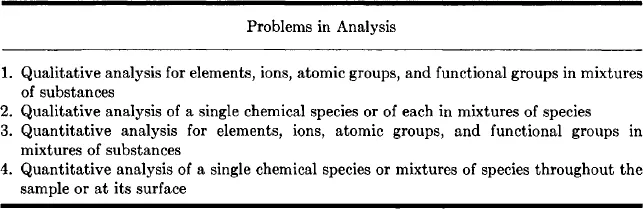
Analytical chemistry deals with the solving of qualitative and quantitative problems. In qualitative analysis the goal is to determine what the constituents are in the sample while in quantitative analysis the goal is to determine how much of each constituent is in the sample. Table 1-1 surveys in general terms the types of problems encountered in analytical chemistry.
Table 1-1
A Survey of Analytical Problems
Many paths are available to achieve the information sought, and many individual techniques may be incorporated into the route leading to a completed analysis. An important part of the analytical chemist’s task is choosing the optimum pathway, a choice which is simplified only through the assimilation of knowledge and experience. Thus, in solving analytical problems an analytical chemist is often required to design or repair electronic systems, arrange optical systems, design instruments, interpret spectra and other instrumental data, perform classical analyses with simple chemicals and solutions, develop and evaluate new procedures or modify old ones, separate simple and complex mixtures, purify samples, and write computer programs. It is not likely that any one analytical chemist will be capable in all of these areas.
The nature of the chemical and physical systems which an analytical chemist encounters is a further complication. An analytical chemist must deal with inorganic and organic mixtures composed of metallurgical, biochemical, pharmaceutical, or medicinal compounds. For example,...
Table of contents
- Cover image
- Title page
- Table of Contents
- Copyright
- Dedication
- Preface
- Chapter 1: Introduction to Analytical Chemistry
- Chapter 2: Development of an Analytical Method
- Chapter 3: Stoichiometry
- Chapter 4: Statistical Treatment of Analytical Data
- Chapter 5: Preliminary Operations in Quantitative Analysis
- Chapter 6: Introduction to Chemical Reactions in Analytical Chemistry
- Chapter 7: Precipitation Methods
- Chapter 8: Neutralization in Analytical Chemistry
- Chapter 9: Nonaqueous Acid–Base Titrations
- Chapter 10: Oxidation–Reduction Equilibria
- Chapter 11: Oxidation–Reduction Titrations
- Chapter 12: Oxidizing and Reducing Agents as Titrants in Analytical Chemistry
- Chapter 13: Ion-Selective Electrodes
- Chapter 14: Precipitation Titrations
- Chapter 15: Complexes in Analytical Chemistry: Complexometric Titrations
- Chapter 16: Introduction to Multiple Equilibrium Systems
- Chapter 17: Fundamental Principles of Optical Spectroscopy
- Chapter 18: Qualitative Analysis: Ultraviolet, Visible, and Infrared
- Chapter 19: Quantitative Analysis in Absorption Spectroscopy
- Chapter 20: Spectroscopy of Atoms
- Chapter 21: Luminescence
- Chapter 22: Separations: Introduction to Chromatography
- Chapter 23: Column Methods
- Chapter 24: Gas Chromatography
- Chapter 25: Sheet Methods
- Chapter 26: Ion Exchange
- Chapter 27: Solvent Extraction
- Chapter 28: Introduction to Electrochemistry
- Chapter 29: Polarography
- Chapter 30: Experimental Techniques
- Experiments
- Appendix I: MATHEMATICAL OPERATIONS
- Appendix II: SOLUBILITY PRODUCT CONSTANTS
- Appendix III: IONIZATION CONSTANTS OF WEAK ACIDS AND BASES
- Appendix IV: REDUCTION POTENTIALS
- Appendix V: LOG FORMATION CONSTANTS FOR METAL COMPLEXES
- Appendix VI: DISTRIBUTION DIAGRAMS FOR SELECTED COMPOUNDS
- Appendix VII: FOUR-PLACE LOGARITHMS
- PROBLEM ANSWERS
- Index
Trusted by 375,005 students
Access to over 1.5 million titles for a fair monthly price.
Study more efficiently using our study tools.
Frequently asked questions
Yes, you can cancel anytime from the Subscription tab in your account settings on the Perlego website. Your subscription will stay active until the end of your current billing period. Learn how to cancel your subscription
No, books cannot be downloaded as external files, such as PDFs, for use outside of Perlego. However, you can download books within the Perlego app for offline reading on mobile or tablet. Learn how to download books offline
Perlego offers two plans: Essential and Complete
- Essential is ideal for learners and professionals who enjoy exploring a wide range of subjects. Access the Essential Library with 800,000+ trusted titles and best-sellers across business, personal growth, and the humanities. Includes unlimited reading time and Standard Read Aloud voice.
- Complete: Perfect for advanced learners and researchers needing full, unrestricted access. Unlock 1.5M+ books across hundreds of subjects, including academic and specialized titles. The Complete Plan also includes advanced features like Premium Read Aloud and Research Assistant.
We are an online textbook subscription service, where you can get access to an entire online library for less than the price of a single book per month. With over 1.5 million books across 990+ topics, we’ve got you covered! Learn about our mission
Look out for the read-aloud symbol on your next book to see if you can listen to it. The read-aloud tool reads text aloud for you, highlighting the text as it is being read. You can pause it, speed it up and slow it down. Learn more about Read Aloud
Yes! You can use the Perlego app on both iOS and Android devices to read anytime, anywhere — even offline. Perfect for commutes or when you’re on the go.
Please note we cannot support devices running on iOS 13 and Android 7 or earlier. Learn more about using the app
Please note we cannot support devices running on iOS 13 and Android 7 or earlier. Learn more about using the app
Yes, you can access Analytical Chemistry by Clyde Frank in PDF and/or ePUB format, as well as other popular books in Physical Sciences & Analytic Chemistry. We have over 1.5 million books available in our catalogue for you to explore.