- 792 pages
- English
- ePUB (mobile friendly)
- Available on iOS & Android
eBook - ePub
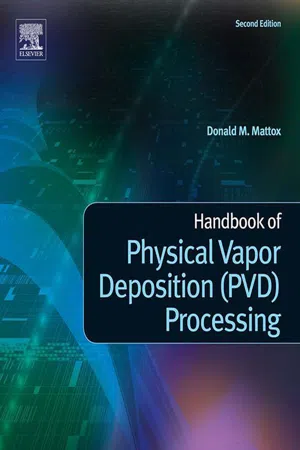
Handbook of Physical Vapor Deposition (PVD) Processing
About this book
This updated version of the popular handbook further explains all aspects of physical vapor deposition (PVD) process technology from the characterizing and preparing the substrate material, through deposition processing and film characterization, to post-deposition processing. The emphasis of the new edition remains on the aspects of the process flow that are critical to economical deposition of films that can meet the required performance specifications, with additional information to support the original material.
The book covers subjects seldom treated in the literature: substrate characterization, adhesion, cleaning and the processing. The book also covers the widely discussed subjects of vacuum technology and the fundamentals of individual deposition processes. However, the author uniquely relates these topics to the practical issues that arise in PVD processing, such as contamination control and film growth effects, which are also rarely discussed in the literature. In bringing these subjects together in one book, the reader can understand the interrelationship between various aspects of the film deposition processing and the resulting film properties. The author draws upon his long experience with developing PVD processes and troubleshooting the processes in the manufacturing environment, to provide useful hints for not only avoiding problems, but also for solving problems when they arise. He uses actual experiences, called "war stories", to emphasize certain points. Special formatting of the text allows a reader who is already knowledgeable in the subject to scan through a section and find discussions that are of particular interest. The author has tried to make the subject index as useful as possible so that the reader can rapidly go to sections of particular interest. Extensive references allow the reader to pursue subjects in greater detail if desired.
The book is intended to be both an introduction for those who are new to the field and a valuable resource to those already in the field. The discussion of transferring technology between R&D and manufacturing provided in Appendix 1, will be of special interest to the manager or engineer responsible for moving a PVD product and process from R&D into production. Appendix 2 has an extensive listing of periodical publications and professional societies that relate to PVD processing. The extensive Glossary of Terms and Acronyms provided in Appendix 3 will be of particular use to students and to those not fully conversant with the terminology of PVD processing or with the English language.
- Fully revised and updated to include the latest developments in PVD process technology
- 'War stories' drawn from the author's extensive experience emphasize important points in development and manufacturing
- Appendices include listings of periodicals and professional societies, terms and acronyms, and material on transferring technology between R&D and manufacturing
Information
Chapter 1
Introduction
Publisher Summary
A surface modification process changes the properties of the surface, but the substrate material is still present on the surface. One of such processes is physical vapor deposition (PVD) processes that are atomistic deposition processes in which material is vaporized from a solid or liquid source in the form of atoms or molecules and transported in the form of a vapor through a vacuum or low pressure gaseous (or plasma) environment to the substrate, where it condenses. The main categories of PVD processing are vacuum deposition (evaporation), sputter deposition, arc vapor deposition, and ion plating. There are a number of other thin film deposition processes that should be considered for certain applications, for example, a TiN hard coating can be deposited by PVD or chemical vapor deposition (CVD). The ability to scale-up (up-scale) a deposition process and associated equipment to provide a quality product at an attractive price is essential in the commercialization of any process. It is important that the development work be done on representative substrate material and with processes and equipment that can be scaled to production requirements. An important factor in manufacturability is the deposition fixturing, which holds the substrates in the deposition chamber.
1.1 Surface Engineering
Surface engineering involves changing the properties of the surface and near-surface region in a desirable way. Surface engineering can involve an overlay process or a surface modification process. In overlay processes a material is added to the surface and the underlying material (substrate) is covered and not detectable on the surface. A surface modification process changes the properties of the surface but the substrate material is still present on the surface. For example, in aluminum anodization, oxygen reacts with the anodic aluminum electrode of an electrolysis cell to produce a thick oxide layer on the aluminum surface. Table 1.1 shows a number of overlay and surface modification processes that can be used for surface engineering.
Table 1.1
| Atomistic/Molecular Deposition | Bulk Coatings |
|---|---|
Electrolytic Environment Electroplating Electroless platings Displacement plating Electrophoretic deposition Vacuum Environment Vacuum evaporation Ion beam sputter deposition Ion beam assisted deposition (IBAD) Laser vaporization Hot-wire and low pressure CVD Jet vapor deposition Plasma Environment Sputter deposition Arc vaporization Ion plating Plasma enhanced (PE) CVD Plasma polymerization Chemical Vapor Environment Chemical vapor deposition (CVD) Pack cementation Chemical Solution Spray pyrolysis Chemical reduction Particulate Deposition Thermal Spray Flame spray Arc-wire spray Plasma spraying D-gun High-velocity-oxygen-fuel (HVOF) Impact Plating Mechanical plating | Wetting Processes Dip coating Spin coating Painting Fusion Coatings Thick films Enameling Sol-gel coatings Powder coating Solid Coating Cladding Weld overlay Gilding Surface Modification Chemical Conversion Wet chemical solution (dispersion & layered) Gaseous (thermal) plasma Electrolytic Environment Anodizing Ion substitution Plasma electrolysis Mechanical Shot peening Work hardening Thermal Treatment Thermal stressing Ion Implantation Ion beam Plasma immersion ion implantation (PIII) Roughening and Smoothing Chemical Mechanical Chemical–mechanical polishing Sputter texturing Enrichment and Depletion Thermal Chemical |
Each process has its advantages, disadvantages, and applications. In some cases surface modification processes can be used to modify the substrate surface prior to depositing a film or coating. For example, a steel surface can be hardened by plasma nitriding (ionitriding) prior to the deposition of a hard coating by a physical vapor deposition (PVD) process. In other cases, a surface modification process can be used to change the properties of an overlay coating. For example, a sputter-deposited coating on an aircraft turbine blade can be shot peened to densify the coating and place it into compressive stress.
An atomistic deposition process is one in which the overlay material is deposited atom-by-atom. The resulting film can range from single crystal to amorphous, fully dense to less than fully dense, pure to impure, and thin to thick. Generally the term “thin film” is applied to layers which have thicknesses on the order of a micron or less (1 micron = 10−6 meters) and may be as thin as a few atomic layers. Thicker deposits are called coatings. The term “thick film” is usually not used for thick atomistically deposited vacuum deposits as that term is used for “paint-on, fire-on” types of deposition.
Often the properties of thin films are affected by the properties of the underlying material (substrate) and can vary through the thickness of the film. Thicker layers are generally called coatings. An atomistic deposition process can be done in a vacuum, plasma, gaseous, or electrolytic environment.
1.1.1 Physical Vapor Deposition (PVD) Processes
Physical vapor deposition processes (often just called thin film processes) are atomistic deposition processes in which material is vaporized from a solid or liquid source in the form of atoms or molecules and transported in the form of a vapor through a vacuum or low pressure gaseous (or plasma) environment to the substrate, where it condenses. Typically, PVD processes are used to deposit films with thicknesses in the range of a few nanometers to thousands of nanometers; however, they can ...
Table of contents
- Cover image
- Title page
- Table of Contents
- Dedication To my wife Vivienne
- Copyright
- Preface to First Edition
- Preface to Second Edition
- Acknowledgements
- Acronyms Used in Vacuum Coating and Surface Engineering
- Donald M. Mattox
- Chapter 1. Introduction
- Chapter 2. Substrate (“Real”) Surfaces and Surface Modification
- Chapter 3. The “Good” Vacuum (Low Pressure) Processing Environment
- Chapter 4. The Sub-Atmospheric Processing Environment
- Chapter 5. The Low Pressure Plasma Processing Environment
- Chapter 6. Vacuum Evaporation and Vacuum Deposition
- Chapter 7. Physical Sputtering and Sputter Deposition (Sputtering)
- Chapter 8. Arc Vapor Deposition
- Chapter 9. Ion Plating and Ion Beam-Assisted Deposition
- Chapter 10. Atomistic Film Growth and Some Growth-Related Film Properties
- Chapter 11. Film Characterization and Some Basic Film Properties
- Chapter 12. Adhesion and Deadhesion
- Chapter 13. Cleaning
- Chapter 14. The External Processing Environment
- Appendix. The Transfer of Technology from Research and Development to Manufacturing
- Index
Trusted by 375,005 students
Access to over 1.5 million titles for a fair monthly price.
Study more efficiently using our study tools.
Frequently asked questions
Yes, you can cancel anytime from the Subscription tab in your account settings on the Perlego website. Your subscription will stay active until the end of your current billing period. Learn how to cancel your subscription
No, books cannot be downloaded as external files, such as PDFs, for use outside of Perlego. However, you can download books within the Perlego app for offline reading on mobile or tablet. Learn how to download books offline
Perlego offers two plans: Essential and Complete
- Essential is ideal for learners and professionals who enjoy exploring a wide range of subjects. Access the Essential Library with 800,000+ trusted titles and best-sellers across business, personal growth, and the humanities. Includes unlimited reading time and Standard Read Aloud voice.
- Complete: Perfect for advanced learners and researchers needing full, unrestricted access. Unlock 1.5M+ books across hundreds of subjects, including academic and specialized titles. The Complete Plan also includes advanced features like Premium Read Aloud and Research Assistant.
We are an online textbook subscription service, where you can get access to an entire online library for less than the price of a single book per month. With over 1.5 million books across 990+ topics, we’ve got you covered! Learn about our mission
Look out for the read-aloud symbol on your next book to see if you can listen to it. The read-aloud tool reads text aloud for you, highlighting the text as it is being read. You can pause it, speed it up and slow it down. Learn more about Read Aloud
Yes! You can use the Perlego app on both iOS and Android devices to read anytime, anywhere — even offline. Perfect for commutes or when you’re on the go.
Please note we cannot support devices running on iOS 13 and Android 7 or earlier. Learn more about using the app
Please note we cannot support devices running on iOS 13 and Android 7 or earlier. Learn more about using the app
Yes, you can access Handbook of Physical Vapor Deposition (PVD) Processing by Donald M. Mattox in PDF and/or ePUB format, as well as other popular books in Technology & Engineering & Industrial Engineering. We have over 1.5 million books available in our catalogue for you to explore.