- 381 pages
- English
- ePUB (mobile friendly)
- Available on iOS & Android
eBook - ePub
Solar Cell Device Physics
About this book
There has been an enormous infusion of new ideas in the field of solar cells over the last 15 years; discourse on energy transfer has gotten much richer, and nanostructures and nanomaterials have revolutionized the possibilities for new technological developments. However, solar energy cannot become ubiquitous in the world's power markets unless it can become economically competitive with legacy generation methods such as fossil fuels.
The new edition of Dr. Stephen Fonash's definitive text points the way toward greater efficiency and cheaper production by adding coverage of cutting-edge topics in plasmonics, multi-exiton generation processes, nanostructures and nanomaterials such as quantum dots. The book's new structure improves readability by shifting many detailed equations to appendices, and balances the first edition's semiconductor coverage with an emphasis on thin-films. Further, it now demonstrates physical principles with simulations in the well-known AMPS computer code developed by the author.
- Classic text now updated with new advances in nanomaterials and thin films that point the way to cheaper, more efficient solar energy production
- Many of the detailed equations from the first edition have been shifted to appendices in order to improve readability
- Important theoretical points are now accompanied by concrete demonstrations via included simulations created with the well-known AMPS computer code
Trusted by 375,005 students
Access to over 1 million titles for a fair monthly price.
Study more efficiently using our study tools.
Information
Chapter One
Introduction
1.1 Photovoltaic Energy Conversion
Photovoltaic energy conversion is the direct production of electrical energy in the form of current and voltage from electromagnetic (i.e., light, including infrared, visible, and ultraviolet) energy. The basic four steps needed for photovoltaic energy conversion are:
1. a light absorption process which causes a transition in a material (the absorber) from a ground state to an excited state,
2. the conversion of the excited state into (at least) a free negative- and a free positive-charge carrier pair, and
3. a discriminating transport mechanism, which causes the resulting free negative-charge carriers to move in one direction (to a contact that we will call the cathode) and the resulting free positive-charge carriers to move in another direction (to a contact that we will call the anode).
The energetic, photogenerated negative-charge carriers arriving at the cathode result in electrons which travel through an external path (an electric circuit). While traveling this path, they lose their energy doing something useful at an electrical “load,” and finally they return to the anode of the cell. At the anode, every one of the returning electrons completes the fourth step of photovoltaic energy conversion, which is closing the circle by
4. combining with an arriving positive-charge carrier, thereby returning the absorber to the ground state.
In some materials, the excited state may be a photogenerated free electron–free hole pair. In such a situation, step 1 and step 2 coalesce. In some materials, the excited state may be an exciton, in which case steps 1 and 2 are distinct.
A study of the various man-made photovoltaic devices that carry out these four steps is the subject of this text. Our main interest is photovoltaic devices that can efficiently convert the energy in sunlight into usable electrical energy. Such devices are termed solar cells or solar photovoltaic devices. Photovoltaic devices can be designed to be effective for electromagnetic spectra other than sunlight. For example, devices can be designed to convert radiated heat (infrared light) into usable electrical energy. These are termed thermal photovoltaic devices. There are also devices which directly convert light into chemical energy. In these, the photogenerated excited state is used to drive chemical reactions rather than to drive electrons through an electric circuit. One example is the class of devices used for photolysis. While our emphasis is on solar cells for producing electrical energy, photolysis is briefly discussed later in the book.
1.2 Solar Cells and Solar Energy Conversion
The energy supply for a solar cell is photons coming from the sun. This input is distributed, in ways that depend on variables like latitude, time of day, and atmospheric conditions, over different wavelengths. The various distributions that are possible are called solar spectra. The product of this light energy input, in the case of a solar cell, is usable electrical energy in the form of current and voltage. Some common “standard” energy supplies from the sun, which are available at or on the earth, are plotted against wavelength (λ) in W/m2/nm spectra in Figure 1.1A. An alternative photons/m2-s/nm spectrum is seen in Figure 1.1B. The spectra in Figure 1.1A give the power impinging per area (m2) in a band of wavelengths 1 nm wide (the bandwidth Δλ) centered on each wavelength λ. In this figure, the AM0 spectrum is based on ASTM standard E 490 and is used for satellite applications.1 The AM1.5G spectrum, based on ASTM standard G173, is for terrestrial applications and includes direct and diffuse light. It integrates to 1000 W/m2. The AM1.5D spectrum, also based on G173, is for terrestrial applications but includes direct light only. It integrates to 888 W/m2.2 The spectrum in Figure 1.1B has been obtained from the AM1.5G spectrum of Figure 1.1A by converting power to photons per second per cm2 and by using a bandwidth of 20 nm. Photon spectra Φ0(λ), exemplified by that in Figure 1.1B, are more convenient for solar cell assessments, because optimally one photon translates into one free electron–free hole pair via steps 1 and 2 of the four steps needed for photovoltaic energy conversion.
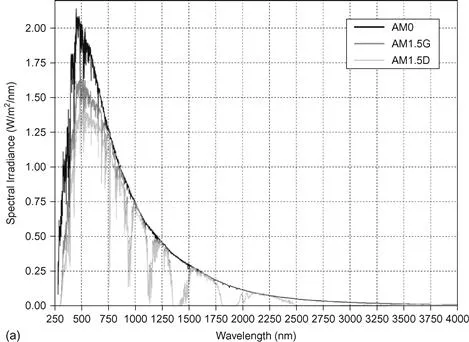

Figure 1.1 Solar energy spectra. (a): Data expressed in watts per m2 per 1 nm bandwidth for AMO (from Ref. 1, with permission) and for AM1.5G, and AM1.5D spectra (from Ref. 2, with permission). (b): The AM1.5G data expressed in terms of impinging photons per second per cm2 per 20 nm bandwidth.
Standard spectra are needed in solar cell research, development, and marketing because the actual spectrum impinging on a cell in operation can vary due to weather, season, time of day, and location. Having standard spectra allows the experimental solar cell performance of one device to be compared to that of other devices and to be judged fairly, since the cells can be exposed to the same agreed-upon spectrum. The comparisons can be done even in the laboratory since standard distributions can be duplicated using solar simulators.
The total power PIN per area impinging on a cell for a given photon spectrum Φ0(λ) is the integral of the incoming energy per time per area per bandwidth over the entire photon spectrum; i.e.,
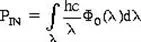
where an example Φ0(λ), expressed as photons/time/area/bandwidth, is plotted in Figure 1.1B. In Equation 1.1 the quantity h is Planck's constant and c is the speed of light. The electrical power POUT per area produced by the cell of Figure 1.2 operating at the voltage V and delivering the current I as a result of this incoming solar power is the product of the current I times V divided by the cell area.
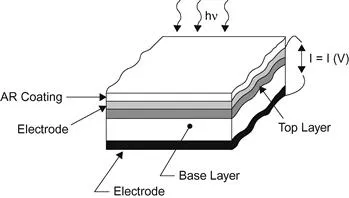
Figure 1.2 Cross-section of a typical solar cell. The area of photon impingement and the area of current production are the same. The anti-reflection (AR) coating has the function of reducing reflection losses. The collecting electrodes (cathode and anode) are shown with the top electrode being transparent.
Introducing the current density J defined as I divided by the cell area allows POUT to be written as

A plot of the possible J-V operating points (called the “light” J-V characteristics) of the cell of Figure 1.2 is seen in Figure 1.3. The points labeled Jsc and Voc represent, respectively, the extreme cases of no voltage produced between the anode and cathode (i.e., the illuminated solar cell is short-circuited) and of no current flowing between the anode and cathode (i.e., the illuminated solar cell is open-circuited). At any of the operating points seen in Figure 1.3, POUT is given by the JV product.
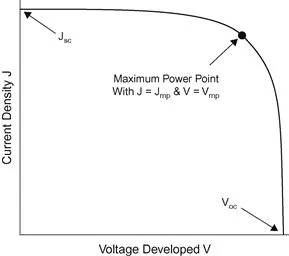
Figure 1.3 The current density-voltage (J-V) characteristic of the photovoltaic structure of Figure 1.2 under illumination. The short-circuit current density Jsc and open-circuit voltage Voc are shown. The maximum power point (largest J-V product) is also shown. Device efficiency η is defined as η = (Jmp Vmp)/PIN where PIN is the incoming power per area.
The quantity POUT has its best value at the maximum power point labeled by the current density Jmp and the voltage Vmp on the light J-V characteristic in Figure 1.3. This operating point gives the maximum obtainable current density-voltage product. Therefore, the best thermodynamic efficiency η of the photovoltaic energy conversion process for the cell of Figure 1.2 is:

Table of contents
- Cover image
- Title
- Copyright
- Dedication
- Preface
- Acknowledgments
- List of Symbols
- List of Abbreviations
- Chapter One. Introduction
- Chapter Two. Material Properties and Device Physics Basic to Photovoltaics
- Chapter Three. Structures, Materials, and Scale
- Chapter Four. Homojunction Solar Cells
- Chapter Five. Semiconductor–semiconductor Heterojunction Cells
- Chapter Six. Surface-barrier Solar Cells
- Chapter Seven. Dye-sensitized Solar Cells
- APPENDIX A. The Absorption Coefficient
- APPENDIX B. Radiative Recombination
- APPENDIX C. Shockley-Read-Hall (Gap-state–assisted) Recombination
- APPENDIX D. Conduction- and Valence-band Transport
- APPENDIX E. The Quasi-neutral-region Assumption and Lifetime Semiconductors
- APPENDIX F. Determining p(x) and n(x) for the Space-charge-neutral Regions of a Homojunction
- APPENDIX G. Determining n(x) for the Space-charge-neutral Region of a Heterojunction p-type Bottom Material
- Index
Frequently asked questions
Yes, you can cancel anytime from the Subscription tab in your account settings on the Perlego website. Your subscription will stay active until the end of your current billing period. Learn how to cancel your subscription
No, books cannot be downloaded as external files, such as PDFs, for use outside of Perlego. However, you can download books within the Perlego app for offline reading on mobile or tablet. Learn how to download books offline
Perlego offers two plans: Essential and Complete
- Essential is ideal for learners and professionals who enjoy exploring a wide range of subjects. Access the Essential Library with 800,000+ trusted titles and best-sellers across business, personal growth, and the humanities. Includes unlimited reading time and Standard Read Aloud voice.
- Complete: Perfect for advanced learners and researchers needing full, unrestricted access. Unlock 1.4M+ books across hundreds of subjects, including academic and specialized titles. The Complete Plan also includes advanced features like Premium Read Aloud and Research Assistant.
We are an online textbook subscription service, where you can get access to an entire online library for less than the price of a single book per month. With over 1 million books across 990+ topics, we’ve got you covered! Learn about our mission
Look out for the read-aloud symbol on your next book to see if you can listen to it. The read-aloud tool reads text aloud for you, highlighting the text as it is being read. You can pause it, speed it up and slow it down. Learn more about Read Aloud
Yes! You can use the Perlego app on both iOS and Android devices to read anytime, anywhere — even offline. Perfect for commutes or when you’re on the go.
Please note we cannot support devices running on iOS 13 and Android 7 or earlier. Learn more about using the app
Please note we cannot support devices running on iOS 13 and Android 7 or earlier. Learn more about using the app
Yes, you can access Solar Cell Device Physics by Stephen Fonash,Stephen J. Fonash in PDF and/or ePUB format, as well as other popular books in Technology & Engineering & Environmental Science. We have over one million books available in our catalogue for you to explore.