eBook - ePub
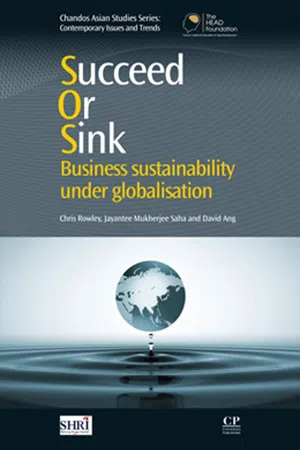
Succeed or Sink
Business Sustainability Under Globalisation
- 190 pages
- English
- ePUB (mobile friendly)
- Available on iOS & Android
eBook - ePub
About this book
Aimed at business strategists, policy makers, researchers and adult learners, this book has an Asian perspective on business sustainability and is about understanding how recent developments and future actions in one part of the world will have a global impact. The book magnifies the concept of so-called 'globalisation' and examines the topic of business sustainability from a broad and integrated approach to business: encapsulating people, prosperity and the planet. Furthermore, it acknowledges the contributions, challenges and potential of not only the big corporate houses, but also the smaller ones, in this situation. Chapters discuss the benefits organisations can attain with better governance, and social and environmental practices are also analysed.
- Broad and integrated approach to business encapsulating people, prosperity and sustainability
- Details recent developments and future actions in the areas of business sustainability and applicable more globally
- Written by highly knowledgeable and well-respected academician and practitioners in the field; a perfect blend of the best of both worlds
Information
1
Introduction: setting the context of business sustainability and globalisation
Abstract:
New business infrastructure and competitive human capital within a dynamic labour market are factors that lead organisations to redefine their business strategies and enhance people management practices. Addressing these efficiently means that organisations will have to strike a balance with their limiting resources and constraints as they work towards business excellence and sustainability. This chapter introduces the context of this book and elaborates the research methodologies which are the basis of this book. It also explains why this book has a focus on Singapore and its linkage to the dynamics of business sustainability under globalisation.
Key words
human resources
Singapore
Singapore Human Resources Institute (SHRI)
Introduction
The post-2008 global financial crisis and its commensurate impacts prompted businesses around the world to re-examine their capability to be able to better survive and endure through such economic strife and chaos. Also, the term ‘business sustainability’ became a more popular buzzword amongst many managers and corporate boardrooms. Our book presents an Asian perspective on this area of business sustainability and it is about gaining a greater and more nuanced understanding concerning how recent developments and future actions in one part of the world have wider lessons and a global impact. As such, our findings, analysis, conclusions and implications have relevance beyond just Asia.
The book examines the topic of business sustainability from a broad and integrated approach to business. This encapsulates the ‘3Ps’ of: people, prosperity and the planet. Furthermore, the book acknowledges the contributions and challenges for not only multinational companies (MNCs) and large organisations, but also diverse small and medium sized enterprises (SMEs) in this situation. The numerous benefits that organisations can attain with better governance, social and environmental practices, are also analysed in the following chapters. Importantly, real life cases of recent organisational events and experiences based on managerial views and comments are used. These are the result of research conducted in Singapore.
Why Singapore? Singapore is strategically located at the crossroads of two Asian superpowers – China and India – and is a major international transportation hub, positioned on many sea and air trade routes. Along with Hong Kong, Taiwan and South Korea, Singapore is one of the Asian Tiger economies. Ranked third in the World Economic Forum’s Global Competitiveness Index (GCI) report 2009–10 and first among the Asian countries (WEF 2010), Singapore is somewhat representative of more developed Asia. Also, Singapore is a large, busy port and entrepot city-state with an important and leading financial centre and an economy that is based upon foreign MNC capital (Dent 2003: 255). By way of illustration, we can note that foreign transnational corporations (TNCs) accounted for well over half of Singapore’s production, employment and investment and around 80 per cent of its exports by 2000 (Lim 2009: 1). Hence, the business cases, experiences and perspectives that organisations operating in Singapore have on business sustainability carry the flavours of Asia and the world, though there are also a few instances where they may be more unique, specific and context-constrained.
Singapore in context
Singapore is a cosmopolitan world city located 137 kilometers North of the equator in South East Asia between Malaysia (separated by the Straits of Johor to the North) and Indonesia (separated by the Singapore Straits to the South) covering 687 square kilometres over 60 islands and with on-going land reclamation projects. It is very densely populated, with a population of 4.7 million. Its age structure is as follows: 0–14 years old: 14.4 per cent; 15–64 years: 76.7 per cent; 65 + years: 8.9 per cent; with a median age of 39.6 years, population growth of 0.863 per cent and total fertility rate of 1.1 (CIA World Factbook 2010).
Historical and political
From the second century there are early records of settlement on the island. Known by the Javanese name of ‘Temasek’ (‘sea town’), the island was an outpost of the Sumatran Srivijaya empire. Between the sixteenth and nineteenth centuries it was part of the Sultanate of Johor. In 1613 Portuguese raiders burnt the settlement and for the next two centuries the island remained obscure.
Singapore began in 1819, with Sir Stamford Raffles, who spotted the island’s potential as a strategic trading post for South East Asia and signed a treaty to develop the Southern part of Singapore as a British trading post and settlement for the East India Company. Singapore was a territory controlled by a Malay Sultan until 1824, when it became a British possession and then, in 1826, part of the Straits Settlements – a British colony.
During the Second World War the Japanese defeated the British army. Following the war the British allowed Singapore to hold its first general election in 1955. The foundation of modern Singapore started with the formation of the People’s Action Party (PAP) in 1954. Led by Lee Kuan Yew as secretary general, the party sought to attract a following among the mostly poor and non-English speaking masses. The pro-independence victory led to demands for complete self-rule and finally led to internal self-government with a prime minister and cabinet overseeing all matters of government, except for defence and foreign affairs. Elections in 1959 followed and led to a self-governing state.
Singapore declared independence and joined the Malaysian Federation in 1963 and the Republic of Singapore became an independent nation in 1965 (Lepoer 1989). Lee Kuan Yew became the first prime minister and remained so until 1990. Under the administration of Singapore’s second prime minister, Goh Chok Tong, he also served as senior minister and holds the post of minister mentor, a post created when his son, Lee Hsien Loong, became Singapore’s third prime minister in 2004 (The Guardian 2004).
Singapore is a parliamentary republic with a UK-style system of unicameral parliamentary government representing different constituencies. The PAP dominates the political process and has won control of parliament at every election since self-government. The majority of executive powers rest with the cabinet, which is headed by the prime minister. The president has a ceremonial role, although the post was granted some veto powers in 1991.
Economic
In his book, From Third World to First: The Singapore Story 1965–2000 (Lee 2000), Lee Kuan Yew narrates how he and a small group of Singaporean leaders banded together and, by ‘getting the basics right’, transformed a poor and polyglot city into a successful modern nation. Singapore’s growth story has been miraculous, attracting the attention of scholars, politicians and policy-makers from around the world eager to decipher its success formula. A key component in this was the government’s post- independence industrialisation plan – the government assumed a more proactive entrepreneurial role by establishing state enterprises in key sectors such as manufacturing, finance, trading, transportati...
Table of contents
- Cover image
- Title page
- Table of Contents
- Copyright
- Dedication
- List of figures and tables
- Foreword
- Foreword
- Foreword
- Map of South East Asia
- About the authors
- Chapter 1: Introduction: setting the context of business sustainability and globalisation
- Chapter 2: The depths and heights of business sustainability
- Chapter 3: Business sustainability in practice: case studies and examples
- Chapter 4: The challenges and the future for business sustainability
- Chapter 5: Towards a business sustainability future
- Chapter 6: Conclusion: business sustainability is beyond just lasting
- Appendix: Singapore education and training system at a glance
- References
- Index
Trusted by 375,005 students
Access to over 1.5 million titles for a fair monthly price.
Study more efficiently using our study tools.
Frequently asked questions
Yes, you can cancel anytime from the Subscription tab in your account settings on the Perlego website. Your subscription will stay active until the end of your current billing period. Learn how to cancel your subscription
No, books cannot be downloaded as external files, such as PDFs, for use outside of Perlego. However, you can download books within the Perlego app for offline reading on mobile or tablet. Learn how to download books offline
Perlego offers two plans: Essential and Complete
- Essential is ideal for learners and professionals who enjoy exploring a wide range of subjects. Access the Essential Library with 800,000+ trusted titles and best-sellers across business, personal growth, and the humanities. Includes unlimited reading time and Standard Read Aloud voice.
- Complete: Perfect for advanced learners and researchers needing full, unrestricted access. Unlock 1.5M+ books across hundreds of subjects, including academic and specialized titles. The Complete Plan also includes advanced features like Premium Read Aloud and Research Assistant.
We are an online textbook subscription service, where you can get access to an entire online library for less than the price of a single book per month. With over 1.5 million books across 990+ topics, we’ve got you covered! Learn about our mission
Look out for the read-aloud symbol on your next book to see if you can listen to it. The read-aloud tool reads text aloud for you, highlighting the text as it is being read. You can pause it, speed it up and slow it down. Learn more about Read Aloud
Yes! You can use the Perlego app on both iOS and Android devices to read anytime, anywhere — even offline. Perfect for commutes or when you’re on the go.
Please note we cannot support devices running on iOS 13 and Android 7 or earlier. Learn more about using the app
Please note we cannot support devices running on iOS 13 and Android 7 or earlier. Learn more about using the app
Yes, you can access Succeed or Sink by Chris Rowley,Jayantee Saha,David Ang in PDF and/or ePUB format, as well as other popular books in Business & Business Education. We have over 1.5 million books available in our catalogue for you to explore.