eBook - ePub
Student Feedback
The Cornerstone to an Effective Quality Assurance System in Higher Education
- 182 pages
- English
- ePUB (mobile friendly)
- Available on iOS & Android
eBook - ePub
Student Feedback
The Cornerstone to an Effective Quality Assurance System in Higher Education
About this book
In recent years, student feedback has appeared at the forefront of higher education quality. In particular, the issues of effectiveness and the use of student feedback to affect improvement in higher education teaching and learning, and also other areas of student tertiary experience. Despite this, there has been a relative lack of academic literature, especially in book format, focusing on the experiences of academics, higher education leaders and managers with expertise in this area. This comprehensive book addresses this gap.With contributions by experts in the area of higher education quality (academics, higher education leaders and managers) from a range of countries the book is concerned with the practices and theory of evaluation in higher education quality, in particular the issue of student feedback.
- Experiences from interaction experts in the field
- Practical applications
- A resource guide that can be utilized in the higher education sector
Information
Topic
EducationPart 1
Overview
1
The nexus of feedback and improvement
Lee Harvey
Abstract:
Student feedback on their experience is ubiquitous but is only useful if valued and acted upon. Generic student surveys are often used but more fine-grained surveys are more effective in informing improvement initiatives. To make an effective contribution to internal improvement processes, students’ views need to be integrated into a regular and continuous cycle of analysis, action and report back to students on action taken. Student feedback often assumes a consumerist view rather than a transformative view of learning and hence a focus on facilities and teaching rather than learning. As well as feedback from students on their learning environment, feedback to students on their work and progress is vital for transformative learning. Feedback to students is often poor and there are various ways to improve such feedback and hence empower students as effective autonomous learners.
Key words
valuing student views
feedback cycle
transformative learning
improvement
feedback to students
Introduction
Student feedback on aspects of their experience is ubiquitous. Indeed, it is now expected. The recent Parliamentary Select Committee report in the UK (House of Commons, 2009) concluded, inter alia, with the following student comment: ‘What contributes to a successful university experience is an institution which actively seeks, values and acts on student feedback’ (p. 131).
Carr et al. (2005) commented:
Student surveys are perhaps one of the most widely used methods of evaluating learning outcomes (Leckey and Neill, 2001: 24) and teaching quality. Students may have a certain bias which influences their responses, however, the student perspective is advantageous for being much more immediate than analyses of, for example, completion and retention rates. Further, the view presented in the survey is that of the learner, ‘the person participating in the learning process’ (Harvey, 2001). Harvey also identified the value in the richness of information that can be obtained through the use of student surveys (Harvey, 2001).
Much earlier, Astin (1982), for example, had argued that students are in a particularly good position to comment upon programmes of study and thus to assist institutions to improve their contribution to student development. Hill (1995) later argued, from a student perspective, that students are ‘often more acutely aware of problems, and aware more quickly’ than staff or visiting teams of peers; which is, ‘perhaps, the primary reason for student feedback on their higher education to be gathered and used regularly’ (p. 73).
However, this has not always been the case. Twenty years ago, systematic feedback from students about their experience in higher education was a rarity. With the expansion of the university sector, the concerns with quality and the growing ‘consumerism’ of higher education, there has been a significant growth of, and sophistication in, processes designed to collect views from students.
Most higher education institutions, around the world, collect some type of feedback from students about their experience of higher education. ‘Feedback’ in this sense refers to the expressed opinions of students about the service they receive as students. This may include: perceptions about the learning and teaching; the learning support facilities, such as libraries and computing facilities; the learning environment, such as lecture rooms, laboratories, social space and university buildings; support facilities including refectories, student accommodation, sport and health facilities and student services; and external aspects of being a student, such as finance, car parking and the transport infrastructure.
Student views are usually collected in the form of ‘satisfaction’ feedback in one way or another; albeit some surveys pretend that by asking ‘agree-disagree’ questions they are not actually asking about satisfaction with provision. Sometimes, but all too rarely, there are specific attempts to
obtain student views on how to improve specific aspects of provision or on their views about potential or intended future developments.
The reaction to student views also seems to have shifted. Baxter (1991) found that over half the respondents in a project he reported experienced improved job satisfaction and morale and almost all were influenced by student evaluation to change their teaching practice. Massy and French (2001) also stated, in their review of the teaching quality in Hong Kong, that ‘staff value and act upon student feedback’ and are ‘proactive in efforts to consult with students’ (p. 38). However, more recently, Douglas and Douglas (2006) suggested that staff have very little faith in student feedback questionnaires, whether module or institutional. This is not so surprising when student feedback processes tend to be bureaucratised and disconnected from the everyday practice of students and teaching staff; a problem that is further compounded by a lack of real credit and reward for good teaching.
Ironically, although feedback from students is assiduously collected in many institutions, it is less clear that it is used to its full potential. Indeed, a question mark hangs over the value and usefulness of feedback from students as collected in most institutions. The more data institutions seek to collect, the more cynical students seem to become and the less valid the information generated and the less the student view is taken seriously. Church (2008) remarked that ‘students can often feel ambivalent about completing yet another course or module questionnaire. This issue becomes particularly acute when students are not convinced of the value of such activity –- particularly if they don’t know what resulted from it.’
In principle, feedback from students has two main functions: internal information to guide improvement; and external information for potential students and other stakeholders. In addition, student feedback data can be used for control and accountability purposes when it is part of external quality assurance processes. This is not discussed here as it is in fact a trivial use of important data, which has as its first priority improvement of the learning experience.
Improvement
It is not always clear how views collected from students fit into institutional quality improvement policies and processes. To be effective in quality improvement, data collected from surveys and peer reviews must be transformed into information that can be used within an institution to effect change.
To make an effective contribution to internal improvement processes, views of students need to be integrated into a regular and continuous cycle of analysis, reporting, action and feedback, be it at the level of an individual taught unit or at the institutional level (Figure 1.1). In many cases it is not always clear that there is a means to close the loop between data collection and effective action, let alone feedback to students on action taken, even within the context of module feedback questionnaires. Closing the loop is, as various commentators have suggested, an important, albeit neglected, element in the student feedback process (Ballantyne, 1997; Powney and Hall, 1998; Watson, 2003; Palermo, 2004; Walker-Garvin, undated). Watson (2003) argued that closing the loop and providing information on action taken encourages participation in further research and increases confidence in results, as well as it being ethical to debrief respondents. It also encourages the university management to explain how they will deal with the highlighted issues.
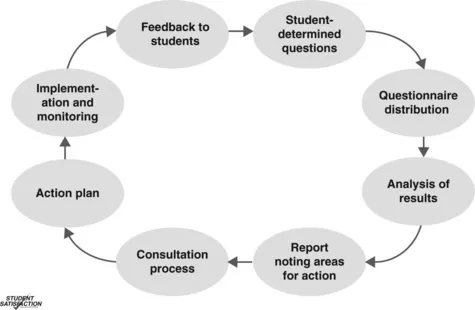
Figure 1.1 Satisfaction cycle
Making effective use of feedback requires that the institution has in place an appropriate system at each level that:

As Yorke (1995) noted, ‘The University of Central England has for some years been to the fore in systematising the collection and analysis of data in such a way as to suggest where action might be most profitably directed (Mazelan et al., 1992)’ (p. 20). However, establishing an effective system is not an easy task, which is why so much data on student views is not used to effect change, irrespective of the good intent...
Table of contents
- Cover image
- Title page
- Table of Contents
- Copyright
- List of figures and tables
- About the authors
- Preface
- Part 1: Overview
- Part 2: International Perspectives
- Part 3: Tools and Administration
- Index
Trusted by 375,005 students
Access to over 1.5 million titles for a fair monthly price.
Study more efficiently using our study tools.
Frequently asked questions
Yes, you can cancel anytime from the Subscription tab in your account settings on the Perlego website. Your subscription will stay active until the end of your current billing period. Learn how to cancel your subscription
No, books cannot be downloaded as external files, such as PDFs, for use outside of Perlego. However, you can download books within the Perlego app for offline reading on mobile or tablet. Learn how to download books offline
Perlego offers two plans: Essential and Complete
- Essential is ideal for learners and professionals who enjoy exploring a wide range of subjects. Access the Essential Library with 800,000+ trusted titles and best-sellers across business, personal growth, and the humanities. Includes unlimited reading time and Standard Read Aloud voice.
- Complete: Perfect for advanced learners and researchers needing full, unrestricted access. Unlock 1.5M+ books across hundreds of subjects, including academic and specialized titles. The Complete Plan also includes advanced features like Premium Read Aloud and Research Assistant.
We are an online textbook subscription service, where you can get access to an entire online library for less than the price of a single book per month. With over 1.5 million books across 990+ topics, we’ve got you covered! Learn about our mission
Look out for the read-aloud symbol on your next book to see if you can listen to it. The read-aloud tool reads text aloud for you, highlighting the text as it is being read. You can pause it, speed it up and slow it down. Learn more about Read Aloud
Yes! You can use the Perlego app on both iOS and Android devices to read anytime, anywhere — even offline. Perfect for commutes or when you’re on the go.
Please note we cannot support devices running on iOS 13 and Android 7 or earlier. Learn more about using the app
Please note we cannot support devices running on iOS 13 and Android 7 or earlier. Learn more about using the app
Yes, you can access Student Feedback by Chenicheri Sid Nair,Patricie Mertova in PDF and/or ePUB format, as well as other popular books in Education & Evaluation & Assessment in Education. We have over 1.5 million books available in our catalogue for you to explore.