- 280 pages
- English
- ePUB (mobile friendly)
- Available on iOS & Android
eBook - ePub
About this book
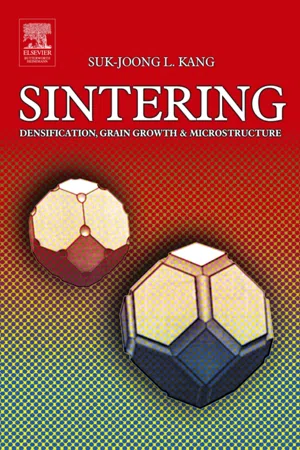
Sintering is the process of forming materials and components from a powder under the action of thermal energy. It is a key materials science subject: most ceramic materials and many specialist metal powder products for use in key industries such as electronics, automotive and aerospace are formed this way. Written by one of the leading experts in the field, this book offers an unrivalled introduction to sintering and sintering processes for students of materials science and engineering, and practicing engineers in industry. The book is unique in providing a complete grounding in the principles of sintering and equal coverage of the three key sintering processes: densification, grain growth and microstructure. Students and professional engineers alike will be attracted by the emphasis on developing a detailed understanding of the theory and practical processes of sintering, the balanced coverage of ceramic and metal sintering, and the accompanying examination questions with selected solutions.
- Delivering unrivalled depth of coverage on the basis of sintering, science, including thermodynamics and polycrystalline microstructure.
- Unique in its balanced coverage of the three key sintering elements - densification, grain growth and microstructure.
- A key reference for students and engineers in materials science and engineering, accompanied by examination questions and selected solutions.
Information
Part I
Basis of Sintering Science
1
SINTERING PROCESSES
Publisher Summary
Sintering is categorized in the synthesis/processing element among the four basic elements of materials science and engineering. It is a processing technique employed to produce density-controlled materials and components from metal or/and ceramic powders by applying thermal energy. As material synthesis and processing have become crucial in recent years for materials development, the importance of sintering is increasing as a material processing technology. Sintering is one of the oldest human technologies, originating in the pre-historic era with the firing of pottery. Only after the 1940s, sintering was studied fundamentally and scientifically. Since then, remarkable developments in sintering science have been made. One of the most important and beneficial uses of sintering in the modern era is the fabrication of sintered parts of all kinds, including powder-metallurgical parts and bulk ceramic components. Sintering aims at producing sintered parts, with reproducible micro-structure, through the control of sintering variables. Micro-structural control means the control of grain size, sintered density, and size and distribution of other phases including pores. In most cases, the final goal of micro-structural control is to prepare a fully dense body with a fine grain structure.
1.1 WHAT IS SINTERING?
Sintering is a processing technique used to produce density-controlled materials and components from metal or/and ceramic powders by applying thermal energy. Hence, sintering is categorized in the synthesis/processing element among the four basic elements of materials science and engineering, as shown in Figure 1.1.1 As material synthesis and processing have become crucial in recent years for materials development, the importance of sintering is increasing as a material processing technology.

Sintering is, in fact, one of the oldest human technologies, originating in the prehistoric era with the firing of pottery. The production of tools from sponge iron was also made possible by sintering. Nevertheless, it was only after the 1940s that sintering was studied fundamentally and scientifically. Since then, remarkable developments in sintering science have been made. One of the most important and beneficial uses of sintering in the modern era is the fabrication of sintered parts of all kinds, including powder-metallurgical parts and bulk ceramic components.
Figure 1.2 shows the general fabrication pattern of sintered parts. Unlike other processing technologies, various processing steps and variables need to be considered for the production of such parts. For example, in the shaping step, one may use simple...
Table of contents
- Cover image
- Title page
- Table of Contents
- PREFACE
- Part I: Basis of Sintering Science
- Part II: Solid State Sintering Models and Densification
- Part III: Grain growth
- Part IV: Microstructure Development
- Part V: Sintering of Ionic Compounds
- Part VI: Liquid phase sintering
- Index
Trusted by 375,005 students
Access to over 1.5 million titles for a fair monthly price.
Study more efficiently using our study tools.
Frequently asked questions
Yes, you can cancel anytime from the Subscription tab in your account settings on the Perlego website. Your subscription will stay active until the end of your current billing period. Learn how to cancel your subscription
No, books cannot be downloaded as external files, such as PDFs, for use outside of Perlego. However, you can download books within the Perlego app for offline reading on mobile or tablet. Learn how to download books offline
Perlego offers two plans: Essential and Complete
- Essential is ideal for learners and professionals who enjoy exploring a wide range of subjects. Access the Essential Library with 800,000+ trusted titles and best-sellers across business, personal growth, and the humanities. Includes unlimited reading time and Standard Read Aloud voice.
- Complete: Perfect for advanced learners and researchers needing full, unrestricted access. Unlock 1.5M+ books across hundreds of subjects, including academic and specialized titles. The Complete Plan also includes advanced features like Premium Read Aloud and Research Assistant.
We are an online textbook subscription service, where you can get access to an entire online library for less than the price of a single book per month. With over 1.5 million books across 990+ topics, we’ve got you covered! Learn about our mission
Look out for the read-aloud symbol on your next book to see if you can listen to it. The read-aloud tool reads text aloud for you, highlighting the text as it is being read. You can pause it, speed it up and slow it down. Learn more about Read Aloud
Yes! You can use the Perlego app on both iOS and Android devices to read anytime, anywhere — even offline. Perfect for commutes or when you’re on the go.
Please note we cannot support devices running on iOS 13 and Android 7 or earlier. Learn more about using the app
Please note we cannot support devices running on iOS 13 and Android 7 or earlier. Learn more about using the app
Yes, you can access Sintering by Suk-Joong L. Kang in PDF and/or ePUB format, as well as other popular books in Technology & Engineering & Chemical & Biochemical Engineering. We have over 1.5 million books available in our catalogue for you to explore.