- 560 pages
- English
- ePUB (mobile friendly)
- Available on iOS & Android
eBook - ePub
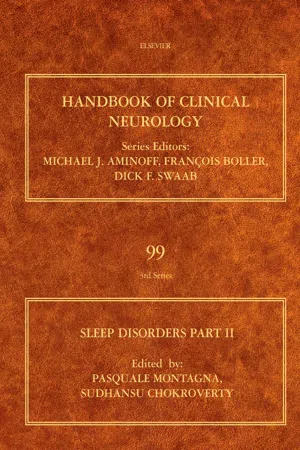
Sleep Disorders Part II
About this book
Sleep Disorders II covers various aspects of sleep disorders. These include the different classification of sleep disorders, the genetic influences of sleep disorders, abnormality in the sleeping pattern, and the circadian rhythm sleep disorder. A sleep disorder is a medical disorder that affects the sleeping patterns of humans (and sometimes animals). The disruptions in sleep can be caused by different factors, such as teeth grinding, night terrors, and the like. The book also discusses different perspectives on insomnia and hypersomnia. According to the International Classification of Sleep Disorders, insomnia is a sleep that is low in quality or a difficulty in sleeping. On the other hand, hypersomnia is a sleeping disorder characterized by excessive daytime sleepiness (EDS) or prolonged nighttime sleep. The book discusses narcolepsy, a syndrome that is characterized by excessive daytime sleepiness that is associated with cataplexy and other REM sleep phenomena. The different medicines for this disease are also discussed. People who are practicing neurology and internal medicine, especially those in pulmonary, cardiovascular, gastrointestinal, renal and endocrine specialties, will find this book valuable.
- A comprehensive resource for the study of sleep science, sleep medicine, and sleep disorders
- Fascinating noninvasive neuroimaging studies that demonstrate marked changes during different sleep states
- A state-of-the-art reference that summarizes the clinical features and management of many of the neurological manifestations of sleep disorders
Handbook of Clinical Neurology, Vol. 99, No. Suppl C, 2011
ISSN: 0072-9752
doi: 10.1016/B978-0-444-52007-4.00020-5
Chapter 61Sleep disorders in neurodegenerative diseases other than Parkinson's disease
Introduction
The relationship between neurodegenerative diseases and sleep disorders is increasingly being recognized, as is the profound effect of impaired sleep on health in general. We begin this chapter by discussing normal age-related changes in sleep/wakefulness processes, attempting where possible to correlate these changes with clinical sleep disturbances. It is our hope that such a background will enhance understanding of the sleep-related findings of neurodegenerative diseases, and/or generate further hypotheses.
The bulk of the literature addressing this topic involves patients with Alzheimer's disease (AD), and the focus is therefore necessarily weighted in this direction. It should be noted, however, that a substantial number of patients with typical clinical features of AD are not confirmed to have this condition when examined post mortem, and prove instead to have other dementing illnesses such as dementia with Lewy bodies (DLB). This is an important caveat, considering the fact that some sleep disorders, such as rapid eye movement (REM)-sleep behavior disorder (RBD), are closely associated with specific neurodegenerative illnesses, and thus their presence may be of diagnostic and pathophysiological significance.
The review of neurodegenerative diseases commences with a discussion of circadian dysrhythmias in dementia, followed by a review of RBD, and the significance of its presence in the setting of dementia. The phenomenon of nocturnal agitation will be examined subsequently, followed by a discussion of the role of medications in the exacerbation of insomnia, with a particular emphasis on cholinesterase inhibitors. An exploration of primary sleep disorders in association with neurodegenerative diseases will ensue, with a particular focus on sleep-disordered breathing and restless legs syndrome (RLS). We will proceed with a comprehensive literature review regarding multiple system atrophy and progressive supranuclear palsy, followed by a review of investigations of other neurodegenerative diseases for which comparatively fewer data are available. We conclude with evidence-based recommendations regarding the symptomatic treatment of insomnia.
Changes in Sleep with Normal Aging
Overview
Sleep-related symptoms are common in elderly patients. A study by the National Institute on Aging comprising over 9000 community-dwelling individuals (aged 65 years and over) reported that more than 50% of the cohort described having at least one of five sleep complaints occurring on a chronic basis. These included difficulty initiating or maintaining sleep, early awakening, requiring a nap during the day, or feeling poorly rested (Foley et al., 1995). An increased prevalence of medical and psychiatric illnesses is felt to be primarily responsible for this age-related increase in sleep disturbances, as demonstrated by the relatively low prevalence of insomnia in healthy individuals from this study (Foley et al., 1995) and other studies (Vitiello et al., 2002). Longitudinal studies similarly demonstrate a low incidence of insomnia in those without a depressed mood or impaired physical health (Foley et al., 1999).
The cumulative data therefore suggest that sleep disturbance is not a result of the aging process per se, and that underlying etiologies should be actively sought in those with complaints related to sleep. In a prospective study of a large number of community-dwelling elderly residents, insomnia was the strongest predictor of both mortality and nursing home placement in the male cohort (Pollak et al., 1990), and in a large observational study a subjective complaint of daytime sleepiness predicted increased mortality (Newman et al., 2000).
Well established associations with sleep disturbances include painful medical conditions, pulmonary disease, congestive heart failure, gastrointestinal disorders, incontinence, and menopause (Sleep Research Society, 2005). In addition, 60–90% of patients with major depression report insomnia (Weissman et al., 1996; McCall et al., 2000; Ohayon et al., 2000), and up to 44% report hypersomnia (Novick et al., 2005). Although their relative contribution to sleep disturbance is uncertain with the available data, the prevalence of primary sleep disorders also increases with age, some of which appear to be particularly pronounced in those with neurodegenerative diseases. However, poor health does not explain all of the sleep complaints of older adults. Both objective and subjective measures of sleep quality may still decline in older adults who remain healthy, and approximately 27% describe at least one chronic sleep complaint (Morin and Gramling, 1989; Foley et al., 1995; Ohayon et al., 2004). Following is a summary of the phenomena that may contribute to age-related changes in sleep in otherwise healthy individuals.
Changes in sleep architecture with normal aging
Objective sleep parameters change with age, and include a decrease in sleep efficiency (time asleep divided by time in bed), decreased percentage of REM and slow-wave sleep (SWS), and a related increase in the remaining nonrapid eye movement (NREM) stages of sleep (Van Cauter et al., 2000). Apart from continued deterioration of sleep efficiency, however, there are no significant changes in these measurements after the age of 60 years (Ohayon et al., 2004), and it is therefore unlikely that these ontogenetic findings contribute predominantly to increased sleep-related complaints with progressive age.
Advances in circadian phase
Age-related changes in the timing of sleep have been described frequently. Older people generally retire earlier at night and awaken earlier in the morning than younger individuals (Czeisler et al., 1992; Duffy et al., 1998; Carrier et al., 1999; Yoon et al., 2003). Numerous physiological studies also report age-related advances of circadian rhythms (Czeisler et al., 1992; Duffy et al., 1998, 2002; Carrier et al., 1999; Yoon et al., 2003), but results have been conflicting overall (Monk et al., 1995; Youngstedt et al., 2001).
Campbell and Dawson (1992) investigated whether objective sleep disturbances were associated with phase advances, by exposing seven healthy young adults to morning bright light, while holding the time of sleep constant. The subjects exhibited deleterious changes in sleep architecture, as well as increased wakefulness after sleep onset (WASO), but overall sleep efficiency remained high. A separate study confirmed a greater tendency for a “morningness” circadian preference with advanced age, and demonstrated that this tendency was a significant mediator of numerous age-related ...
Table of contents
- Cover
- Contents
- Series Editors
- Copyright
- Handbook of Clinical Neurology 3rd Series
- Foreword
- Preface
- Acknowledgments
- List of contributors
- Chapter 42: Classification of sleep disorders
- Chapter 43: Genetics of sleep disorders
- Chapter 44: Neurological perspectives in insomnia and hyperarousal syndromes
- Chapter 45: Insomnia
- Chapter 46: Pharmacotherapy for insomnia
- Chapter 47: Hypothalamus, hypocretins/orexin, and vigilance control
- Chapter 48: Narcolepsy and cataplexy
- Chapter 49: Recurrent hypersomnias
- Chapter 50: Excessive daytime sleepiness
- Chapter 51: Motor control in sleep
- Chapter 52: NREM parasomnias
- Chapter 53: REM sleep parasomnias
- Chapter 54: Isolated motor phenomena and symptoms of sleep
- Chapter 55: Sleep bruxism
- Chapter 56: Restless legs syndrome and periodic leg movements in sleep
- Chapter 57: Molecular neurobiology of circadian rhythms
- Chapter 58: Circadian rhythm sleep disorders
- Chapter 59: Fatal familial insomnia and the role of the thalamus in sleep regulation
- Chapter 60: Sleep disorders in Parkinson's disease
- Chapter 61: Sleep disorders in neurodegenerative diseases other than Parkinson's disease
- Chapter 62: Sleep and stroke
- Chapter 63: Sleep and headache
- Chapter 64: Sleep and breathing in neuromuscular disorders
- Chapter 65: Sleep-related epilepsy
- Chapter 66: Sleep disorders in multiple sclerosis
- Chapter 67: Violent parasomnias
- Subject Index
Trusted by 375,005 students
Access to over 1.5 million titles for a fair monthly price.
Study more efficiently using our study tools.
Frequently asked questions
Yes, you can cancel anytime from the Subscription tab in your account settings on the Perlego website. Your subscription will stay active until the end of your current billing period. Learn how to cancel your subscription
No, books cannot be downloaded as external files, such as PDFs, for use outside of Perlego. However, you can download books within the Perlego app for offline reading on mobile or tablet. Learn how to download books offline
Perlego offers two plans: Essential and Complete
- Essential is ideal for learners and professionals who enjoy exploring a wide range of subjects. Access the Essential Library with 800,000+ trusted titles and best-sellers across business, personal growth, and the humanities. Includes unlimited reading time and Standard Read Aloud voice.
- Complete: Perfect for advanced learners and researchers needing full, unrestricted access. Unlock 1.5M+ books across hundreds of subjects, including academic and specialized titles. The Complete Plan also includes advanced features like Premium Read Aloud and Research Assistant.
We are an online textbook subscription service, where you can get access to an entire online library for less than the price of a single book per month. With over 1.5 million books across 990+ topics, we’ve got you covered! Learn about our mission
Look out for the read-aloud symbol on your next book to see if you can listen to it. The read-aloud tool reads text aloud for you, highlighting the text as it is being read. You can pause it, speed it up and slow it down. Learn more about Read Aloud
Yes! You can use the Perlego app on both iOS and Android devices to read anytime, anywhere — even offline. Perfect for commutes or when you’re on the go.
Please note we cannot support devices running on iOS 13 and Android 7 or earlier. Learn more about using the app
Please note we cannot support devices running on iOS 13 and Android 7 or earlier. Learn more about using the app
Yes, you can access Sleep Disorders Part II by Pasquale Montagna,Sudhansu Chokroverty in PDF and/or ePUB format, as well as other popular books in Medicine & Neurology. We have over 1.5 million books available in our catalogue for you to explore.