- 1,200 pages
- English
- ePUB (mobile friendly)
- Available on iOS & Android
eBook - ePub
Bioconjugate Techniques
About this book
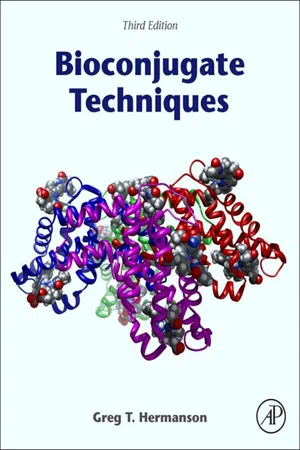
Bioconjugate Techniques, Third Edition, is the essential guide to the modification and cross linking of biomolecules for use in research, diagnostics, and therapeutics. It provides highly detailed information on the chemistry, reagent systems, and practical applications for creating labeled or conjugate molecules. It also describes dozens of reactions, with details on hundreds of commercially available reagents and the use of these reagents for modifying or crosslinking peptides and proteins, sugars and polysaccharides, nucleic acids and oligonucleotides, lipids, and synthetic polymers.
- Offers a one-stop source for proven methods and protocols for synthesizing bioconjugates in the lab
- Provides step-by-step presentation makes the book an ideal source for researchers who are less familiar with the synthesis of bioconjugates
- Features full color illustrations
- Includes a more extensive introduction into the vast field of bioconjugation and one of the most thorough overviews of immobilization chemistry ever presented
Information
Topic
Scienze biologicheSubtopic
BiotecnologiaTable of contents
- Cover image
- Title page
- Table of Contents
- Copyright
- Dedication
- Preface to the Third Edition
- Acknowledgments
- Important Information
- Chapter 1. Introduction to Bioconjugation
- Chapter 2. Functional Targets for Bioconjugation
- Chapter 3. The Reactions of Bioconjugation
- Chapter 4. Zero-Length Crosslinkers
- Chapter 5. Homobifunctional Crosslinkers
- Chapter 6. Heterobifunctional Crosslinkers
- Chapter 7. Trifunctional Crosslinkers
- Chapter 8. Dendrimers and Dendrons
- Chapter 9. Cross-Bridges and Cleavable Reagent Systems
- Chapter 10. Fluorescent Probes
- Chapter 11. (Strept)avidin–Biotin Systems
- Chapter 12. Isotopic Labeling Techniques
- Chapter 13. Silane Coupling Agents
- Chapter 14. Microparticles and Nanoparticles
- Chapter 15. Immobilization of Ligands on Chromatography Supports
- Chapter 16. Buckyballs, Fullerenes, and Carbon Nanotubes
- Chapter 17. Chemoselective Ligation; Bioorthogonal Reagents
- Chapter 18. PEGylation and Synthetic Polymer Modification
- Chapter 19. Vaccines and Immunogen Conjugates
- Chapter 20. Antibody Modification and Conjugation
- Chapter 21. Liposome Conjugates and Derivatives
- Chapter 22. Enzyme Modification and Conjugation
- Chapter23. Nucleic Acid and Oligonucleotide Modification and Conjugation
- Chapter 24. Bioconjugation in the Study of Protein Interactions
- References
- Index
Trusted by 375,005 students
Access to over 1.5 million titles for a fair monthly price.
Study more efficiently using our study tools.
Frequently asked questions
Yes, you can cancel anytime from the Subscription tab in your account settings on the Perlego website. Your subscription will stay active until the end of your current billing period. Learn how to cancel your subscription
No, books cannot be downloaded as external files, such as PDFs, for use outside of Perlego. However, you can download books within the Perlego app for offline reading on mobile or tablet. Learn how to download books offline
We are an online textbook subscription service, where you can get access to an entire online library for less than the price of a single book per month. With over 1.5 million books across 990+ topics, we’ve got you covered! Learn about our mission
Look out for the read-aloud symbol on your next book to see if you can listen to it. The read-aloud tool reads text aloud for you, highlighting the text as it is being read. You can pause it, speed it up and slow it down. Learn more about Read Aloud
Yes! You can use the Perlego app on both iOS and Android devices to read anytime, anywhere — even offline. Perfect for commutes or when you’re on the go.
Please note we cannot support devices running on iOS 13 and Android 7 or earlier. Learn more about using the app
Please note we cannot support devices running on iOS 13 and Android 7 or earlier. Learn more about using the app
Yes, you can access Bioconjugate Techniques by Greg T. Hermanson in PDF and/or ePUB format, as well as other popular books in Scienze biologiche & Biotecnologia. We have over 1.5 million books available in our catalogue for you to explore.