This long-awaited new edition is the complete reference for engineers and designers working on pump design and development or using centrifugal pumps in the field. This authoritative guide has been developed with access to the technical expertise of the leading centrifugal pump developer, Sulzer Pumps. In addition to providing the most comprehensive centrifugal pump theory and design reference with detailed material on cavitation, erosion, selection of materials, rotor vibration behavior and forces acting on pumps, the handbook also covers key pumping applications topics and operational issues, including operating performance in various types of circuitry, drives and acceptance testing.
- Enables readers to understand, specify and utilise centrifugal pumps more effectively, drawing on the industry-leading experience of Sulzer Pumps, one of the world's major centrifugal pump developers
- Covers theory, design and operation, with an emphasis on providing first class quality and efficiency solutions for high capital outlay pump plant users
- Updated to cover the latest design and technology developments, including applications, test and reliability procedures, cavitation, erosion, selection of materials, rotor vibration behaviour and operating performance in various types of circuitry
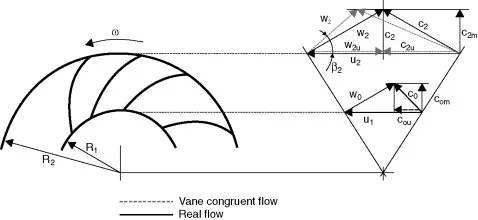
In contrast to displacement pumps, which generate pressure hydrostatically, energy is converted in centrifugal pumps by hydrodynamic means. A one-dimensional representation of the complex flow patterns in the impeller allows the energy transfer in the impeller to be computed from the fluid flow momentum theorem (Euler equation) with the aid of vector diagrams as follows (Fig. 1.1):
Figure 1.1 Vector diagrams
The torque acting on the impeller is defined as:
(1)
With u = Rω, the energy transferred to the fluid from the impeller is defined as:
(2)
The power transferred per unit mass flow to the fluid being pumped is defined as the specific work YLA done by the impeller. This is derived from equation (2) as:
(3)
The useful specific work Y delivered by the pump is less than that done by the impeller because of the losses in the intake, impeller and diffuser.
These losses are expressed in terms of hydraulic efficiency ηh:
(4)
The specific work done thus depends only on the size and shape of the hydraulic components of the pump, the flow rate and the peripheral velocity. It is independent of the medium being pumped and of gravitational acceleration. Therefore any given pump will transfer the same amount of energy to completely different media such as air, water or mercury.
In order to use equation (4) to calculate the specific work done by the pump, the flow deflection characteristics of the impeller and all the flow losses must be known. However, these data can only be determined with sufficient precision by means of tests.
In all the above equations the actual velocities must be substituted.
If it were possible for the flow to follow the impeller vane contours precisely, a larger absolute tangential flow component c2u∞ would be obtained for a given impeller vane exit angle β2 than with the actual flow c2u, which is not vane-congruent (see Fig. 1.1). The difference between c2u∞ and c2u is known as “slip”. However, slip is not a loss that causes any increase in the pump’s power consumption.
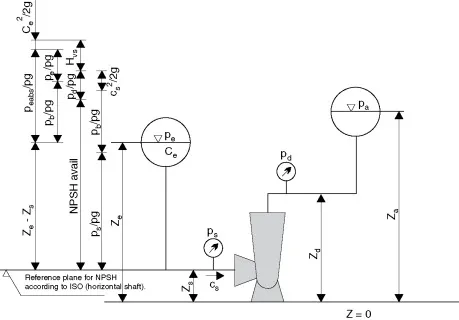
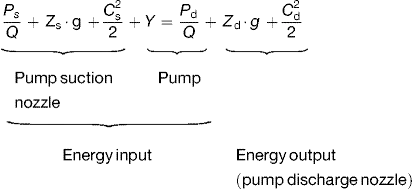
In order to examine the interrelationship between a pump and the pumping plant in which it is installed (Fig. 1.2), it is necessary to consider the energy equation (Bernoulli equation). In terms of energy per unit mass of pumped fluid it can be written:
Figure 1.2 Pumping plant
(5)
1.2 Power, Losses and Efficiency
Equations (1) to (4) hold only as long as no part load recirculation occurs. The same assumption is implied below.
The impeller flow QLA generally comprises three components:
• the useful flow rate (at the pump discharge nozzle): Q;
• the leakage flow rate (through the impeller sealing rings): QL;
• the balancing flow rate (for balancing axial thrust): QE.
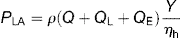
Taking into account the hydraulic losses in accordance with equation (4), the power transferred to the fluid by the impeller is defined as:
(6)
The power input required at the pump drive shaft is larger than PLA because the following losses also have to be taken into account:
• disc friction losses PRR (impeller side discs, seals);
• mechanical losses Pm (bearings, seals);
• frictional losses PER in the balancing device (disc or piston).
The power input required at the pump drive shaft is calculated from:
(7)
If the volumetric efficiency ηv is:
(8)
the power input required by the pump can be written as:
(9)
Pump efficiency is defined as the ratio of ...
Table of contents
Cover
Title Page
Copyright
Table of Contents
Preface
Chapter One: Physical Principles
Chapter Two: Behavior of Centrifugal Pumps in Operation
Chapter Three: Acceptance Tests with Centrifugal Pumps
Chapter Four: Special Data for Planning Centrifugal Pump Installations
Chapter Five: Mechanical Components
Chapter Six: Pipelines, Valves and Flanges
Chapter Seven: Centrifugal Pump Drives
Chapter Eight: Materials and Corrosion
Chapter Nine: Principal Features of Centrifugal Pumps for Selected Applications
Index
Trusted by 375,005 students
Access to over 1.5 million titles for a fair monthly price.
Study more efficiently using our study tools.
Frequently asked questions
Yes, you can cancel anytime from the Subscription tab in your account settings on the Perlego website. Your subscription will stay active until the end of your current billing period. Learn how to cancel your subscription
No, books cannot be downloaded as external files, such as PDFs, for use outside of Perlego. However, you can download books within the Perlego app for offline reading on mobile or tablet. Learn how to download books offline
Perlego offers two plans: Essential and Complete
Essential is ideal for learners and professionals who enjoy exploring a wide range of subjects. Access the Essential Library with 800,000+ trusted titles and best-sellers across business, personal growth, and the humanities. Includes unlimited reading time and Standard Read Aloud voice.
Complete: Perfect for advanced learners and researchers needing full, unrestricted access. Unlock 1.5M+ books across hundreds of subjects, including academic and specialized titles. The Complete Plan also includes advanced features like Premium Read Aloud and Research Assistant.
Both plans are available with monthly, semester, or annual billing cycles.
We are an online textbook subscription service, where you can get access to an entire online library for less than the price of a single book per month. With over 1.5 million books across 990+ topics, we’ve got you covered! Learn about our mission
Look out for the read-aloud symbol on your next book to see if you can listen to it. The read-aloud tool reads text aloud for you, highlighting the text as it is being read. You can pause it, speed it up and slow it down. Learn more about Read Aloud
Yes! You can use the Perlego app on both iOS and Android devices to read anytime, anywhere — even offline. Perfect for commutes or when you’re on the go. Please note we cannot support devices running on iOS 13 and Android 7 or earlier. Learn more about using the app
Yes, you can access Centrifugal Pump Handbook by Sulzer Sulzer Pumps,Sulzer Pumps in PDF and/or ePUB format, as well as other popular books in Technology & Engineering & Mechanical Engineering. We have over 1.5 million books available in our catalogue for you to explore.