By some measure the most widely produced chemical in the world today, sulfuric acid has an extraordinary range of modern uses, including phosphate fertilizer production, explosives, glue, wood preservative and lead-acid batteries. An exceptionally corrosive and dangerous acid, production of sulfuric acid requires stringent adherence to environmental regulatory guidance within cost-efficient standards of production.
This work provides an experience-based review of how sulfuric acid plants work, how they should be designed and how they should be operated for maximum sulfur capture and minimum environmental impact. Using a combination of practical experience and deep physical analysis, Davenport and King review sulfur manufacturing in the contemporary world where regulatory guidance is becoming ever tighter (and where new processes are being required to meet them), and where water consumption and energy considerations are being brought to bear on sulfuric acid plant operations. This 2e will examine in particular newly developed acid-making processes and new methods of minimizing unwanted sulfur emissions.
The target readers are recently graduated science and engineering students who are entering the chemical industry and experienced professionals within chemical plant design companies, chemical plant production companies, sulfuric acid recycling companies and sulfuric acid users. They will use the book to design, control, optimize and operate sulfuric acid plants around the world.
- Unique mathematical analysis of sulfuric acid manufacturing processes, providing a sound basis for optimizing sulfuric acid manufacturing processes
- Analysis of recently developed sulfuric acid manufacturing techniques suggests advantages and disadvantages of the new processes from the energy and environmental points of view
- Analysis of tail gas sulfur capture processes indicates the best way to combine sulfuric acid making and tailgas sulfur-capture processes from the energy and environmental points of view
- Draws on industrial connections of the authors through years of hands-on experience in sulfuric acid manufacture
Sulfuric acid is a dense clear liquid. It is used for making fertilizers, leaching metallic ores, refining petroleum, and manufacturing a myriad of chemicals and materials. Worldwide, about 200 million tonnes of sulfuric acid is consumed per year (Apodaca, 2012).
The raw material for sulfuric acid is SO2 gas. It is obtained by:
Elemental sulfur is far and away the largest source.
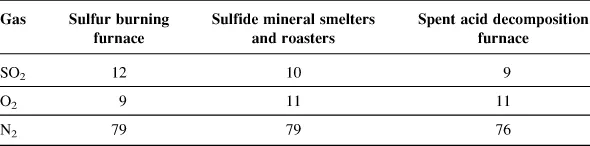
Table 1.1 describes three typical sulfuric acid plant feed gases. It shows that acid plant SO2 feed is always mixed with other gases.
Table 1.1
Typical compositions (volume%) of acid plant feed gases entering SO2 oxidation “converters,” 2013. The gases may also contain small amounts of CO2 and SO3.
Sulfuric acid is almost always made from these gases by:
(a) catalytically reacting their SO2 and O2 to form SO3(g)
(b) reacting (a)’s product SO3 with the H2O(ℓ) in 98.5 mass% H2SO4(ℓ), 1.5 mass% H2O(ℓ) sulfuric acid.
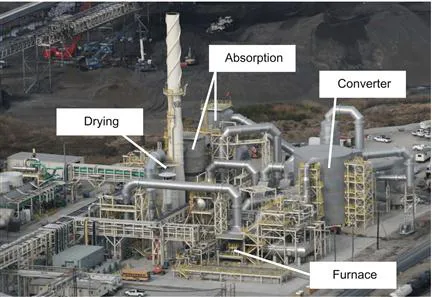
Industrially, both processes are carried out rapidly and continuously (Fig. 1.1).
Figure 1.1 Modern 4100 tonnes/day sulfur burning sulfuric acid plant, courtesy PCS Phosphate Company, Inc. (2012). The main components are the catalytic SO2 oxidation “converter” (tall, right), twin H2SO4(ℓ) making (“absorption”) towers (middle, right of stack) and a sulfur burning furnace (middle, bottom). The air dehydration (“drying”) tower is left of the stack. The catalytic converter is 16.5 m diameter.
The standard state for SO2, SO3, O2, N2, and CO2 is gas in the acid plant. Each is referenced in this book, for example, as O2 not O2(g). The standard state for H2O, S, and H2SO4 is gas or liquid in the acid plant. Each is referenced accordingly.
1.1 Catalytic oxidation of SO2 to SO3
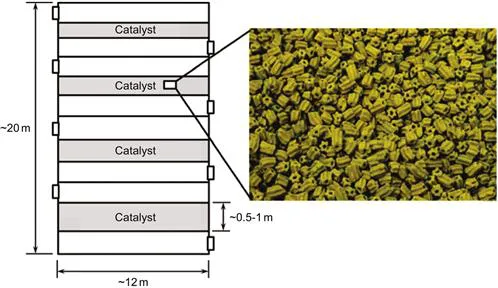
O2 does not oxidize SO2 to SO3 without a catalyst. All industrial SO2 oxidation is done by sending SO2 bearing gas down through “beds” of catalyst (Fig. 1.2). The reaction is:
(1.1)
It is strongly exothermic (ΔH°25 °C = − 100 MJ/kg mol of SO3). Its heat of reaction provides considerable energy for operating the acid plant.
At normal operating temperature, 400-630 °C, SO2 oxidation catalyst consists of a molten film of V, K, Na, Cs pyrosulfate salt on a solid porous SiO2 substrate. The molten film rapidly absorbs SO2 and O2 and rapidly produces and desorbs SO3 (Chapters 7 and 8).
1.1.2 Feed gas drying
Equation (1.1) indicates that catalytic oxidation feed gas is almost always dry.1 This dryness avoids:
(a) accidental formation of H2SO4 by the reaction of H2O(g) with the SO3 product of catalytic SO2 oxidation
(b) condensation of the H2SO4(ℓ) in cool flues and heat exchangers
(c) corrosion.
The H2O(g) is removed by cooling/condensation (Chapter 4) and by dehydration with H2SO4(ℓ) (Chapter 6).
1.2 H2SO4 production
Catalytic oxidation’s SO3 product is made into H2SO4(ℓ) by contacting catalytic oxidation’s exit gas with strong sulfuric acid (Fig. 1.3). The reaction is:
(1.2)
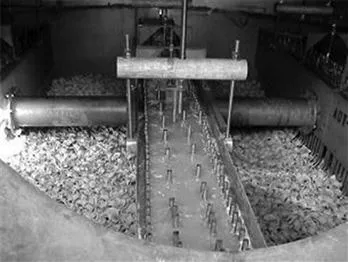
Figure 1.3 Top of H2SO4 making (“absorption”) tower, courtesy MECS (www.mecsglobal.com). The tower is packed with ceramic saddles. 98.5 mass% H2SO4(ℓ), 1.5 mass% H2O(ℓ) sulfuric acid is distributed uniformly across this packed bed. Distributor headers and “downcomer” pipes are shown. The acid flows through slots in the downcomers down across the bed (see buried downcomers at the right of the photograph). It descends around the saddles, while SO3-rich gas ascends, giving excellent gas-liquid contact. The result is efficient H2SO4(ℓ) production by Reaction (1.2). A tower is ~ 7 m diameter. Its packed bed is ~ 4 m deep. About 25 m3 of acid descends per minute, while 3000 Nm3 of gas ascends per minute.
Reaction (1.2) produces strengthened sulfuric acid because it consumes H2O(ℓ) and makes H2SO4(ℓ)....
Table of contents
Cover image
Title page
Table of Contents
Copyright
Preface
1. Overview
2. Production and consumption
3. Sulfur burning
4. Metallurgical offgas cooling and cleaning
5. Regeneration of spent sulfuric acid
6. Dehydrating air and gases with strong sulfuric acid
7. Catalytic oxidation of SO2 to SO3
8. SO2 oxidation catalyst and catalyst beds
9. Production of H2SO4(ℓ) from SO3(g)
Break
10. Oxidation of SO2 to SO3—Equilibrium curves
11. SO2 oxidation heatup paths
12. Maximum SO2 oxidation: Heatup path-equilibrium curve intercepts
13. Cooling first catalyst bed exit gas
14. Second catalyst bed heatup path
15. Maximum SO2 oxidation in a second catalyst bed
16. Third catalyst bed SO2 oxidation
17. SO3 and CO2 in feed gas
18. Three catalyst bed acid plant
19. After-H2SO4-making SO2 oxidation
20. Optimum double contact acidmaking
21. Enthalpies and enthalpy transfers
22. Control of gas temperature by bypassing
23. H2SO4 making
24. Acid temperature control and heat recovery
25. Making sulfuric acid from wet feed gas
26. Wet sulfuric acid process fundamentals
27. SO3 gas recycle for high SO2 concentration gas treatment
28. Sulfur from tail gas removal processes
29. Minimizing sulfur emissions
30. Materials of construction
31. Costs of sulfuric acid production
Appendix A. Sulfuric acid properties
Appendix B. Derivation of equilibrium equation (10.12)
Appendix C. Free energy equations for equilibrium curve calculations
Appendix D. Preparation of Fig. 10.2’s equilibrium curve
Appendix E. Proof that volume%=mol% (for ideal gases)
Appendix F. Effect of CO2 and Ar on equilibrium equations (none)
Appendix G. Enthalpy equations for heatup path calculations
Appendix H. Matrix solving using Tables 11.2 and 14.2 as examples
Appendix I. Enthalpy equations in heatup path matrix cells
Appendix J. Heatup path-equilibrium curve: Intercept calculations
Appendix K. Second catalyst bed heatup path calculations
Appendix L. Equilibrium equation for multicatalyst bed SO2 oxidation
Appendix M. Second catalyst bed intercept calculations
Appendix N. Third catalyst bed heatup path worksheet
Appendix O. Third catalyst bed intercept worksheet
Appendix P. Effect of SO3 in Fig. 10.1’s feed gas on equilibrium equations
Appendix Q. SO3-in-feed-gas intercept worksheet
Appendix R. CO2- and SO3-in-feed-gas intercept worksheet
Appendix S. Three-catalyst-bed “converter” calculations
Appendix T. Worksheet for calculating after-intermediate-H2SO4-making heatup path-equilibrium curve intercepts
Appendix U. After-H2SO4-making SO2 oxidation with SO3 and CO2 in input gas
Appendix V. Moist air in H2SO4 making calculations
Appendix W. Calculation of H2SO4 making tower mass flows
Appendix X. Equilibrium equations for SO2, O2, H2O(g), N2 feed gas
Appendix Y. Cooled first catalyst bed exit gas recycle calculations
Answers to numerical problems
Index
Trusted by 375,005 students
Access to over 1.5 million titles for a fair monthly price.
Study more efficiently using our study tools.
Frequently asked questions
Yes, you can cancel anytime from the Subscription tab in your account settings on the Perlego website. Your subscription will stay active until the end of your current billing period. Learn how to cancel your subscription
No, books cannot be downloaded as external files, such as PDFs, for use outside of Perlego. However, you can download books within the Perlego app for offline reading on mobile or tablet. Learn how to download books offline
Perlego offers two plans: Essential and Complete
Essential is ideal for learners and professionals who enjoy exploring a wide range of subjects. Access the Essential Library with 800,000+ trusted titles and best-sellers across business, personal growth, and the humanities. Includes unlimited reading time and Standard Read Aloud voice.
Complete: Perfect for advanced learners and researchers needing full, unrestricted access. Unlock 1.5M+ books across hundreds of subjects, including academic and specialized titles. The Complete Plan also includes advanced features like Premium Read Aloud and Research Assistant.
Both plans are available with monthly, semester, or annual billing cycles.
We are an online textbook subscription service, where you can get access to an entire online library for less than the price of a single book per month. With over 1.5 million books across 990+ topics, we’ve got you covered! Learn about our mission
Look out for the read-aloud symbol on your next book to see if you can listen to it. The read-aloud tool reads text aloud for you, highlighting the text as it is being read. You can pause it, speed it up and slow it down. Learn more about Read Aloud
Yes! You can use the Perlego app on both iOS and Android devices to read anytime, anywhere — even offline. Perfect for commutes or when you’re on the go. Please note we cannot support devices running on iOS 13 and Android 7 or earlier. Learn more about using the app
Yes, you can access Sulfuric Acid Manufacture by Matt King,Michael Moats,William G. Davenport in PDF and/or ePUB format, as well as other popular books in Physical Sciences & Inorganic Chemistry. We have over 1.5 million books available in our catalogue for you to explore.