- 350 pages
- English
- ePUB (mobile friendly)
- Available on iOS & Android
eBook - ePub
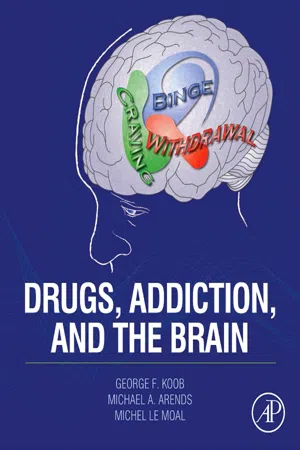
Drugs, Addiction, and the Brain
About this book
Drugs, Addiction, and the Brain explores the molecular, cellular, and neurocircuitry systems in the brain that are responsible for drug addiction. Common neurobiological elements are emphasized that provide novel insights into how the brain mediates the acute rewarding effects of drugs of abuse and how it changes during the transition from initial drug use to compulsive drug use and addiction. The book provides a detailed overview of the pathophysiology of the disease. The information provided will be useful for neuroscientists in the field of addiction, drug abuse treatment providers, and undergraduate and postgraduate students who are interested in learning the diverse effects of drugs of abuse on the brain.
- Full-color circuitry diagrams of brain regions implicated in each stage of the addiction cycle
- Actual data figures from original sources illustrating key concepts and findings
- Introduction to basic neuropharmacology terms and concepts
- Introduction to numerous animal models used to study diverse aspects of drug use.
- Thorough review of extant work on the neurobiology of addiction
Information
Topic
MedicineSubtopic
Psychiatry & Mental HealthChapter 1
What is Addiction?
Abstract
This chapter defines addiction as a chronic relapsing disorder characterized by compulsive drug seeking, a loss of control in limiting intake, and emergence of a negative emotional state when access to the drug is prevented. The definition of addiction is derived from the evolution of the concept of dependence and the nosology of addiction diagnosis. A distinction is made between drug use and substance use disorders (formerly abuse and dependence). Addiction affects a large percentage of society and has enormous monetary costs. Addiction evolves over time, moving from impulsivity to compulsivity and ultimately being composed of three stages: preoccupation/anticipation, binge/intoxication, and withdrawal/negative affect. Motivational, psychodynamic, social psychological, and vulnerability factors all contribute to the etiology of addiction, but this book focuses on the neuroadaptational changes that occur during the addiction cycle. A theoretical framework is described that derives from early homeostatic theories and subsequent opponent process theories to provide a framework for understanding the neurobiology of addiction. This framework is followed in each chapter for each major drug class.
Keywords
addiction; chronic relapsing disorder; drug; preoccupation; anticipation; binge; intoxication; withdrawal; negative affectDefinitions of Addiction
Drug Use, Drug Abuse, and Drug Addiction
Drug addiction, formerly known as substance dependence (American Psychiatric Association, 1994), is a chronically relapsing disorder that is characterized by:
1) A compulsion to seek and take a drug,
2) Loss of control in limiting intake, and
3) Emergence of a negative emotional state (e.g., dysphoria, anxiety, irritability) when access to the drug is prevented.
The occasional but limited use of an abusable drug is clinically distinct from escalated drug use, the loss of control over limiting drug intake, and the emergence of chronic compulsive drug seeking that characterize addiction. Historically, three types of drug use have been delineated:
1) Occasional, controlled, or social use,
2) Drug abuse or harmful use, and
3) Drug addiction as characterized as either Substance Dependence (Diagnostic and Statistical Manual of Mental Disorders, 4th edition [DSM-IV]) or Dependence (see below, and Tables 1.1 and 1.2).
More current descriptions have elaborated a continuum of behavioral pathology, from drug use to addiction, in the context of substance use disorders.
TABLE 1.1
DSM-5, DSM-IV, and ICD-10 Diagnostic Criteria for Abuse and Dependence
| DSM-5 | DSM-IV | ICD-10 |
| DEPENDENCE | ||
| A problematic pattern of substance use leading to clinically significant impairment or distress, as manifested by at least two of the following occurring within a 12 month period 1. Tolerance is defined by either of the following: a) a need for markedly increased amounts of substance to achieve intoxication or desired effect b) a markedly diminished effect with continued use of the same amount of substance. 2. Withdrawal is manifested by either of the following: a) the characteristic withdrawal syndrome for substance or b) substance is taken to relieve or avoid withdrawal symptoms. 3. There is persistent desire or unsuccessful efforts to cut down or control substance use. 4. Substance is often taken in larger amounts or over a longer period than was intended. 5. Important social, occupational, or recreational activities are given up or reduced because of substance use. 6. A great deal of time is spent in activities necessary to obtain substance, use substance, or recover from its effects. 7. Continued substance use despite having persistent or recurrent social or interpersonal problems caused or exacerbated by the effects of substance. None | A maladaptive pattern of substance use, leading to clinically significant impairment or distress as manifested by three or more of the following occurring at any time in the same 12-month period 1. Need for markedly increased amounts of a substance to achieve intoxication or desired effect; or markedly diminished effect with continued use of the same amount of the substance. 2. The characteristic withdrawal syndrome for a substance or use of a substance (or a closely related substance) to relieve or avoid withdrawal symptoms. 3. Persistent desire or one or more unsuccessful efforts to cut down or control substance use. 4. Substance used in larger amounts or over a longer period than the person intended. 5. Important social, occupational, or recreational activities given up or reduced because of substance use. 6. A great deal of time spent in activities necessary to obtain, to use, or to recover from the effects of substance used. 7. Continued substance use despite knowledge of having a persistent or recurrent physical or psychological problem that is likely to be caused or exacerbated by use. None | Three or more of the following have been experienced or exhibited at some time during the previous year 1. Evidence of tolerance, such that increased doses are required in order to achieve effects originally produced by lower doses. 2. A physiological withdrawal state when substance use has ceased or been reduced as evidenced by: the characteristic substance withdrawal syndrome, or use of substance (or a closely related substance) to relieve or avoid withdrawal symptoms. 3. Difficulties in controlling substance use in terms of onset, termination, or levels of use. None4. Progressive neglect of alternative pleasures or interests in favor of substance use; or A great deal of time spent in activities necessary to obtain, to use, or to recover from the effects of substance use. 5. Continued substance use despite clear evidence of overtly harmful physical or psychological consequences. 6. A strong desire or sense of compulsion to use substance. |
| Table Continued | ||

| DSM-5 | DSM-IV | ICD-10 |
| ABUSE | ||
8. Substance use is continued despite knowledge of having a persistent or recurrent physical or psychological problem that is likely to have been caused or exacerbated by substance 9. Recurrent use in situations in which it is physically hazardous None10. Recurrent substance use resulting in a failure to fulfill major role obligations at work, school or home 11. Craving or a strong desire or urge to use alcohol (or other substance) | A maladaptive pattern of substance use leading to clinically significant impairment or distress, as manifested by one (or more) of the following occurring with a 12 month period 1. Recurrent substance use resulting in a failure to fulfill major role o... | |
Table of contents
- Cover image
- Title page
- Table of Contents
- Copyright
- Preface
- Chapter 1. What is Addiction?
- Chapter 2. Introduction to the Neuropsychopharmacology of Drug Addiction
- Chapter 3. Animal Models of Addiction
- Chapter 4. Psychostimulants
- Chapter 5. Opioids
- Chapter 6. Alcohol
- Chapter 7. Nicotine
- Chapter 8. Cannabinoids
- Chapter 9. Medications for the Treatment of Addiction – A Neurobiological Perspective
- Index
- Sync with Jellybooks
Trusted by 375,005 students
Access to over 1.5 million titles for a fair monthly price.
Study more efficiently using our study tools.
Frequently asked questions
Yes, you can cancel anytime from the Subscription tab in your account settings on the Perlego website. Your subscription will stay active until the end of your current billing period. Learn how to cancel your subscription
No, books cannot be downloaded as external files, such as PDFs, for use outside of Perlego. However, you can download books within the Perlego app for offline reading on mobile or tablet. Learn how to download books offline
Perlego offers two plans: Essential and Complete
- Essential is ideal for learners and professionals who enjoy exploring a wide range of subjects. Access the Essential Library with 800,000+ trusted titles and best-sellers across business, personal growth, and the humanities. Includes unlimited reading time and Standard Read Aloud voice.
- Complete: Perfect for advanced learners and researchers needing full, unrestricted access. Unlock 1.5M+ books across hundreds of subjects, including academic and specialized titles. The Complete Plan also includes advanced features like Premium Read Aloud and Research Assistant.
We are an online textbook subscription service, where you can get access to an entire online library for less than the price of a single book per month. With over 1.5 million books across 990+ topics, we’ve got you covered! Learn about our mission
Look out for the read-aloud symbol on your next book to see if you can listen to it. The read-aloud tool reads text aloud for you, highlighting the text as it is being read. You can pause it, speed it up and slow it down. Learn more about Read Aloud
Yes! You can use the Perlego app on both iOS and Android devices to read anytime, anywhere — even offline. Perfect for commutes or when you’re on the go.
Please note we cannot support devices running on iOS 13 and Android 7 or earlier. Learn more about using the app
Please note we cannot support devices running on iOS 13 and Android 7 or earlier. Learn more about using the app
Yes, you can access Drugs, Addiction, and the Brain by George F. Koob,Michael A. Arends,Michel Le Moal in PDF and/or ePUB format, as well as other popular books in Medicine & Psychiatry & Mental Health. We have over 1.5 million books available in our catalogue for you to explore.