- 496 pages
- English
- ePUB (mobile friendly)
- Available on iOS & Android
eBook - ePub
About this book
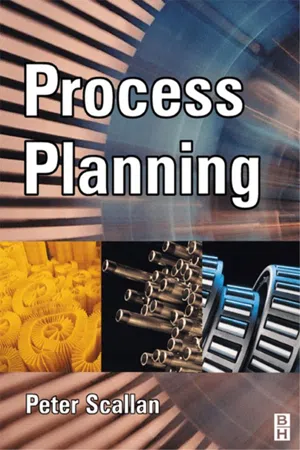
Process Planning covers the selection of processes, equipment, tooling and the sequencing of operations required to transform a chosen raw material into a finished product. Initial chapters review materials and processes for manufacturing and are followed by chapters detailing the core activities involved in process planning, from drawing interpretation to preparing the final process plan. The concept of maximising or 'adding value' runs throughout the book and is supported with activities.Designed as a teaching and learning resource, each chapter begins with learning objectives, explores the theory behind process planning, and sets it in a 'real-life' context through the use of case studies and examples. Furthermore, the questions in the book develop the problem-solving skills of the reader.ISO standards are used throughout the book (these are cross-referenced to corresponding British standards).This is a core textbook, aimed at undergraduate students of manufacturing engineering, mechanical engineering with manufacturing options and materials science.
- Features numerous case studies and examples from industry to help provide an easy guide to a complex subject
- Fills a gap in the market for which there are currently no suitable texts
- Learning aims and objectives are provided at the beginning of each chapter - a user-friendly method to consolidate learning
Information
1
Introduction to manufacturing
1.1 Introduction
The prosperity of human kind has been inextricably linked with the ability to use and work with the available materials and tools throughout history. Indeed, there is archaeological evidence of man’s toolmaking ability dating as far back as 2–3 million years (Mair, 1993). However, the basis for manufacturing as we know it today can be traced as far back as 5000–4000 BC, with the manufacture of artefacts from materials such as wood, stone, metal and ceramics (Kalpakjian, 1995). The modern manufacturing organization, based on the factory system and the division of labour, was borne of the Industrial Revolution of the eighteenth century. The roots of modern manufacturing processes can also be traced to the late eighteenth century with the development of the cotton gin by Eli Whitney in the United States (Amstead et al., 1987) and the first all metal lathe by Henry Maudsley in the United Kingdom in 1794 (DeGarmo et al., 1988). The development of manufacturing processes continued in the early part of the nineteenth century with the introduction of a loom automatically controlled by punched cards in France in 1804, the development of the milling machine by Whitney and the use of mass manufacturing techniques by Marc Isambard Brunel in 1803 in the United Kingdom (Mair, 1993).
The development of manufacturing industries to this day still relies heavily on research into manufacturing processes and materials and the development of new products. Those countries that have been at the forefront of the development of manufacturing have come to be known as the developed countries, while those that have very little manufacturing are considered underdeveloped (el Wakil, 1989). This ability to manufacture products has a huge bearing on the wealth and prosperity of a country. In theory, the greater the ability of a country to manufacture, the wealthier that country should be (how this is achieved is discussed later in this chapter). Prime examples of this type of country are the United Kingdom and the United States. For example, in the United Kingdom, manufacturing still makes a significant contribution to the wealth and prosperity of the nation, despite the decline of manufacturing in the 1980s. A recent government report estimated that there are 4.3 million people directly involved in manufacturing and account for 20 per cent of the Gross Domestic Profit or GDP (DTI, 1999). Similarly, figures for the United States estimate that approximately 17.8 million people are employed in manufacturing (van Ark and Monnikhof, 1996) and again account for around 20 per cent of GDP (BEA, 1998). However, for the likes of the United Kingdom and the United States to remain competitive in the global market, the resources employed in manufacturing must be used in the most cost effective manner. This means that the manufacturing of the products must be planned to make best use of these resources, which is the very essence of process planning.
1.2 Aims and objectives
The aims of this chapter are to define manufacturing and present the main types of manufacturing systems employed and their operational characteristics.
On completion of this chapter, you should be able to:
• define the manufacturing activity;
• state the main goals of a manufacturing organization;
• define the Principle of Added Value;
• define a manufacturing system;
• identify and describe the common manufacturing systems and their operational characteristics;
• identify and describe the main processing strategies and relate them to the common manufacturing systems;
• identify and describe the main roles and responsibilities of a manufacturing engineer.
1.3 What is manufacturing?
In the introduction to this chapter the importance of manufacturing to the wealth and prosperity of a country was explained. However, before proceeding, the question ‘What is manufacturing?’ has to be answered.
Although the basis of manufacturing can be traced back as far as 5000–4000 BC, the word manufacture did not appear until 1567, with manufacturing appearing over 100 years later in 1683 (Kalpakjian, 1995). The word was derived from the Latin words manus (meaning ‘hand’) and facere (meaning ‘to make’). In Late Latin, these were combined to form the word manufactus meaning ‘made by hand’ or ‘hand-made’. Indeed, the word factory was derived from the now obsolete word manufactory. In its broadest and most general sense, manufacturing is defined as (DeGarmo et al., 1988):
the conversion of stuff into things.
However, in more concise terms, it is defined in the Collins English Dictionary (1998) as:
processing or making (a product) from raw materials, especially as a large scale operation using machinery.
In a modern context, this definition can be expanded further to:
the making of products from raw materials using various processes, equipment, operations and manpower according to a detailed plan.
During processing, the raw material undergoes changes to allow it to become a part of a product or products. Once processed, it should have worth in the market or a value. Therefore, manufacturing is ‘adding value’ to the material. The value added to the material through processing must be greater than the cost of processing to...
Table of contents
- Cover image
- Title page
- Table of Contents
- Copyright
- Preface
- Acknowledgements
- Chapter 1: Introduction to manufacturing
- Chapter 2: What is process planning?
- Chapter 3: Drawing interpretation
- Chapter 4: Material evaluation and process selection
- Chapter 5: Production equipment and tooling selection
- Chapter 6: Process parameters
- Chapter 7: Workholding devices
- Chapter 8: Selection of quality assurance methods
- Chapter 9: Economics of process planning
- Chapter 10: From design to manufacture
- Control chart factors for variables
- Blank control charts
- Blank process planning documents
- Index
Trusted by 375,005 students
Access to over 1.5 million titles for a fair monthly price.
Study more efficiently using our study tools.
Frequently asked questions
Yes, you can cancel anytime from the Subscription tab in your account settings on the Perlego website. Your subscription will stay active until the end of your current billing period. Learn how to cancel your subscription
No, books cannot be downloaded as external files, such as PDFs, for use outside of Perlego. However, you can download books within the Perlego app for offline reading on mobile or tablet. Learn how to download books offline
Perlego offers two plans: Essential and Complete
- Essential is ideal for learners and professionals who enjoy exploring a wide range of subjects. Access the Essential Library with 800,000+ trusted titles and best-sellers across business, personal growth, and the humanities. Includes unlimited reading time and Standard Read Aloud voice.
- Complete: Perfect for advanced learners and researchers needing full, unrestricted access. Unlock 1.5M+ books across hundreds of subjects, including academic and specialized titles. The Complete Plan also includes advanced features like Premium Read Aloud and Research Assistant.
We are an online textbook subscription service, where you can get access to an entire online library for less than the price of a single book per month. With over 1.5 million books across 990+ topics, we’ve got you covered! Learn about our mission
Look out for the read-aloud symbol on your next book to see if you can listen to it. The read-aloud tool reads text aloud for you, highlighting the text as it is being read. You can pause it, speed it up and slow it down. Learn more about Read Aloud
Yes! You can use the Perlego app on both iOS and Android devices to read anytime, anywhere — even offline. Perfect for commutes or when you’re on the go.
Please note we cannot support devices running on iOS 13 and Android 7 or earlier. Learn more about using the app
Please note we cannot support devices running on iOS 13 and Android 7 or earlier. Learn more about using the app
Yes, you can access Process Planning by Peter Scallan in PDF and/or ePUB format, as well as other popular books in Business & Operations. We have over 1.5 million books available in our catalogue for you to explore.