- 368 pages
- English
- ePUB (mobile friendly)
- Available on iOS & Android
eBook - ePub
About this book
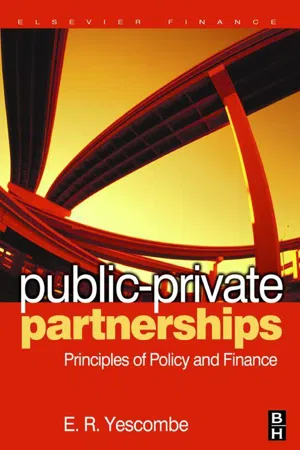
Over the last decade or so, private-sector financing through public-private partnerships (PPPs) has become increasingly popular around the world as a way of procuring and maintaining public-sector infrastructure, in sectors such as transportation (roads, bridges, tunnels, railways, ports, airports), social infrastructure (hospitals, schools, prisons, social housing) public utilities (water supply, waste water treatment, waste disposal), government offices and other accommodation, and other specialised services (communications networks or defence equipment). This book, based on the author's practical experience on the public- and private-sector sides of the table, reviews the key policy issues which arise for the public sector in considering whether to adopt the PPP procurement route, and the specific application of this policy approach in PPP contracts, comparing international practices in this respect. It offers a systematic and integrated approach to financing PPPs within this public-policy framework, and explains the project-finance techniques used for this purpose. The book deals with both the Concession and PFI models of PPP, and provides a structured introduction for those who are new to the subject, whether in the academic, public-sector, investment, finance or contracting fields, as well as an aide memoire for those developing PPP policies or negotiating PPPs. The author focuses on practical concepts, issues and techniques, and does not assume any prior knowledge of PPP policy issues or financing techniques. The book describes and explains:* The different types of PPPs and how these have developed* Why PPPs are attractive to governments* General policy issues for the public sector in developing a PPP programme* PPP procurement procedures and bid evaluation* The use of project-finance techniques for PPPs* Sources of funding* Typical PPP contracts and sub-contracts, and their relationship with the project's financial structure * Risk assessment from the points of view of the public sector, investors, lenders and other project parties* Structuring the investment and debt financing* The key issues in negotiating a project-finance debt facility. In addition the book includes an extensive glossary, as well as cross-referencing.
- Reviews the PPP policy framework and development from an international perspective
- Covers public- and private-sector financial analysis, structuring and investment in PPPs
- No prior knowledge of project financing required
Information
Chapter 1
What are Public–private Partnerships?
§1.1 Introduction
This chapter examines the reasons for private involvement in public infrastructure (§1.2), defines what is meant by a PPP (§1.3), and traces their historical development and current structures (§1.4). The place of PPPs in provision of public infrastructure is considered (§1.5), and the main types of PPP are summarised (§1.6).
§1.2 Public Infrastructure and the Private Sector
Public infrastructure can be defined as facilities which are necessary for the functioning of the economy and society. These are thus not an end in themselves, but a means of supporting a nation’s economic and social activity, and include facilities which are ancillary to these functions, such as public-sector offices or accommodation. Broadly speaking, public infrastructure can be divided into:
• ‘economic’ infrastructure, such as transportation facilities and utility networks (for water, sewage, electricity, etc.), i.e. infrastructure considered essential for day-to-day economic activity; and
• ‘social’ infrastructure such as schools, hospitals, libraries, prisons, etc., i.e. infrastructure considered essential for the structure of society.
A distinction can also be made between ‘hard’ infrastructure, whether economic or social, primarily involving provision of buildings or other physical facilities, and ‘soft’ infrastructure, involving the provision of services, either for economic infrastructure (e.g. street cleaning), or for social infrastructure (e.g. education and training, social services).
There is probably universal agreement that the state has to play a rôle in the provision of public infrastructure, on the grounds that:
• The private sector cannot take account of ‘externalities’—i.e. general economic and social benefits—and therefore public-sector intervention is required (cf. §5.2.1).
• Without such intervention infrastructure which has to be freely available to all (‘public goods’) will not be built, especially where this involves networks, such as roads, or services, such as street lighting.
• Competitive provision of infrastructure may not be efficient, and a monopoly provision requires some form of public control.
• Even where competition is possible, the public sector should still provide ‘merit goods’, i.e. those that would otherwise be underprovided (such as schools, as the rich could pay for private schools but the poor would get no education).
• Infrastructure requires a high initial investment on which only a very long-term return can be expected. It may be difficult to raise private capital for this investment without some public-sector support.
It could thus be argued that infrastructure should be provided by the public sector where competitive market pricing would distort behaviour or lead to loss of socio-economic benefits. But history suggests that there are two ways for the state to do this—either by direct provision, or by facilitation of private-sector provision (whether through regulation, tax subsidy or similar incentives, or by contract). As discussed below, the use of private capital to fund economic infrastructure (e.g. for transportation) is of long standing. Equally, it was generally only during the 19th and 20th centuries that the state took over responsibility, mainly from religious or private charity, for the provision of much social infrastructure (e.g. for schools and hospitals). Indeed it may be said that private provision of a large proportion of public infrastructure was the historical norm until recently, but the definition of ‘necessary’ public infrastructure has clearly widened over the last couple of centuries. PPPs may therefore be considered a modern way of facilitating private provision to help meet an increased demand for public infrastructure.
§1.3 Public–Private Partnerships
§1.3.1 Meaning
The term ‘public–private partnership’ appears to have originated in the United States, initially relating to joint public- and private-sector funding for educational programmes, and then in the 1950s to refer to similar funding for utilities (cf. §17.6.2), but came into wider use in the 1960s to refer to public–private joint ventures for urban renewal. It is also used in the United States to refer to publicly-funded provision of social services by non public-sector bodies, often from the voluntary (not-for-profit) sector, as well as public funding of private-sector research and development in fields such as technology. In the international-development field the term is used when referring to joint government, aid agency and private-sector initiatives to combat diseases such as AIDS and malaria, introduce improvements in farming methods, or promote economic development generally. Most of these can be described as ‘policy-based’ or ‘programme-based’ PPPs.
However the subject of this book is what may be called ‘project-based’ or ‘contract-based’ PPPs, a more recent development. (Although some urban-renewal PPPs are also project-specific, they do not involve the same long-term relationship.) PPPs as defined here have the following key elements:
• a long-term contract (a ‘PPP Contract’) between a public-sector party and a private-sector party;
• for the design, construction, financing, and operation of public infrastructure (the ‘Facility’) by the private-sector party;
• with payments over the life of the PPP Contract to the private-sector party for the use of the Facility, made either by the public-sector party or by the general public as users of the Facility; and
• with the Facility remaining in public-sector ownership, or reverting to public-sector ownership at the end of the PPP Contract.
In some cases, a PPP Contract may involve major upgrading of existing infrastructure rather than a ‘greenfield’ construction. However private-sector acquisition or management of existing public infrastructure without any major new capital investment or upgrading is not considered to be a PPP as defined here. Similarly private-sector provision of soft infrastructure, which involves no significant investment in fixed assets (and hence no need for private-sector financing), falls into the category of ‘outsourcing’ rather than PPPs, although obviously the boundary is not precise as soft services are often associated with hard infrastructure (cf. §13.2). Nor is a PPP a simple joint-venture investment between the public and private sectors, unless this is also linked to a PPP Contract (cf. §17.5). Also this book does not deal in detail with smaller PPPs, usually at a municipal level, in sectors such as parking garages; this smaller end of the market follows the same general principles, but is obviously less elaborate in contract form and financing (cf. §8.5.3).
The public-sector party to a PPP Contract (the ‘Public Authority’—also known by a variety of other terms such as the ‘Public Entity’, ‘Public Party’, ‘Government Procuring Entity’, ‘Institution’, ‘Contracting Authority’ or just the ‘Authority’) may be a central-government department, a state or regional government, a local (municipal) authority, a public agency or any other entity which is public-sector controlled. The private-sector party is normally a special-purpose company (the ‘Project Company’—also known as the ‘Private Party’), created by private-sector investors specifically to undertake the PPP Contract. It should be noted that the relationship between these two parties is not a partnership in the legal sense, but is contractual, being based on the terms of the PPP Contract. ‘Partnership’ is largely a political slogan in this context (but cf. §6.6).
§1.3.2 PPP v. Public-Sector Procurement
A PPP is thus an alternative to procurement of the Facility by the public sector (‘public-sector procurement’), using funding from tax revenues or public borrowing. In a typical public-sector procurement (known as ‘design-bid-build’), the Public Authority sets out the specifications and design of the Facility, calls for bids on the basis of this detailed design, and pays for construction of the Facility by a private-sector contractor. The Public Authority has to fund the full cost of construction, including any cost overruns. Operation and maintenance of the Facility are entirely handled by the Public Authority, and the contractor takes no responsibility for the long-term performance of the Facility after the (relatively short) construction-warranty period has expired.
In a PPP, on the other hand, the Public Authority specifies its requirements in terms of ‘outputs’, which set out the public services which the Facility is intended to provide, but which do not specify how these are to be provided. It is then left to the private sector to design, finance, build and operate the Facility to meet these long-term output specifications. The Project Company receives payments (‘Service Fees’) over the life of the PPP Contract (perhaps 25 years on average) on a pre-agreed basis, which are intended to repay the financing costs and give a return to investors. The Service Fees are subject to deductions for failure to meet output specifications, and there is generally no extra allowance for cost overruns which occur during construction or in operation of the Facility.
The result of this PPP a...
Table of contents
- Cover image
- Title page
- Table of Contents
- List of figures
- List of tables
- Introduction
- Chapter 1. What are Public–private Partnerships?
- Chapter 2. PPPs—For and Against
- Chapter 3. PPPs Worldwide
- Chapter 4. Cash Flow and Investment Analysis
- Chapter 5. The Public-Sector Investment Decision
- Chapter 6. Public-Sector Procurement and Contract Management
- Chapter 7. The Private-Sector Investor’s Perspective
- Chapter 8. Project Finance and PPPs
- Chapter 9. Private-Sector Financing— Sources and Procedures
- Chapter 10. Financial Structuring
- Chapter 11. Financial Hedging
- Chapter 12. Lenders’ Cash-Flow Controls, Security and Enforcement
- Chapter 13. Service-Fee Mechanism
- Chapter 14. Risk Evaluation and Transfer
- Chapter 15. Changes in circumstances and termination
- Chapter 16. Funding Competition, Debt Refinancing and Equity Sale
- Chapter 17. Alternative models
- Bibliography
- Glossary and Abbreviations
Trusted by 375,005 students
Access to over 1.5 million titles for a fair monthly price.
Study more efficiently using our study tools.
Frequently asked questions
Yes, you can cancel anytime from the Subscription tab in your account settings on the Perlego website. Your subscription will stay active until the end of your current billing period. Learn how to cancel your subscription
No, books cannot be downloaded as external files, such as PDFs, for use outside of Perlego. However, you can download books within the Perlego app for offline reading on mobile or tablet. Learn how to download books offline
Perlego offers two plans: Essential and Complete
- Essential is ideal for learners and professionals who enjoy exploring a wide range of subjects. Access the Essential Library with 800,000+ trusted titles and best-sellers across business, personal growth, and the humanities. Includes unlimited reading time and Standard Read Aloud voice.
- Complete: Perfect for advanced learners and researchers needing full, unrestricted access. Unlock 1.5M+ books across hundreds of subjects, including academic and specialized titles. The Complete Plan also includes advanced features like Premium Read Aloud and Research Assistant.
We are an online textbook subscription service, where you can get access to an entire online library for less than the price of a single book per month. With over 1.5 million books across 990+ topics, we’ve got you covered! Learn about our mission
Look out for the read-aloud symbol on your next book to see if you can listen to it. The read-aloud tool reads text aloud for you, highlighting the text as it is being read. You can pause it, speed it up and slow it down. Learn more about Read Aloud
Yes! You can use the Perlego app on both iOS and Android devices to read anytime, anywhere — even offline. Perfect for commutes or when you’re on the go.
Please note we cannot support devices running on iOS 13 and Android 7 or earlier. Learn more about using the app
Please note we cannot support devices running on iOS 13 and Android 7 or earlier. Learn more about using the app
Yes, you can access Public-Private Partnerships by E. R. Yescombe in PDF and/or ePUB format, as well as other popular books in Economics & Banks & Banking. We have over 1.5 million books available in our catalogue for you to explore.