
eBook - ePub
Alternative Energy Systems
Electrical Integration and Utilisation
- 300 pages
- English
- ePUB (mobile friendly)
- Available on iOS & Android
eBook - ePub
Alternative Energy Systems
Electrical Integration and Utilisation
About this book
Alternative Energy Systems: Electrical Integration and Utilisation covers the proceedings of the conference held at the Coventry (Lanchester) Polytechnic Coventry, England from 10th to 12th of September 1984. The book presents 24 papers that tackle alternative energy systems and their electrical integration and utilization. The text covers different alternative energy sources, such as hydro, solar, wind, wave, and waste materials. The book discusses the practical, technical, and economic aspects of alternatives energy systems and their electrical integration and utilization. The book will be of great use to individuals who are interested in the application of alternative energy systems.
Information
Energy from Low Head Water Sources
A.M. Peatfield, L.J. Duckers, F.P. Lockett, B.W. Loughridge, P.R.S. White and M.J. West, Coventry (Lanchester) Polytechnic, Coventry, England
ABSTRACT
The high cost of electrical power from fossil fuels in the developed countries, the lack of indigenous fuels in the developing countries, the world wide abundance of hydro sites with potential capacities in the region of 10 kW and recent UK legislation ensuring reasonable ‘buy-back’ prices for surplus electricity from private generation, has led to a resurgence of interest in micro hydro sites. The Authors describe a modular low head hydro device capable of efficient electrical power generation from available resource heads of as little as 1 metre. The device consists of a chamber which, by use of suitable valve action on the water flow, acts as a water-to-air gearbox and results in air being alternately drawn into and expelled from the chamber. A Wells turbine located in the air ducting is directly coupled to an electrical generator, the type of which depends on user requirements. An analysis of a unit utilising a 10 kW resource with a head of 1 m is presented, as are indications of how production costs may be minimised by using locally available skills and materials.
KEYWORDS
Low head
micro hydro
electrical power generation
Wells turbine
hydroelectric system
INTRODUCTION
The energy from fast flowing or falling water has been used for centuries to provide power for particular applications and more recently for the generation of electricity. Over the years of this century the abundance of cheap power available from oil or coal has caused many of the small dam and run-of-the-river sites to be abandoned as uneconomic or rejected in favour of larger centralised systems. However in recent years the escalating costs of electricity generation has brought about a resurgence of interest in the redevelopment of abandoned sites and the development of new sites.
REVIEW
Many of the developing countries with little indigenous supply of hydrocarbon fuel are unable to afford expensive imports and are rapidly exploring and developing their hydro-power potential. 40% of the electricity used by developing countries is produced by hydro-power. (Flood, 1983). While major multi-megawatt schemes would appear initially to be the most economically attractive, in many cases the huge capital costs and long lead times of the construction work, together with the lack of a suitable distribution system make impossible demands on the overstretched budgets of developing countries. Often, therefore, small schemes serving limited areas and requiring construction effort within the capability of local communities are the ones which stand most chance of success. China, for example, makes extensive use of small hydro, deriving more than 7 GW from nearly 100,000 micro hydro sites.
Even in developed western countries recent legislative policies of ensuring reasonable ‘buy-back’ prices for surplus electricity from private generation, sometimes combined with encouraging tax advantages, has brought the start of a tremendous new growth in the exploitation of small hydro power.
Salford, (1980), has surveyed 565 hydro-power sites in Wales each with potential capacities greater than 25 kW. Of these, 78 have heads of less than 3 m. The number of possible sites of less than 25 kW in Wales is therefore expected to be very large. Indeed if we consider the sites of old mills (typically producing 5 hp of mechanical power, about 4 kW), it is estimated that there were as many as 20,000 in England alone during the 18th century. Rainfall in England and Wales is typically 500–2000 mm per year. In Table 1, we have estimated the percentage of land area of each continent receiving various levels of rainfall and it is interesting to note that a considerable portion of land surface area is subjected to rainfalls in the range 500 – 2000 mm per year.
TABLE 1
World Rainfall
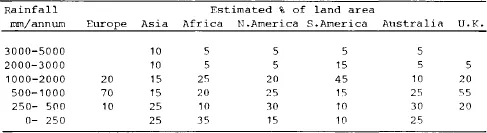
From an extrapolation of the U.K. situation, the World-wide potential for low head hydro power is likely to be vast, provided that the installations can be cost effective.
Turbine technology is well developed and many advances are being made in reducing the cost of construction and in the use of electronics to aid efficient and near automatic control of generation. However, even though in many cases the required construction works would be of a relatively simple nature, the development of the vast number of sites with available heads of less than about 3 metres is usually considered uneconomic and impractical due to the large size and slow rotational speeds of conventional water turbines operating under such small heads.
This paper outlines the design of a modular water-air system capable of operating efficiently with heads as low as 1 m. The characteristics of a typical operational cycle are evaluated and some possible electrical generation equipment and integration strategies are considered for a number of end use situations.
PRINCIPLE OF OPERATION
In its simplest form the system consists of an enclosed chamber into which the available water flow can be controlled by the operation of inlet and outlet valves in such a way that the effective driving pressures for both the filling and the emptying cycles can be a large proportion of the head available at the site chosen.
At the top of the enclosed chamber, above the maximum height of the upstream water level, is an inlet-outlet air duct leading through an air turbine to atmosphere (see Figure 1.). In low head operations the Wells turbine would be well suited to provide a power take-off unit with a high rotational speed suitable for electrical generation, with its ability to operate in reversing flow without the use of rectifying valves being a major advantage.
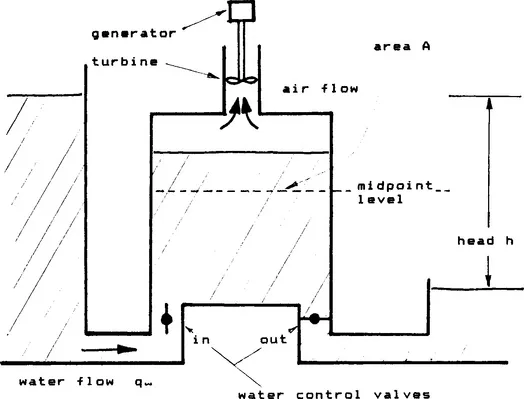
Fig. 1 Schematic diagram of chamber showing water in/air out phase
The operational cycle commences with the opening of the water inlet valve, allowing water into the empty chamber with the outlet valve closed, thus filling the chamber with water and driving the air out under pressure through the rotating Wells turbine. At a suitable point near the end of the filling cycle the inlet valve is closed and the outlet valve is then opened allowing exit of the water to the downstream side of the water retaining structure. This emptying process causes air to be sucked back into the chamber through the still rotating Wells turbine which is thus used to extract ...
Table of contents
- Cover image
- Title page
- Table of Contents
- Other Pergamon Titles of Interest
- Copyright
- Preface
- Sponsors
- Chapter 1: Energy from Low Head Water Sources
- Chapter 2: Tidal Stream Energy Systems for Isolated Communities
- Chapter 3: Grid-connected Kinetic Hydro Energy Conversion System
- Chapter 4: Optimum Positioning of a Solar Collector for Summer Applications in Baghdad
- Chapter 5: Novel Microwave Energy Converters for the Solar Power Satellite Programme
- Chapter 6: A Solar Experiment: Mississippi County Community College Blytheville, Arkansas
- Chapter 7: Current Progress in the Development of a Wind Diesel System for Autonomous Electricity Generation
- Chapter 8: An Electronic Controller to Maximise Efficiency of Battery Charging from a Wind Generator (Patent Pending)
- Chapter 9: The Availability of Offshore Alternative Energy Systems
- Chapter 10: The Application of Flywheels in Short-term Energy Storage
- Chapter 11: Practical Flywheel Energy Storage
- Chapter 12: Wood Residues as Fuel in Pulp Paper Manufacturing Industries in Nigeria
- Chapter 13: Electrical Power Generation from Refuse
- Chapter 14: The Economic Analysis of Wave Energy
- Chapter 15: Electrical Considerations with Wave Powered Navigation Aids
- Chapter 16: An Experimental Investigation of BD101 Type Wave-activated Wells Turbine Generator for Lighted Buoys
- Chapter 17: Study of Utilization and Management of Power Generated by a Pneumatic Wave Energy Conversion System
- Chapter 18: Electronics in Extreme Environments
- Chapter 19: Power Take-off and Output from the Sea-Lanchester Clam Wave Energy Device
- Chapter 20: A Power Smoothing Scheme for the Sea Clam Wave Energy Converter
- Chapter 21: Addition of Power from Parallel Alternators Operating at Different Varying Speeds and Power Levels
- Chapter 22: Floating Wave Driven Wind Turbines and Island Supplies
- Chapter 23: Dynamic Simulation of Alternative Island Power Supply
- Chapter 24: Harmonic Analyses of Wound Rotor and Inverter Systems
- Author Index
- Subject Index
Trusted by 375,005 students
Access to over 1.5 million titles for a fair monthly price.
Study more efficiently using our study tools.
Frequently asked questions
Yes, you can cancel anytime from the Subscription tab in your account settings on the Perlego website. Your subscription will stay active until the end of your current billing period. Learn how to cancel your subscription
No, books cannot be downloaded as external files, such as PDFs, for use outside of Perlego. However, you can download books within the Perlego app for offline reading on mobile or tablet. Learn how to download books offline
Perlego offers two plans: Essential and Complete
- Essential is ideal for learners and professionals who enjoy exploring a wide range of subjects. Access the Essential Library with 800,000+ trusted titles and best-sellers across business, personal growth, and the humanities. Includes unlimited reading time and Standard Read Aloud voice.
- Complete: Perfect for advanced learners and researchers needing full, unrestricted access. Unlock 1.5M+ books across hundreds of subjects, including academic and specialized titles. The Complete Plan also includes advanced features like Premium Read Aloud and Research Assistant.
We are an online textbook subscription service, where you can get access to an entire online library for less than the price of a single book per month. With over 1.5 million books across 990+ topics, we’ve got you covered! Learn about our mission
Look out for the read-aloud symbol on your next book to see if you can listen to it. The read-aloud tool reads text aloud for you, highlighting the text as it is being read. You can pause it, speed it up and slow it down. Learn more about Read Aloud
Yes! You can use the Perlego app on both iOS and Android devices to read anytime, anywhere — even offline. Perfect for commutes or when you’re on the go.
Please note we cannot support devices running on iOS 13 and Android 7 or earlier. Learn more about using the app
Please note we cannot support devices running on iOS 13 and Android 7 or earlier. Learn more about using the app
Yes, you can access Alternative Energy Systems by Mike West, Peter White, Brian Loughridge, Mike West,Peter White,Brian Loughridge in PDF and/or ePUB format, as well as other popular books in Technology & Engineering & Physics. We have over 1.5 million books available in our catalogue for you to explore.