eBook - ePub
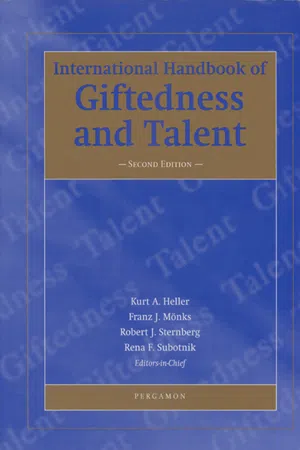
International Handbook of Giftedness and Talent
- 950 pages
- English
- ePUB (mobile friendly)
- Available on iOS & Android
eBook - ePub
International Handbook of Giftedness and Talent
About this book
The first edition of this popular reference work was published in 1993 and received critical acclaim for its achievement in bringing together international perspectives on research and development in giftedness and talent. Scholars welcomed it as the first comprehensive volume in the field and it has proved to be an indispensable resource to researchers. Since the first edition, the scholarly field of giftedness and talent studies has expanded and developed, welcoming contributions from researchers in related disciplines. Several theoretical frameworks outlined in the first edition have now been empirically tested and a number of new trends have emerged. The Second Edition of the International Handbook of Giftedness and Talent provides an invaluable research tool to academics, researchers and students interested in the field of giftedness and talent. The contributors are renowned in the field and the broad range of topics on giftedness that have been studied in the past century, right up to the late 1990s, are represented in this volume. It is truly international in scope, bringing together leading scholars and teachers from all around the world. This new edition has been fully updated and rewritten and includes 22 completely new chapters. It provides a comprehensive review and critical synthesis of significant theory; a unique cross-national perspective with contributions from over 100 distinguished authors covering 24 nations; significant contributions from scholars working in related fields; an increased focus on empirically supported scholarship; and is arranged for quick and easy reference with comprehensive subject and author indexes.
Information
PART I
CHANGING CONCEPTIONS OF GIFTEDNESS AND TALENT
Conceptions of Giftedness from a Meta-Theoretical Perspective
Albert Ziegler1 and Kurt A. Heller2 [email protected], 1University of Munich, Germany; 2University of Munich, Germany. E-mail address: [email protected]
Introduction
In this chapter conceptions of giftedness will be presented from a meta-theoretical perspective. The intention here is not to present individual conceptions, contrast their inherent advantages and disadvantages with one another or identify those points they have or do not have in common. Rather, the objectives here are to deliniate meta-theoretical criteria which provide a sound basis for giftedness research and to examine the most important conditions which could influence the validity of conceptions of giftedness.
A brief survey of the present state of the theoretical development of conceptions of giftedness reveals the existence of three recurring points of criticism: (1) The empirical basis is often insufficient, (2) their ontological status is unclear, and (3) they often fall short of meta-theoretical standards set by the philosophy of science. In the following section, we want to explain these points of criticism in detail. The attempt to develop a constructive argument is the main purpose of this chapter. The goal is to formulate a conclusive response to them by the end of the chapter, which in and of itself enables a scientifically fertile coming to terms with the topic of giftedness research.
Empirical, Ontological and Meta-Theoretical Difficulties with Conceptions of Giftedness
The fact that there is no object one can simply point to which demonstrates the existence of a gift or a talent appears to be trivial for a scientific branch like psychology which is largely based on constructs. However, is there at least indirect evidence that would support the postulation of gifts? The most important denial comes from the field of expertise research. Howe, Davidson and Sloboda (1998) seriously question how realistic the assumption of the existence of gifts or talents is, or whether one is actually being taken in by a myth. Basically, there are at least three reasons for the empirical difficulties facing conceptions of giftedness. (1) Empirical evidence obtained with average gifted persons cannot easily be transferred to highly gifted persons. For example, several conceptions of giftedness incorporate genetic influences as a significant component of the basic meaning of talent. In fact, there is a large body of research that proves that genetic influences account for some inter-individual differences. Wagner (1999) indicates, and correctly so, that these genetic influences have only been proven by untrained persons. In the same vein, Ericsson (Ericsson & Crutcher, 1990; Ericsson, Krampe & Tesch-Römer, 1993; Ericsson & Pennington, 1993) arrives at the overwhelmingly convincing conclusion that the estimated performance barriers seen as genetically fixed upper boundaries can be overcome through suitable learning processes. (2) By and large, the second empirical difficulty can be attributed to the inadequate methods currently available for the identification of gifted persons. According to the predominant opinion, gifts are not automatically transformed into exceptional achievements which leads us to contend with the existence of quite talented underachievers (Butler-Por, 1993). On the other hand, it could very well be that we are speaking of persons who have attained eminent achievement; these could be either highly gifted or average gifted persons who have had successful learning careers. In sum, giftedness research can not make an absolutely clear distinction between a highly gifted person and a well-trained person or between an average gifted person and a highly gifted person not taking full advantage of his/her gift. (3) The last empirical problem is due to the rarity of talents. For example, a country like Germany would need to conduct several complete cohorts in order to find just one individual major chess master. The scope of the problem increases when one wants to ascertain specific components of giftedness such as genetic influence. For example, in order to assess these genetic influences among chess players one would need to implement twin and adoption studies within an already extremely small population (cf. Thompson & Plomin in this handbook). Such samples are impossible to recruit.
From an ontological point of view, it is actually difficult to determine the precise ontological status of gifts. It seems to be clear that there is no direct correspondence between a gift and a natural entity, but rather that a construct is indicated. For example, Howe et al. (1998), in their devastating criticism of the talent construct, present a so-called list definition of talent, in other words talent as a composite of several necessary factors. Although some of the peer comments criticized of the individual points of the theory, none of them complained about the form of the definition as a list of criteria. A survey of the practical research reveals that talents seem to be handled as predictors indicated by variables such as intelligence or attributions of giftedness in a nomination procedure (see empirical publications in journals dedicated to questions involving talent and giftedness: Creativity Research Journal, Exceptional Children, Gifted Child Quarterly, Gifted Child Today, Gifted Education International, High Ability Studies, Journal for the Education of the Gifted, Roeper Review). On the other hand, it is difficult to accept talent as a proximal explanation for exceptional achievements. When an investigator attempts to explain why an exceptional achievement has occurred, he would need to analyze psychological processes, specific skills or physical structures (see Chi, Glaser & Farr, 1988; Ericsson & Smith, 1991; Hoffman, 1992). For example, when the basis or organization of the knowledge structures used by chess experts (Freyhof, Grub & Ziegler, 1992) or the capacity to mentally generate chess moves in advance (Holding, 1985) are investigated, an investigator would not be satisfied in using the expression ‘giftedness’ to explain such achievements. In certain ways, we are addressing the direct explanation of an exceptional achievement in terms of a methodological anti-gift-approach, since one would constantly attempt to break down gifts into psychological processes or entities.
From a meta-theoretical perspective, the consideration of current giftedness research as well as the existing theoretical basis of giftedness is striking in many respects. First, one must concede that it is difficult to justify the scientific necessity of gifts without becoming caught up in a vicious circle. Often, conceptions of gifts create their own legitimacy through empirical evidence of achievement eminence which are used to justify gifts themselves. Many arguments run along lines similar to this simplified example: If someone is a high achiever, it follows that he is gifted and vice versa; if someone is gifted, he will demonstrate exceptional achievements (as long as he is not restricted by unfavorable environmental conditions). Examples of this can particularly be found in the biographies of extraordinary persons (e.g., Ellis, 1927; Kretschmer, 1931). Therefore, conceptions of giftedness must also be capable of making a conceptional differentiation between achievement eminence and gifts.
The second troublesome point concerning the construct of gifts from a meta-theoretical perspective is that there is a tendency to immunize them against potential falsification. This is of course not a problem if one is speaking of a theoretical term whose measurement more or less presupposes its existence (cf. Sneed, 1994; Sneed, Baber & Moulines, 1987), similarly to how a concept such as intelligence is handled. Intelligence, in the strictest sense of the word, cannot be falsified; at most it can be proven to be scientifically less fruitful. In the debate over the existence of talents and giftedness, the question as to who carries the burden of the proof of existence is posed often enough (cf. Howe, Davidson & Sloboda, 1998, as well as the open peer commentaries): Do talent researchers now need to come up with proof of the existence of gifts, or do their opponents need to offer proof of nonexistence? In our opinion this question is poorly formulated and suffers under a petitio principii, i.e. the adoption of an unjustified tacit assumption. This exists within the universal assumption that gifts always—according to the proponents—or never—according to the opponents—are at the base of the behaviors leading to achievement eminence. In contrast, we believe that a conception of giftedness should allow for the possibility that a behavior leading to achievement eminence could, in fact, either be or not be based on the existence of a gift. A decision should be made in each case in collusion with an empirical clarification.
The third troublesome point from a meta-theoretical perspective is evidence of a significant decrease in progressiveness regarding the ability to move forward (Lakatos, 1978) seen in the last few years. Giftedness research is mainly a receptive research of psychology whereby methodological standards do suffer, in some respects, from deficits. In order to prove the first part of this claim one need only take a glimpse through the leading psychological journals. It becomes immediately obvious that practically all important scientific discoveries are not being obtained from subject pools with striking talents. Methodological deficits were evident in a meta-analysis of current empirical works appearing in peer-reviewed journals on giftedness by Ziegler and Raul (2000). Among other points, they confirmed that control groups were employed in less than one quarter of the studies! Some studies even neglected to indicate the number of subjects participating in their investigations.
The above depicted analyses of empirical, ontological and scientific aspects point to the necessity of a complete and thorough deliberation of the theoretical foundations of giftedness research. This does not necessarily entail the development and presentation of a new conception of giftedness, but rather a reflection on the basis upon which the forthcoming as well as current conceptions of giftedness can be evaluated.
In the next section of this chapter we will address the concept of giftedness, a term which has so far only been intuitively applied. In face of the abundance of various applications of the term currently in use, it is not possible to present an all encompassing concept of giftedness here nor to offer a complete overview of the various views of the construct. The only goal here is to provide an intuitive understanding for the following sections of this chapter; initially we will define the object, which giftedness research attempts to explain. Then a meta-conceptual m...
Table of contents
- Cover image
- Title page
- Table of Contents
- Copyright
- Foreword
- Preface of the 2nd edition
- PART I: CHANGING CONCEPTIONS OF GIFTEDNESS AND TALENT
- PART II: DEVELOPMENT OF GIFTEDNESS AND TALENT
- PART III: IDENTIFICATION OF GIFTEDNESS AND TALENT
- PART IV: GIFTED EDUCATION AND PROGRAMMING
- PART V: COUNSELING AND NURTURING GIFTEDNESS AND TALENT
- PART VI: EXAMPLES OF COUNTRY EFFORTS, POLICIES, PROGRAMS AND ISSUES
- PART VII: PRESENT AND FUTURE OF RESEARCH AND EDUCATION OF THE GIFTED AND TALENTED
- List of Contributors
- Author Index
- Subject Index
Trusted by 375,005 students
Access to over 1.5 million titles for a fair monthly price.
Study more efficiently using our study tools.
Frequently asked questions
Yes, you can cancel anytime from the Subscription tab in your account settings on the Perlego website. Your subscription will stay active until the end of your current billing period. Learn how to cancel your subscription
No, books cannot be downloaded as external files, such as PDFs, for use outside of Perlego. However, you can download books within the Perlego app for offline reading on mobile or tablet. Learn how to download books offline
Perlego offers two plans: Essential and Complete
- Essential is ideal for learners and professionals who enjoy exploring a wide range of subjects. Access the Essential Library with 800,000+ trusted titles and best-sellers across business, personal growth, and the humanities. Includes unlimited reading time and Standard Read Aloud voice.
- Complete: Perfect for advanced learners and researchers needing full, unrestricted access. Unlock 1.5M+ books across hundreds of subjects, including academic and specialized titles. The Complete Plan also includes advanced features like Premium Read Aloud and Research Assistant.
We are an online textbook subscription service, where you can get access to an entire online library for less than the price of a single book per month. With over 1.5 million books across 990+ topics, we’ve got you covered! Learn about our mission
Look out for the read-aloud symbol on your next book to see if you can listen to it. The read-aloud tool reads text aloud for you, highlighting the text as it is being read. You can pause it, speed it up and slow it down. Learn more about Read Aloud
Yes! You can use the Perlego app on both iOS and Android devices to read anytime, anywhere — even offline. Perfect for commutes or when you’re on the go.
Please note we cannot support devices running on iOS 13 and Android 7 or earlier. Learn more about using the app
Please note we cannot support devices running on iOS 13 and Android 7 or earlier. Learn more about using the app
Yes, you can access International Handbook of Giftedness and Talent by K. A. Heller,F. J. Mönks,R. Subotnik,Robert J. Sternberg in PDF and/or ePUB format, as well as other popular books in Education & Education General. We have over 1.5 million books available in our catalogue for you to explore.