- 329 pages
- English
- ePUB (mobile friendly)
- Available on iOS & Android
eBook - ePub
Autoimmune Disease Models
About this book
Because autoimmune disorders can wreak havoc in both humans and animals, these disorders are now the objects of intense and focused research. This book details specific animal models for a variety of autoimmune disorders. The contributors are recognized authorities who deal with the panoply of experimentally induced autoimmune disorders, including encephalomyelitis, allergic neuritis, uveoretinitis, myocarditis, and hepatitis. Also included are discussions of spontaneously appearing diseases such as autoimmune thyroiditis and systemic lupus erythematosus. Many other disorders are also covered in this comprehensive guide. Certain to be an aid in the planning of individual experiments and broader research programs, this book will be a valuable addition to the library of all practicing immunologists interested in immune system function and dysfunction.
Information
Topic
MedicineSubtopic
ImmunologyChapter 1
Experimental Autoimmune Encephalomyelitis in the Mouse
Stefan Brocke, Koenraad Gijbels and Lawrence Steinman, Department of Neurology and Neurological Sciences, Stanford University Medical Center, Stanford, California 94305
Publisher Summary
This chapter focuses on experimental autoimmune encephalomyelitis (EAE) in the mouse. EAE in the mouse is characterized by perivascular inflammatory demyelinating lesions in the central nervous system (CNS) and an immunogenetically determined susceptibility. Clinical expression of the disease is obvious from neurological signs and can be easily quantified. Actively induced or adoptively transferred EAE allows for the separate study of immunization and effector events in the pathogenesis of the disease. The immune system of the mouse has been extensively studied and immune reagents are readily available, making mouse EAE an ideal animal model for the study of human inflammatory demyelinating disorders of the CNS. The clinical manifestations of EAE, such as loss of tail tonus and limb paralysis, are readily apparent to most observers and can be quantified according to various schemes. EAE in the mouse shares many features with the human disease multiple sclerosis, such as acute, chronic, and relapsing neurological dysfunctions, including paralysis and ataxia; a histopathology characterized by perivascular inflammatory infiltrates and demyelination in the CNS; and a link to major histocompatibility complex class II determinants.
I Introduction: Murine Experimental Autoimmune Encephalomyelitis as a Model for T-Cell-Mediated Demyelinating Disease of the Central Nervous System
In 1949, Olitsky and Yager described the induction of experimental disseminated encephalomyelitis in white mice, thus establishing murine experimental autoimmune encephalomyelitis (EAE) as a model for autoimmune inflammatory diseases of the central nervous system (CNS). EAE in the mouse shares many features with the human disease multiple sclerosis (MS), such as acute, chronic, and relapsing neurological dysfunctions, including paralysis and ataxia; a histopathology characterized by perivascular inflammatory infiltrates and demyelination in the CNS; and a link to major histocompatibility complex (MHC) class II determinants (Zamvil and Steinman, 1990). A recent study demonstrated an accumulation of T cells in brain lesions of patients with MS which share T-cell receptor (TCR) gene rearrangements with T cells specific for the most commonly used antigen for induction of EAE, myelin basic protein (MBP) (Oksenberg et al., 1993). Thus, murine EAE can be considered a useful model for several aspects of the pathogenesis of MS (Steinman et al., 1984).
II Models of EAE in the Mouse
A Induction of EAE by Immunization with Autoantigens (Actively Induced EAE)
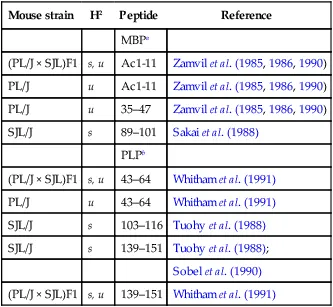
EAE can be induced by immunization of animals with mouse spinal cord homogenate (MSCH) or myelin proteins, namely MBP or proteolipid protein (PLP). Several immunodominant epitopes in these antigens have been determined, and it is possible to induce EAE with peptides representing epitopes of MBP or PLP (Table I). Actively induced EAE allows the study and manipulation of the immunization and effector phases in a model of autoimmune disease. The usually reproducible time course of the disease allows for a study of disease induction and expression. However, owing to the severe long-term inflammation caused by the use of complete Freund’s adjuvant (CTA Difco, Detroit, Michigan) containing Mycobacterium tuberculosis, some of the observed effects could be attributed to the mode of immunization rather than the pathogenic process of inflammation and demyelination in the CNS.
Table I
Encephalitogenic Peptides from MBP and PLP in Various Mouse Strains
| Mouse strain | H2 | Peptide | Reference |
| MBPa | |||
| (PL/J × SJL)F1 | s, u | Ac1-11 | Zamvil et al. (1985, 1986, 1990) |
| PL/J | u | Ac1-11 | Zamvil et al. (1985, 1986, 1990) |
| PL/J | u | 35–47 | Zamvil et al. (1985, 1986, 1990) |
| SJL/J | s | 89–101 | Sakai et al. (1988) |
| PLPb | |||
| (PL/J × SJL)F1 | s, u | 43–64 | Whitham et al. (1991) |
| PL/J | u | 43–64 | Whitham et al. (1991) |
| SJL/J | s | 103–116 | Tuohy et al. (1988) |
| SJL/J | s | 139–151 | Tuohy et al. (1988); |
| Sobel et al. (1990) | |||
| (PL/J × SJL)F1 | s, u | 139–151 | Whitham et al. (1991) |
aMBP peptides are prepared according to the sequence of guinea pig/rat, mouse, or bovine MBP Consult the references for details.
bPLP peptides are prepared according to the sequence of murine PLP with or without substitution. Consult the references for details.
Susceptibility of mice to EAE is genetically controlled (Bernard et al., 1976a). Similarly, the encephalitogeneity of MBP or PLP peptides is dependent on the expression of certain H-2 antigens of mouse strains (Table I) (Whitham et al., 1991; Zamvil and Steinman, 1990; Sobel et al., 1990; Tuohy et al., 1989; Sakai et al., 1988; Tuohy et al., 1988; Zamvil et al., 1985, 1986). Thus, the N-terminal encephalitogenic epitope Ac1–11 of MBP is immunodominant in H-2u mice (Zamvil et al., 1985, 1986), whereas peptide 89–101 is a major encephalitogenic epitope in mice expressing H-2q and H-2s antigens (Zamvil and Steinman, 1990; Sakai et al., 1988).
To induce EAE, mice at 5–9 weeks of age are immunized by subcutaneous (s.c.) inoculation (tail base or flank) with 5 mg of lyophilized spinal cord homogenate or 200 µg of the MBP peptide in a 0.1-ml emulsion with equal volumes of phosphate-buffered saline (PBS) and CFA. In order to enhance the immunization with antigen, killed Mycobacterium tuberculosis, strain H37Ra (Difco) can be added to the emulsion at a concentration of 2–4 mg/ml.
Some older protocols call for the s.c. immunization in the footpads. However, this procedure is not recommended because it ...
Table of contents
- Cover image
- Title page
- Table of Contents
- Copyright
- Contributors
- Preface
- Chapter 1: Experimental Autoimmune Encephalomyelitis in the Mouse
- Chapter 2: Rat Experimental Autoimmune Encephalomyelitis
- Chapter 3: Theiler’s Virus-Induced Demyelinating Disease
- Chapter 4: Experimental Autoimmune Neuritis
- Chapter 5: Experimental Autoimmune Uveoretinitis—Rat and Mouse
- Chapter 6: Experimental Autoimmune Myasthenia Gravis
- Chapter 7: The Obese Strain of Chickens with Spontaneous Autoimmune Thyroiditis as a Model for Hashimoto Disease
- Chapter 8: Experimental Autoimmune Thyroiditis in the Mouse and Rat
- Chapter 9: The NOD Mouse: A Model for Autoimmune Insulin-Dependent Diabetes
- Chapter 10: The BB Rat Models of IDDM
- Chapter 11: Experimental Myocarditis
- Chapter 12: Experimental Hepatitis
- Chapter 13: Adjuvant Arthritis
- Chapter 14: Murine Models of Spontaneous Systemic Lupus Erythematosus
- Chapter 15: Experimental Systemic Lupus Erythematosus: Role of the Idiotypic Network
- Chapter 16: Autoimmune Vasculitis
- Chapter 17: Testicular and Ovarian Autoimmune Diseases
- Chapter 18: Allogeneic Diseases
- Chapter 19: Assessment of Discomfort in Laboratory Animals
- Index
Trusted by 375,005 students
Access to over 1.5 million titles for a fair monthly price.
Study more efficiently using our study tools.
Frequently asked questions
Yes, you can cancel anytime from the Subscription tab in your account settings on the Perlego website. Your subscription will stay active until the end of your current billing period. Learn how to cancel your subscription
No, books cannot be downloaded as external files, such as PDFs, for use outside of Perlego. However, you can download books within the Perlego app for offline reading on mobile or tablet. Learn how to download books offline
Perlego offers two plans: Essential and Complete
- Essential is ideal for learners and professionals who enjoy exploring a wide range of subjects. Access the Essential Library with 800,000+ trusted titles and best-sellers across business, personal growth, and the humanities. Includes unlimited reading time and Standard Read Aloud voice.
- Complete: Perfect for advanced learners and researchers needing full, unrestricted access. Unlock 1.5M+ books across hundreds of subjects, including academic and specialized titles. The Complete Plan also includes advanced features like Premium Read Aloud and Research Assistant.
We are an online textbook subscription service, where you can get access to an entire online library for less than the price of a single book per month. With over 1.5 million books across 990+ topics, we’ve got you covered! Learn about our mission
Look out for the read-aloud symbol on your next book to see if you can listen to it. The read-aloud tool reads text aloud for you, highlighting the text as it is being read. You can pause it, speed it up and slow it down. Learn more about Read Aloud
Yes! You can use the Perlego app on both iOS and Android devices to read anytime, anywhere — even offline. Perfect for commutes or when you’re on the go.
Please note we cannot support devices running on iOS 13 and Android 7 or earlier. Learn more about using the app
Please note we cannot support devices running on iOS 13 and Android 7 or earlier. Learn more about using the app
Yes, you can access Autoimmune Disease Models by Irun R. Cohen,Ariel Miller in PDF and/or ePUB format, as well as other popular books in Medicine & Immunology. We have over 1.5 million books available in our catalogue for you to explore.