- 192 pages
- English
- ePUB (mobile friendly)
- Available on iOS & Android
eBook - ePub
Organisational Culture for Information Managers
About this book
In today's digital environment the workplace is characterised by individuals creating information perhaps independently of formal systems, or establishing new systems without knowledge of information management requirements. This book explains and explores the concept of organisational culture, specifically within the domain of information management. It draws on the author's wide-ranging practical experience in different workplaces and uses research findings from cross-cultural studies of information management.
- Uses research findings from cross-cultural studies of information management
- Provides tools to develop practical and realistic solutions to real-world problems
- Draws on the author's wide-ranging practical experience in different workplaces.
Information
1
The significance of organisational culture
Abstract:
This chapter explains the concept of organisational culture and establishes why it is necessary for information managers to understand this. The values accorded to information and attitudes to it are indicative of the information culture of organisations; understanding organisational culture will enable the development of appropriate strategies and systems. Two contrasting views of organisational culture are discussed, one which assumes culture is solely internally based and the other which acknowledges the external environment in which the organisation is situated.
Key words
organisational culture
information culture
national culture
Introduction
This chapter begins by discussing why it is important to understand organisational culture. Then I start to establish what organisational culture encompasses. Although it is a term that most people are familiar with, and many use frequently when discussing their workplace, interpretation and understanding vary greatly. Two of the key perspectives are discussed, one of which has unfortunately been very prevalent and influential on management thinking, to the detriment of information management. The final section of this chapter outlines the multilevel approach to organisational culture that underpins the thinking in this book, acknowledging the existence of national, occupational and corporate cultural influences in shaping our working environments.
Why is understanding organisational culture so important?
Whether you are a librarian, records manager or archivist, the objective of your work is to manage information. The primary purpose for which you are attempting to manage information will vary according to your occupation. Records managers and archivists manage information as evidence, for accountability. Librarians manage information for knowledge and awareness, and also sometimes for entertainment. So far, so good. These distinct purposes provide a universality for the work undertaken by information managers and enable us to work collaboratively (regionally, nationally and globally) to explore and develop appropriate technologies, systems and processes. However, the specific organisational context that librarians, records managers and archivists are working within is a primary influence on the way that they go about achieving their work objectives. For example, the way in which you would go about ensuring your clients are mindful of their information management obligations in a very structured setting such as a law firm would be quite different to a more anarchic environment such as a university.
Most information managers fulfil key roles in providing the necessary infrastructure to enable the organisation that they serve to function efficiently and effectively. But the nature of that organisation will vary widely, according to a number of factors, in particular

These factors are intertwined, and are likely to influence each other, but all play a role in shaping the culture of the organisation. Each of these will be explored further in this book.
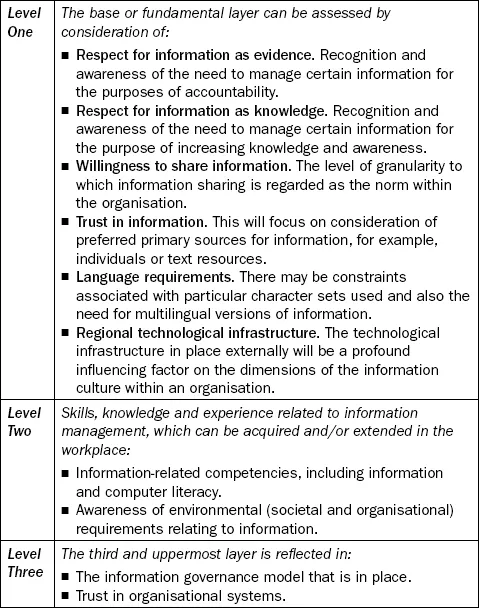
Understanding the importance of these factors will enable the diagnosis of an organisation’s information culture – that is, the values accorded to information, and attitudes towards it, specifically within organisational contexts. Every organisation, no matter how large or small, regardless of type and function, wherever in the world it is situated, has an information culture. Table 1.1 presents a framework for the assessment of information culture; the levels are explored in Chapter 6.
Table 1.1
Framework for information culture assessment
Information culture is inextricably intertwined with organisational culture, and it is only by understanding the organisation that progress can be made with information management initiatives.
Organisations are microcosms of their broader societal context. They may appear to be self-contained, but definitely do not exist in isolation from their broader context. Often consideration of organisational culture focuses solely on internal factors, primarily management and resourcing. The key aim of this book, however, is to highlight and untangle all those features that influence what happens at the library, records service or archives.
One of the features that characterise information management is the sheer diversity of settings in which it is implemented. For that reason, many practitioners remain in the same environment and it can be difficult to swap settings, largely because of the specialist skills and knowledge required. A law librarian, for instance, attempting to change focus to a hospital setting will often be regarded as making a career shift and may find entry into the new field problematic. Consequently, any consideration given to the more fine-grained or nuanced aspects of organisational culture is often overlooked. Where there is differentiation according to setting in literature and guidelines for practice, this is generally restricted to broad-brush domains such as medicine and law. Nevertheless, the work of information managers in, say, hospitals in various parts of the world, although focused on the same outcomes, may be quite different in terms of priorities accorded to different services and activities.
The ways in which information managers will be affected by organisational culture will vary according to the extent to which the main elements of their work (users and materials) are internal to the organisation, or external. For example:
Table of contents
- Cover image
- Title page
- Table of Contents
- Copyright
- List of tables
- About the author
- Introduction
- Chapter 1: The significance of organisational culture
- Chapter 2: National culture
- Chapter 3: The structural environment
- Chapter 4: Occupational culture
- Chapter 5: Corporate culture
- Chapter 6: Assessing information culture
- Chapter 7: Scenarios
- Conclusion
- Index
Trusted by 375,005 students
Access to over 1.5 million titles for a fair monthly price.
Study more efficiently using our study tools.
Frequently asked questions
Yes, you can cancel anytime from the Subscription tab in your account settings on the Perlego website. Your subscription will stay active until the end of your current billing period. Learn how to cancel your subscription
No, books cannot be downloaded as external files, such as PDFs, for use outside of Perlego. However, you can download books within the Perlego app for offline reading on mobile or tablet. Learn how to download books offline
Perlego offers two plans: Essential and Complete
- Essential is ideal for learners and professionals who enjoy exploring a wide range of subjects. Access the Essential Library with 800,000+ trusted titles and best-sellers across business, personal growth, and the humanities. Includes unlimited reading time and Standard Read Aloud voice.
- Complete: Perfect for advanced learners and researchers needing full, unrestricted access. Unlock 1.5M+ books across hundreds of subjects, including academic and specialized titles. The Complete Plan also includes advanced features like Premium Read Aloud and Research Assistant.
We are an online textbook subscription service, where you can get access to an entire online library for less than the price of a single book per month. With over 1.5 million books across 990+ topics, we’ve got you covered! Learn about our mission
Look out for the read-aloud symbol on your next book to see if you can listen to it. The read-aloud tool reads text aloud for you, highlighting the text as it is being read. You can pause it, speed it up and slow it down. Learn more about Read Aloud
Yes! You can use the Perlego app on both iOS and Android devices to read anytime, anywhere — even offline. Perfect for commutes or when you’re on the go.
Please note we cannot support devices running on iOS 13 and Android 7 or earlier. Learn more about using the app
Please note we cannot support devices running on iOS 13 and Android 7 or earlier. Learn more about using the app
Yes, you can access Organisational Culture for Information Managers by Gillian Oliver in PDF and/or ePUB format, as well as other popular books in Business & Information Management. We have over 1.5 million books available in our catalogue for you to explore.