eBook - ePub
Soft Computing and Intelligent Systems
Theory and Applications
- 639 pages
- English
- ePUB (mobile friendly)
- Available on iOS & Android
eBook - ePub
About this book
The field of soft computing is emerging from the cutting edge research over the last ten years devoted to fuzzy engineering and genetic algorithms. The subject is being called soft computing and computational intelligence. With acceptance of the research fundamentals in these important areas, the field is expanding into direct applications through engineering and systems science.This book cover the fundamentals of this emerging filed, as well as direct applications and case studies. There is a need for practicing engineers, computer scientists, and system scientists to directly apply "fuzzy" engineering into a wide array of devices and systems.
Information
Part I
Foundations of Soft Ccomputing and Sntelligent Control Systems
CHAPTER 1
Outline of a Computational Theory of Perceptions Based on Computing with Words
L.A. ZADEH, Berkeley Initiative in Soft Computing (BISC), University of California, Berkeley, California, USA
James Albus and Alex Meystel
INTRODUCTION
Perceptions play a pivotal role in human cognition. The literature on perceptions is enormous, encompassing thousands of papers and books in the realms of psychology, linguistics, philosophy, and brain science, among others [64]. And yet, what is not in existence is a theory in which perceptions are treated as objects of computation. A preliminary version of such a theory, called the computational theory of perceptions (CTP), is outlined in this chapter.
The computational theory of perceptions is inspired by the remarkable human capability to perform a wide variety of physical and mental tasks without any measurements and without any computations. Everyday examples of such tasks are parking a car, driving in city traffic, playing golf, cooking a meal, and summarizing a story. Underlying this remarkable capability is the brain’s ability to manipulate perceptions—perceptions of time, distance, force, direction, speed, shape, color, likelihood, intent, truth and other attributes of physical and mental objects.
A basic difference between measurements and perceptions is that, in general, measurements are crisp and quantitative whereas perceptions are fuzzy and qualitative. Furthermore, the finite ability of the human brain to resolve detail and store information necessitates a partitioning of objects (points) into granules, with a granule being a clump of objects (points) drawn together by indistinguishability, similarity, proximity, or functionality [62]. For example, a perception of age may be described as young, with young being a context-dependent granule of the variable Age (Figure 1). Thus, in general, perceptions are both fuzzy and granular, or for short, f-granular. In this perspective, use of perceptions may be viewed as a human way of achieving fuzzy data compression.
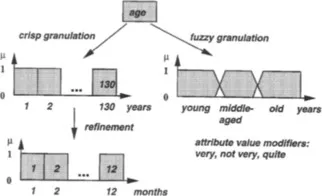
FIGURE 1 Crisp and fuzzy granulation of Age. Note that young is context-dependent.
One of the fundamental aims of science has been and continues to be that of progressing from perceptions to measurement. Pursuit of this aim has led to brilliant successes. We have sent men to the moon; we can build computers that are capable of performing billions of computations per second; we have constructed telescopes that can explore the far reaches of the universe; and we can date rocks that are millions of years old. But alongside the brilliant successes stand conspicuous underachievements. We cannot build robots that can move with the agility of animals or humans; we cannot automate driving in city traffic; we cannot translate from one language to another at the level of a human interpreter; we cannot create programs that can summarize nontrivial stories; our ability to model the behavior of economic systems leaves much to be desired; and we cannot build machines that can compete with children in the performance of a wide variety of physical and cognitive tasks.
It may be argued that underlying the underachievements is the lack of a machinery for manipulation of perception. A case in point is the problem of automation of driving in city traffic—a problem that is certainly not academic in nature. Human drivers do it routinely, without any measurements and any computations. Now assume that we had a limitless number of sensors to measure anything that we might want. Would this be of any help in constructing a system that would do the driving on its own? The answer is a clear no. Thus, in this instance, as in others, progressing from perceptions to measurements does not solve the problem.
To illustrate a related point, consider an example in which we have a transparent box containing black and white balls. Suppose that the question is: What is the probability that a ball drawn at random is black? Now, if I can count the balls in the box and the proportion of black balls is, say, 0.7, then my answer would be 0.7. If I cannot count the balls but my visual perception is that most are black, the traditional approach would be to draw on subjective probability theory. Using an elicitation procedure in this theory would lead to a numerical value of the desired probability, say, 0.7. By so doing, I have quantified my perception of the desired probability; but can I justify the procedure that led me to the numerical value?
Countertraditionally, employing CTP would yield the following answer: If my perception is that most balls are black, then the probability that a ball drawn at random is black is most, where most is interpreted as a fuzzy proportion (Figure 2). Thus, in the traditional approach the data are imprecise but the answer is precise. In the countertraditional approach, imprecise data induce an imprecise answer [63].
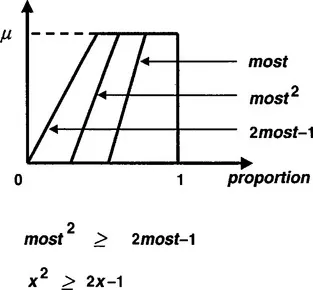
FIGURE 2 Definition of most and related perceptual quantifiers. Note that most is context-dependent.
An interesting point is that even if I know that 80% of the balls are black, it may suffice—for some purposes—to employ a perception of the desired probability rather than its numerical v...
Table of contents
- Cover image
- Title page
- Table of Contents
- ACADEMIC PRESS SERIES IN ENGINEERING
- Copyright
- DEDICATION
- Foreword
- Preface
- Acknowledgements
- List of Contributors
- Summary of Book Chapters with Classification of Approaches
- Part I: Foundations of Soft Ccomputing and Sntelligent Control Systems
- Part II: Theory of Soft Computing and Intelligent Control Systems
- Part III: Implementation and Application of Intelligent Control
- Part IV: Future Perspectives
- Major Current Bibliographical Sources on Neural Networks, Fuzzy Logic, and Applications
- About the Editors
- INDEX
Trusted by 375,005 students
Access to over 1.5 million titles for a fair monthly price.
Study more efficiently using our study tools.
Frequently asked questions
Yes, you can cancel anytime from the Subscription tab in your account settings on the Perlego website. Your subscription will stay active until the end of your current billing period. Learn how to cancel your subscription
No, books cannot be downloaded as external files, such as PDFs, for use outside of Perlego. However, you can download books within the Perlego app for offline reading on mobile or tablet. Learn how to download books offline
Perlego offers two plans: Essential and Complete
- Essential is ideal for learners and professionals who enjoy exploring a wide range of subjects. Access the Essential Library with 800,000+ trusted titles and best-sellers across business, personal growth, and the humanities. Includes unlimited reading time and Standard Read Aloud voice.
- Complete: Perfect for advanced learners and researchers needing full, unrestricted access. Unlock 1.5M+ books across hundreds of subjects, including academic and specialized titles. The Complete Plan also includes advanced features like Premium Read Aloud and Research Assistant.
We are an online textbook subscription service, where you can get access to an entire online library for less than the price of a single book per month. With over 1.5 million books across 990+ topics, we’ve got you covered! Learn about our mission
Look out for the read-aloud symbol on your next book to see if you can listen to it. The read-aloud tool reads text aloud for you, highlighting the text as it is being read. You can pause it, speed it up and slow it down. Learn more about Read Aloud
Yes! You can use the Perlego app on both iOS and Android devices to read anytime, anywhere — even offline. Perfect for commutes or when you’re on the go.
Please note we cannot support devices running on iOS 13 and Android 7 or earlier. Learn more about using the app
Please note we cannot support devices running on iOS 13 and Android 7 or earlier. Learn more about using the app
Yes, you can access Soft Computing and Intelligent Systems by Madan M. Gupta, Naresh K. Sinha in PDF and/or ePUB format, as well as other popular books in Computer Science & Artificial Intelligence (AI) & Semantics. We have over 1.5 million books available in our catalogue for you to explore.