eBook - ePub
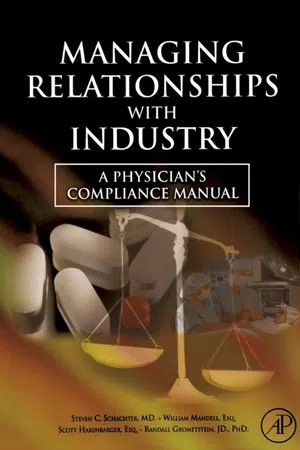
Managing Relationships with Industry
A Physician's Compliance Manual
- 310 pages
- English
- ePUB (mobile friendly)
- Available on iOS & Android
eBook - ePub
Managing Relationships with Industry
A Physician's Compliance Manual
About this book
Now more than ever, doctors are being targeted by government prosecutors and whistleblowers challenging the legality of their relationships with drug and device companies. With reputations at stake and the risk of civil and criminal liability, it is incumbent upon doctors to protect themselves.
Managing Relationships with Industry: A Physician's Compliance Manual is an indispensable resource for doctors, professional societies, academic medical centers, community hospitals, and group practices struggling to understand the ever changing law and ethical standards on interactions with pharmaceutical and device companies. It is the first comprehensive summary of the law and ethics on physician relationships with industry written for the physician. Authored by a former state Attorney General, Harvard Medical School Professor, health care lawyer and professor of ethics, Managing Relationships approaches the topic from a balanced and reasoned perspective adding to the on-going national dialogue and debate on the proper limits to medicine's relationship with industry.
- The first complete and up-to-date summary and analysis of the law and ethics on physician-industry relationships
- Focuses on major enforcement actions and whistleblower lawsuits and the lessons learned for physicians
- Provides options and guidance for maintaining compliant relationships and avoiding traps for the unwary
- Covers both drug and device company relationships
- Summarizes the types of industry relationships that are necessary and productive and those that are harmful and abusive
- Details the law and ethics for each type of relationship including gifts, off-label uses and marketing, CME, speaker's bureaus, free samples, grants, consulting arrangements, etc.
- Includes sample contracts for permissible consulting and CME speaker engagements
Information
Topic
PsicologiaChapter 1
BACKGROUND
Publisher Summary
While doctors and drug and device companies share similar goals—to improve people’s health and well-being—they employ different strategies to achieve these goals and have other objectives that may differ and sometimes conflict, as occurred in the 1930s and continues today. The rising cost of healthcare, however, has alarmed the public, as well as federal and state governments whose programs, such as Medicare and Medicaid, pay an increasing amount of the dollars spent on healthcare services and items, particularly for prescription drugs and medical devices. This chapter describes a number of current issues on the agendas of regulatory and enforcement authorities. It discusses briefly “Marketing 101” for doctors and emphasizes the role of marketing by drug and device companies, which has saturated the culture to an extent beyond which most Americans, and physicians in particular, seem to realize. Physicians have both ethical and legal duties. To effectively and intelligently exercise these duties, physicians must understand the business forces and marketing tactics at play as well as the applicable legal and ethical standards, which are in a state of flux. This chapter also discusses problems that arise because of the extensiveness of drug and device company marketing efforts, particularly those directed to physicians. It also highlights productive, collaborative efforts being pursued together by industry and medicine that preserve the integrity, independence and vital roles of the medical profession in developing new therapies and providing the best medical care for patients.
For over a century, doctors and drug companies have collaborated on developing effective treatments for illness. More recently, doctors have worked with device companies to improve patient care. But these collaborations have not been without conflicts and controversies. While doctors and drug and device companies share similar goals—to improve people’s health and well-being—they employ different strategies to achieve these goals and have other objectives that may differ and sometimes conflict, as occurred in the 1930s and continues today.1 For most of the last century, the medical profession undertook to establish scientific and clinical standards for the pharmaceutical industry, leading to what one scholar called a “mutual accommodation” between industry and the medical profession.2 Mutual accommodation suggests that each party changes in response to the other, and in recent years, critics have charged that medicine may have gone too far in accommodating the pharmaceutical and device companies.
As the medical profession has fragmented into specialties3 and the roles played by individual physicians have proliferated (e.g., specialty leader, researcher, author, patient caregiver, prescriber, shareholder in companies developing new and potentially life-saving treatments, consultant to industry), it has become more complicated for the profession to see the problem of physician–industry relationships as a whole and to speak with one voice.
Meanwhile, since 1980, the pharmaceutical and medical device industries have enjoyed some of their most profitable years, in part due to the adoption of modern marketing techniques such as direct-to-consumer advertising and closer ties with physicians and academic research centers. The rising cost of healthcare, however, has alarmed the public, as well as federal and state governments whose programs, such as Medicare and Medicaid, pay an increasing amount of the dollars spent on healthcare services and items, particularly for prescription drugs and medical devices.
In the view of many commentators, regulators and reformers, drug and device companies have now become the dominant partner in the collaboration between medicine and industry, influencing physicians to prescribe more brand-name drugs and use the latest medical devices, thereby driving up the cost of healthcare. These critics believe that this influence is being achieved through various financial relationships with physicians and medical organizations and is being realized when the prescription written or device used is among the costliest of the available choices.
In reaction, federal and state governments, the media, patient and consumer advocates and voices for reform within organized medicine have challenged industry influence of physicians in the courts, in legislative chambers and in the popular media and medical journals. A series of major federal fraud and abuse cases, in which pharmaceutical and device companies were accused of enticing physicians with various financial incentives to write prescriptions for unapproved uses or to switch a patient’s prescription from a competitor’s product, has galvanized the pharmaceutical and device industries, as well as the medical profession, to better police themselves, and federal and state governments into taking action to protect the public interest.
As legislators, regulators and prosecutors continue to rein in drug and device companies over their marketing practices to physicians, individual physicians must be aware that they can become inadvertently caught up in this struggle and are best advised to remain current with changing legal and ethical rules regarding financial ties between themselves and the industry. But it can be hard to keep one’s footing when the ground itself is in motion.
As legislators, regulators and prosecutors continue to rein in drug and device companies over their marketing practices to physicians, individual physicians must be aware that they can become inadvertently caught up in this struggle and are best advised to remain current with changing legal and ethical rules regarding financial ties between themselves and the industry.
Physicians, as discussed in the Foreword and Preface, have ethical duties as well as legal ones. To effectively and intelligently exercise these duties, physicians must understand the business forces and marketing tactics at play as well as the applicable legal and ethical standards, which are in a state of flux. Before reviewing the law and explaining how physicians can best manage their financial arrangements with drug and device companies, this chapter introduces and describes a number of current issues on the agendas of regulatory and enforcement authorities that form the basis for the chapters that follow. We provide a bit of “Marketing 101” for doctors and emphasize the role of marketing by drug and device companies, which has saturated our culture to an extent beyond which most Americans, and physicians in particular, seem to realize. We also discuss problems that arise because of the extensiveness of drug and device company marketing efforts, particularly those directed to physicians, and in so doing cite recent books by several physician reformers4 on the influence of pharmaceutical companies. We also highlight productive, collaborative efforts being pursued together by industry and medicine that preserve the integrity, independence and vital roles of the medical profession in developing new therapies and providing the best medical care for patients.
THE ERA OF BIG BUSINESS
The election of Ronald Reagan in 1980 is a convenient marker for the beginning of a new era that continues to impact physician–industry relationships today. One observer called it the turning point for America’s laissez-faire revolution, in which the free market and the values associated with it became ascendant.5 Not coincidentally, with the great wealth and technological innovations generated by the dot.com boom of the 1990s came numerous scandals and excesses involving corporate officers and directors at the expense of the interests of employees, shareholders and consumers, involving companies such as Enron, Tyco and WorldCom, as pointed out in the Preface.
These and many other examples of greed, conflict of interest and fraud ultimately led to criminal prosecutions of executives and major federal reforms of corporate governance and compliance, such as the Sarbanes-Oxley Act of 2002. The recent period of corporate excess and reactive governmental reform has been compared to the era of the “robber barons” of the Gilded Age of the 1890s and the subsequent reforms achieved in the Progressive Era in the first decades of the twentieth century. Just as the unregulated industrial excesses captured vividly in Upton Sinclair’s 1906 novel The Jungle led to the passage, in the same year, of the first federal legislation regulating food and drugs, so do some observers today see a need for a new era of reforms, particularly with the role of business in healthcare.
For pharmaceutical companies, 1980 was the beginning of the era of the blockbuster drug (sales exceeding $1 billion a year). Ironically, the catalyst for this new revenue plateau was not simply the free market at work but a series of federal laws intended to encourage the development of new life-saving medications and medical technologies—the University and Small Business Patent Procedures Act (1980; also called Bayh-Dole), the Technology Innovation Act (1980; also called Stevenson-Wydler) and the Drug Price Competition and Patent Term Restoration Act (1984; also called Hatch-Waxman).
The consequences, both intended and unintended, of these laws have been far-reaching. The first two laws were intended to facilitate technology transfer, i.e., developing practical applications for the results of scientific research. Before the passage of Bayh-Dole, drug companies conducted a great deal of basic research, performed pre-clinical and clinical tests on promising drugs and then manufactured and marketed them. Universities and academic medical centers (AMCs) also performed basic research under grants from the National Institutes of Health (NIH), but discoveries arising from this taxpayer-funded research were considered to be in the public domain. Bayh-Dole, however, permitted universities and companies that conducted federally funded research to patent their discoveries and license them to pharmaceutical companies. Stevenson-Wydler contributed to this new relationship between industry and academic researchers by directing federal agencies to actively cooperate with potential users of federally developed technology. These two laws have succeeded in stimulating a much closer relationship between the for-profit and non-profit research sectors, as well as the development of many new drugs.
As a result, pharmaceutical companies do a great deal less basic research than formerly; they pre...
Table of contents
- Cover image
- Title page
- Table of Contents
- FOREWORD
- PREFACE
- CONTRIBUTORS
- Chapter 1: BACKGROUND
- Chapter 2: OVERVIEW OF LEGAL SOURCES
- Chapter 3: SUMMARY OF RECENT PROSECUTIONS AND INVESTIGATIONS
- Chapter 4: APPLICATIONS OF LAW AND PROFESSIONAL AND TRADE ASSOCIATION STANDARDS TO PHYSICIAN RELATIONSHIPS WITH INDUSTRY
- Chapter 5: LEGAL AND ETHICAL ASPECTS OF SPECIFIC PHYSICIAN—INDUSTRY FINANCIAL RELATIONSHIPS
- Chapter 6: APPROACHING AND ADOPTING EFFECTIVE COMPLIANCE PLANS
- CONCLUSION
- Appendix 1: LINKS TO FREQUENTLY CITED DOCUMENTS AND CODES OF CONDUCT
- Appendix 2: KEY TO ABBREVIATIONS
- Appendix 3: MODEL SERVICE AGREEMENT FOR SPEAKING AT A CONTINUING MEDICAL EDUCATION ACTIVITY
- Appendix 4: MODEL AGREEMENT FOR CONSULTING
- INDEX
Trusted by 375,005 students
Access to over 1.5 million titles for a fair monthly price.
Study more efficiently using our study tools.
Frequently asked questions
Yes, you can cancel anytime from the Subscription tab in your account settings on the Perlego website. Your subscription will stay active until the end of your current billing period. Learn how to cancel your subscription
No, books cannot be downloaded as external files, such as PDFs, for use outside of Perlego. However, you can download books within the Perlego app for offline reading on mobile or tablet. Learn how to download books offline
We are an online textbook subscription service, where you can get access to an entire online library for less than the price of a single book per month. With over 1.5 million books across 990+ topics, we’ve got you covered! Learn about our mission
Look out for the read-aloud symbol on your next book to see if you can listen to it. The read-aloud tool reads text aloud for you, highlighting the text as it is being read. You can pause it, speed it up and slow it down. Learn more about Read Aloud
Yes! You can use the Perlego app on both iOS and Android devices to read anytime, anywhere — even offline. Perfect for commutes or when you’re on the go.
Please note we cannot support devices running on iOS 13 and Android 7 or earlier. Learn more about using the app
Please note we cannot support devices running on iOS 13 and Android 7 or earlier. Learn more about using the app
Yes, you can access Managing Relationships with Industry by Steven C. Schachter,William Mandell,Scott Harshbarger,Randall Grometstein in PDF and/or ePUB format, as well as other popular books in Psicologia & Psicologia in industrie e organizzazioni. We have over 1.5 million books available in our catalogue for you to explore.