- 656 pages
- English
- ePUB (mobile friendly)
- Available on iOS & Android
eBook - ePub
DSP for Embedded and Real-Time Systems
About this book
This Expert Guide gives you the techniques and technologies in digital signal processing (DSP) to optimally design and implement your embedded system. Written by experts with a solutions focus, this encyclopedic reference gives you an indispensable aid to tackling the day-to-day problems you face in using DSP to develop embedded systems.
With this book you will learn:
- A range of development techniques for developing DSP code
- Valuable tips and tricks for optimizing DSP software for maximum performance
- The various options available for constructing DSP systems from numerous software components
- The tools available for developing DSP applications
- Numerous practical guidelines from experts with wide and lengthy experience of DSP application development
Features:
- Several areas of research being done in advanced DSP technology
- Industry case studies on DSP systems development
DSP for Embedded and Real-Time Systems is the reference for both the beginner and experienced, covering most aspects of using today's DSP techniques and technologies for designing and implementing an optimal embedded system.
- The only complete reference which explains all aspects of using DSP in embedded systems development making it a rich resource for every day use
- Covers all aspects of using today's DSP techniques and technologies for designing and implementing an optimal embedded system
- Enables the engineer to find solutions to all the problems they will face when using DSP
Information
Chapter 1
Introduction to Digital Signal Processing
Chapter Outline
What is digital signal processing?
Advantages of DSP
DSP systems
Analog-to-digital conversion
The Nyquist criteria
Digital-to-analog conversion
Applications for DSPs
Low cost DSP applications
Power efficient DSP applications
High performance DSP applications
Conclusion
What is digital signal processing?
Digital signal processing (DSP) is the method of processing signals and data in order to enhance, modify, or analyze those signals to determine specific information content. It involves the processing of real-world signals that are converted to, and represented by, sequences of numbers. These signals are then processed using mathematical techniques, in order to extract certain information from the signal, or to transform the signal in some preferably beneficial way.
The term ‘digital’ in DSP requires processing using discrete signals to represent the data in the form of numbers that can be easily manipulated. In other words, the signal is represented numerically. This type of representation implies some form of quantization of one or more properties of the signal, including time.
This is just one type of digital data; other types include ASCII numbers and letters that have a digital representation as well.
The term ‘signal’ in DSP refers to a variable parameter. This parameter is treated as information as it flows through an electronic circuit. The signal usually starts out in the analog world as a constantly changing piece of information.1 Examples of real-world signals include:
• Air temperature
• Sound
• Humidity
• Speed
• Position
• Flow
• Light
• Pressure
• Volume
The signal is essentially a voltage that varies among a theoretically infinite number of values. This represents patterns of variation of physical quantities. Other examples of signals are sine waves, the waveforms representing human speech, and the signals from a conventional television. A signal is a detectable physical quantity. Messages or information can be transmitted based on these signals.
A signal is called one dimensional (1-D) when it describes variations of a physical quantity as a function of a single independent variable. An audio/speech signal is one dimensional because it represents the continuing variation of air pressure as a function of time.
Finally, the term ‘processing’ in DSP relates to the processing of data using software programs as opposed to hardware circuitry. A DSP is a device or a system that performs signal processing functions on signals from the real (analog) world, primarily using software programs to manipulate the signals. This is an advantage in the sense that the software program can be changed relatively easily to modify the performance or behavior of the signal processing. This is much harder to do with analog circuitry.
Since DSPs interact with signals in the environment, the DSP system must be ‘reactive’ to the environment. In other words the DSP must keep up with changes in the environment. This is the concept of ‘real-time’ processing and we will talk about this shortly.
Advantages of DSP
There are many advantages of using a digital signal processing solution over an analog solution. These include:
• Changeability; it is easy to reprogram digital systems for other applications, or to fine tune existing applications. A DSP allows for easy changes and updates to the application.
• Repeatability; analog components have characteristics that may change slightly over time or temperature variances. A programmable digital solution is much more repeatable due to the programmable nature of the system. Multiple DSPs in a system, for example, can also run the exact same program and be very repeatable. With analog signal processing, each DSP in the system would have to be individually tuned.
• Size, weight, and power; a DSP solution that requires mostly programming means the DSP device itself consumes less overall power than a solution using all hardware components.
• Reliability; analog systems are reliable to the extent to which the hardware devices function properly. If any of these devices fail due to physical condition, the entire system degrades or fails. A DSP solution implemented in software will function properly as long as the software is implemented correctly.
• Expandability; to add more functionality to an analog system, the engineer must add more hardware. This may not be possible. Adding the same functionality to a DSP involves adding software, which is much easier.
DSP systems
The signals that a DSP processor uses come from the real world. Because a DSP must respond to signals in the real world, it must be capable of changing based on the changes it sees in the real world. We live in an analog world in which the information around us changes, sometimes very quickly. A DSP system must be able to process these analog signals and respond back to the real world in a timely manner. A typical DSP system (Figure 1-1) consists of the following:
• Signal source; something that is producing the signal such as a microphone, a radar sensor, or a flow gauge.
• Analog signal processing (ASP); circuitry to perform some initial signal amplification or filtering.
• Analog-to-digital conversion (ADC); an electronic process in which a continuously variable signal is changed, without altering its essential content, into a multi-level (digital) signal. The output of the ADC has defined levels or states. The number of states is almost always a power of two – that is, 2, 4, 8, 16, etc. The simplest digital signals have only two states, and are called binary.
• Digital signal processing (DSP); the various techniques used to improve the accuracy and reliability of modern digital communications. DSP works by clarifying, or standardizing, the levels or states of a digital signal. A DSP system is able to differentiate, for example, between human-made signals, which are orderly, and noise, which is inherently chaotic.
• Computer; if additional processing is required in the system, additional computing resources can be applied, if necessary. For example, if the signals being processed by the DSP are to be formatted for display to a user, an additional computer can be used to perform these tasks.
• Digital-to-analog conversion (DAC); the process in which signals having a few (usually two) defined levels or states (digital) are converted into signals having a theoretically infinite number of states (analog). A common example is the processing, by a modem, of computer data into audio-frequency (AF) tones that can be transmitted over a twisted pair telephone line.
• Output; a system for realizing the processed data. This may be a terminal display, a speaker, or another computer.
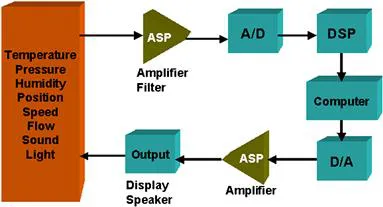
Figure 1-1: A DSP system.
Systems operate on signals to produce new signals. For example, microphones convert air pressure to electrical current, and speakers convert electrical current to air pressure.
Analog-to-digital conversion
The first step in a signal processing system is getting the information from the real world into the system. This requires transforming an analog signal to a digital representation suitable for processing by the digital system. This signal passes through a device called an analog-to-digital converter (A/D or ADC). The ADC converts the analog signal to a digital one by sampling or measuring the signal at a periodic rate. Each sample is assigned a digital code (Figure 1-2). These digital codes can then be processed by the DSP. The number of different codes or states is almost always a power of two (2, 4, 8, 16, etc.). The simplest digital signals have only two states. These are referred to as binary signals.

Figure 1-2: Analog-to-digital conversion for signal processing.
Examples of analog signals are waveforms representing human speech and signals from a television camera. Each of these analog signals can be converted to digital form using ADC and then processed using a programmable DSP.
Digital signals can be processed more efficiently than analog signals. Digital signals are generally well-defined and orderly which makes them easier for electronic circuits to distinguish from noise, which is chaotic. Noise is basically unwanted information. Noise can be anything from the background sound of an automobile engine, to a scratch on a picture that has been converted to digital format. In the analog world noise can be represented as electrical or electromagnetic energy that degrades the quality of signals and data. Noise, however, occurs in both digital and analog systems. Sampling errors (we’ll talk more about this later) can degrade digital signals as well. Too much noise can degrade all forms of information including text, programs, images, audio and video, and telemetry. Digital signal processing pr...
Table of contents
- Cover image
- Title page
- Table of Contents
- Copyright
- Author Biographies
- DSP in Embedded Systems: A Roadmap
- Chapter 1. Introduction to Digital Signal Processing
- Chapter 2. Overview of Real-time and Embedded Systems
- Chapter 3. Overview of Embedded Systems Development Lifecycle Using DSP
- Chapter 4. Programmable DSP Architectures
- Chapter 5. FPGA in Wireless Communications Applications
- Chapter 6. The DSP Hardware/Software Continuum
- Chapter 7. Overview of DSP Algorithms
- Chapter 8. High-level Design Tools for Complex DSP Applications
- Chapter 9. Optimizing DSP Software – Benchmarking and Profiling DSP Systems
- Chapter 10. Optimizing DSP Software – High-level Languages and Programming Models
- Chapter 11. Optimizing DSP Software – Code Optimization
- Chapter 12. DSP Optimization – Memory Optimization
- Chapter 13. Software Optimization for Power Consumption
- Chapter 14. DSP Operating Systems
- Chapter 15. Managing the DSP Software Development Effort
- Chapter 16. Multicore Software Development for DSP
- Chapter 17. Developing and Debugging a DSP Application
- CASE STUDY 1: Case Study – LTE Baseband Software Design
- CASE STUDY 2: DSP for Medical Devices
- CASE STUDY 3: Voice Over IP DSP Software System
- CASE STUDY 4: Software Performance Engineering of an Embedded System DSP Application
- CASE STUDY 5: Specifying Behavior of Embedded Systems
- CASE STUDY 6: DSP for Software Defined Radio
- Index
Trusted by 375,005 students
Access to over 1.5 million titles for a fair monthly price.
Study more efficiently using our study tools.
Frequently asked questions
Yes, you can cancel anytime from the Subscription tab in your account settings on the Perlego website. Your subscription will stay active until the end of your current billing period. Learn how to cancel your subscription
No, books cannot be downloaded as external files, such as PDFs, for use outside of Perlego. However, you can download books within the Perlego app for offline reading on mobile or tablet. Learn how to download books offline
Perlego offers two plans: Essential and Complete
- Essential is ideal for learners and professionals who enjoy exploring a wide range of subjects. Access the Essential Library with 800,000+ trusted titles and best-sellers across business, personal growth, and the humanities. Includes unlimited reading time and Standard Read Aloud voice.
- Complete: Perfect for advanced learners and researchers needing full, unrestricted access. Unlock 1.5M+ books across hundreds of subjects, including academic and specialized titles. The Complete Plan also includes advanced features like Premium Read Aloud and Research Assistant.
We are an online textbook subscription service, where you can get access to an entire online library for less than the price of a single book per month. With over 1.5 million books across 990+ topics, we’ve got you covered! Learn about our mission
Look out for the read-aloud symbol on your next book to see if you can listen to it. The read-aloud tool reads text aloud for you, highlighting the text as it is being read. You can pause it, speed it up and slow it down. Learn more about Read Aloud
Yes! You can use the Perlego app on both iOS and Android devices to read anytime, anywhere — even offline. Perfect for commutes or when you’re on the go.
Please note we cannot support devices running on iOS 13 and Android 7 or earlier. Learn more about using the app
Please note we cannot support devices running on iOS 13 and Android 7 or earlier. Learn more about using the app
Yes, you can access DSP for Embedded and Real-Time Systems by Robert Oshana in PDF and/or ePUB format, as well as other popular books in Computer Science & Hardware. We have over 1.5 million books available in our catalogue for you to explore.