- 332 pages
- English
- ePUB (mobile friendly)
- Available on iOS & Android
eBook - ePub
About this book
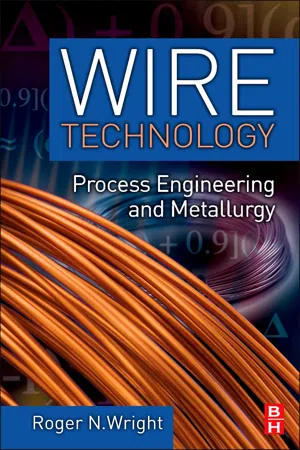
Wire drawing is a metalworking process used to reduce the diameter of a wire by pulling the wire through a single, or series of, drawing die(s). The engineering applications of wire drawing are broad and far-reaching, including electrical wiring, cables, tension-loaded structural components, springs, paper clips and spokes for wheels.
This all-new, classical text is the first to explain the complex theory and sophisticated engineering concepts with relation to wire drawing in an accessible and universal way for practicing engineers.
Designed to facilitate the entry and training of new engineers and upgrade the professional practice of those already in the field in the face of increased product demands and tightening specifications, this essential resource by industry expert Roger Wright provides:
- A technical overview and introduction of engineering concepts related to wire drawing, suitable for beginners and practiced engineers looking to brush up on the theory behind the process
- An interface with basic engineering education so as to provide an accessible introduction for engineers new to the field
- Real-world worked examples, problems and protocols based on true life engineering scenarios and challenges
- Unique coverage of the author's own pass design and risk prediction calculations, developed through decades of research and wire industry consulting
Whilst most competing titles are less practical in their approach and focus on either ferrous, non-ferrous or electrical, our book takes a universal approach more suited to the practicing engineer who needs knowledge of wire drawing across the board. Ideal for use as a complete insight into the process from start to finish or a dip-in resource for practical problem-solving, this versatile work-a-day guide, training tool and desk reference will help readers train their staff and adapt and improve processes at minimal cost for maximum performance.
- Provides a unique universal approach, covering ferrous and non-ferrous metals
- Authored by an internationally-recognized specialist in wire drawing with extensive academic and industry experience
- Real-world worked examples, problems and protocols based on true life engineering scenarios and challenges allow engineers to easily apply the theory to their workplace to improve processes, productivity and efficiency
- Compact, concise and practical in comparison to the large, competing handbook tomes that are overwhelming for beginners and impractical for day-to-day work use
- Ideal for use as a complete insight into the process from start to finish or as a dip-in resource for practical problem-solving, analysis and trouble-shooting
Information
Subtopic
Civil EngineeringTable of contents
- Cover
- Title Page
- Copyright
- Dedication
- Table of Contents
- Preface
- About the Author
- Chapter One: The General Idea
- Chapter Two: A Brief History of Technology
- Chapter Three: Twentieth Century Equipment Concepts
- Chapter Four: Basic Engineering Variables Pertinent to Drawing
- Chapter Five: Basic Drawing Mechanics
- Chapter Six: Drawing Temperature
- Chapter Seven: Drawing Speed
- Chapter Eight: Friction, Lubrication, and Surface Quality
- Chapter Nine: Drawing Die and Pass Schedule Design
- Chapter Ten: Shaped Dies and Roller Dies
- Chapter Eleven: Mechanical Properties of Wire and Related Testing
- Chapter Twelve: Drawability and Breaks
- Chapter Thirteen: Relevant Aspects of Copper and Copper Alloy Metallurgy
- Chapter Fourteen: Relevant Aspects of Carbon and Low Alloy Steel Metallurgy
- Chapter Fifteen: Other Metallurgical Systems for Wire Technology
- Chapter Sixteen: Wire Coatings
- Chapter Seventeen: Redraw Rod Production
- Chapter Eighteen: Wire Forming
- Chapter Nineteen: Physical Properties
- Chapter Twenty: Current and Near-Term Developments
- List of Symbols
- References
- Selected Formulas
- Index
Trusted by 375,005 students
Access to over 1.5 million titles for a fair monthly price.
Study more efficiently using our study tools.
Frequently asked questions
Yes, you can cancel anytime from the Subscription tab in your account settings on the Perlego website. Your subscription will stay active until the end of your current billing period. Learn how to cancel your subscription
No, books cannot be downloaded as external files, such as PDFs, for use outside of Perlego. However, you can download books within the Perlego app for offline reading on mobile or tablet. Learn how to download books offline
Perlego offers two plans: Essential and Complete
- Essential is ideal for learners and professionals who enjoy exploring a wide range of subjects. Access the Essential Library with 800,000+ trusted titles and best-sellers across business, personal growth, and the humanities. Includes unlimited reading time and Standard Read Aloud voice.
- Complete: Perfect for advanced learners and researchers needing full, unrestricted access. Unlock 1.5M+ books across hundreds of subjects, including academic and specialized titles. The Complete Plan also includes advanced features like Premium Read Aloud and Research Assistant.
We are an online textbook subscription service, where you can get access to an entire online library for less than the price of a single book per month. With over 1.5 million books across 990+ topics, we’ve got you covered! Learn about our mission
Look out for the read-aloud symbol on your next book to see if you can listen to it. The read-aloud tool reads text aloud for you, highlighting the text as it is being read. You can pause it, speed it up and slow it down. Learn more about Read Aloud
Yes! You can use the Perlego app on both iOS and Android devices to read anytime, anywhere — even offline. Perfect for commutes or when you’re on the go.
Please note we cannot support devices running on iOS 13 and Android 7 or earlier. Learn more about using the app
Please note we cannot support devices running on iOS 13 and Android 7 or earlier. Learn more about using the app
Yes, you can access Wire Technology by Roger N. Wright in PDF and/or ePUB format, as well as other popular books in Technology & Engineering & Civil Engineering. We have over 1.5 million books available in our catalogue for you to explore.