- 528 pages
- English
- ePUB (mobile friendly)
- Available on iOS & Android
eBook - ePub
About this book
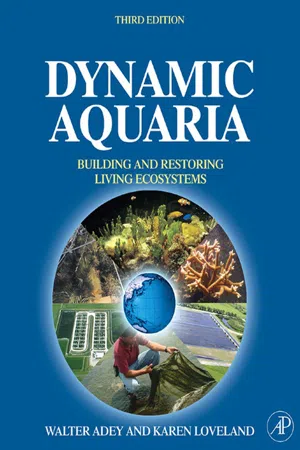
In its third edition, this praised book demonstrates how the living systems modeling of aquatic ecosystems for ecological, biological and physiological research, and ecosystem restoration can produce answers to very complex ecological questions. Dynamic Aquaria further offers an understanding developed in 25 years of living ecosystem modeling and discusses how this knowledge has produced methods of efficiently solving many environmental problems. Public education through this methodology is the additional key to the broader ecosystem understanding necessary to allow human society to pass through the next evolutionary bottleneck of our species. Living systems modeling as a wide spectrum educational tool can provide a primary vehicle for that essential step.
This third editon covers the many technological and biological developments in the eight plus years since the second edition, providing updated technological advice and describing many new example aquarium environments.
- Includes 16 page color insert with 57 color plates and 25% new photographs
- Offers 300 figures and 75 tables
- New chapter on Biogeography
- Over 50% new research in various chapters
- Significant updates in chapters include:
- The understanding of coral reef function especially the relationship between photosynthesis and calcification
- The use of living system models to solve problems of biogeography and the geographic dispersal and interaction of species populations
- The development of new techniques for global scale restoration of water and atmosphere
- The development of new techniques for closed system, sustainable aquaculture
Information
Topic
Scienze biologicheSubtopic
EcologiaTable of contents
- Cover image
- Title page
- Table of Contents
- Preface
- Acknowledgments and Dedication
- Chapter 1: Introduction
- Chapter 2: The Envelope: Physical Parameters and Energy State
- Chapter 3: Substrate: The Active Role of Rock, Mud, and Sand
- Chapter 4: Water Composition: Management of Salinity, Hardness, and Evaporation
- Chapter 5: The Input of Solar Energy: Lighting Requirements
- Chapter 6: The Input of Organic Energy: Particulates and Feeding
- Chapter 7: Metabolism: Respiration, Photosynthesis, and Biological Loading
- Chapter 8: Organisms and Gas Exchange: Oxygen, Carbon Dioxide, pH, and Alkalinity
- Chapter 9: The Primary Nutrients – Nitrogen, Phosphorus, and Silica: Limitation and Eutrophication
- Chapter 10: Biomineralization and Calcification: A Key to Biosphere and Ecosystem Function
- Chapter 11: Control of the Biochemical Environment: Filters, Bacteria, and the Algal Turf Scrubber
- Chapter 12: Community Structure: Biodiversity in Model Ecosystems
- Chapter 13: Trophic Structure: Ecosystems and the Dynamics of Food Chains
- Chapter 14: Primary Producers: Plants That Grow on the Bottom
- Chapter 15: Herbivores: Predators of Plants and Omnivores, Predators of Plants and Animals
- Chapter 16: Carnivores: Predators of Animals
- Chapter 17: Plankton and Planktivores: Floating Plants and Animals and Their Predators
- Chapter 18: Detritus and Detritivores: The Dynamics of Muddy Bottoms
- Chapter 19: Symbionts and Other Feeders
- Chapter 20: Models of Coral Reef Ecosystems
- Chapter 21: A Subarctic/Boreal Microcosm
- Chapter 22: Estuaries
- Chapter 23: Freshwater Ecosystem Models
- Chapter 24: Organisms and Natural Products
- Chapter 25: Large Scale
- Chapter 26: Microcosms, Mesocosms, and Macrocosms
- Index
- Colour Plates
Trusted by 375,005 students
Access to over 1.5 million titles for a fair monthly price.
Study more efficiently using our study tools.
Frequently asked questions
Yes, you can cancel anytime from the Subscription tab in your account settings on the Perlego website. Your subscription will stay active until the end of your current billing period. Learn how to cancel your subscription
No, books cannot be downloaded as external files, such as PDFs, for use outside of Perlego. However, you can download books within the Perlego app for offline reading on mobile or tablet. Learn how to download books offline
Perlego offers two plans: Essential and Complete
- Essential is ideal for learners and professionals who enjoy exploring a wide range of subjects. Access the Essential Library with 800,000+ trusted titles and best-sellers across business, personal growth, and the humanities. Includes unlimited reading time and Standard Read Aloud voice.
- Complete: Perfect for advanced learners and researchers needing full, unrestricted access. Unlock 1.5M+ books across hundreds of subjects, including academic and specialized titles. The Complete Plan also includes advanced features like Premium Read Aloud and Research Assistant.
We are an online textbook subscription service, where you can get access to an entire online library for less than the price of a single book per month. With over 1.5 million books across 990+ topics, we’ve got you covered! Learn about our mission
Look out for the read-aloud symbol on your next book to see if you can listen to it. The read-aloud tool reads text aloud for you, highlighting the text as it is being read. You can pause it, speed it up and slow it down. Learn more about Read Aloud
Yes! You can use the Perlego app on both iOS and Android devices to read anytime, anywhere — even offline. Perfect for commutes or when you’re on the go.
Please note we cannot support devices running on iOS 13 and Android 7 or earlier. Learn more about using the app
Please note we cannot support devices running on iOS 13 and Android 7 or earlier. Learn more about using the app
Yes, you can access Dynamic Aquaria by Walter H. Adey,Karen Loveland in PDF and/or ePUB format, as well as other popular books in Scienze biologiche & Ecologia. We have over 1.5 million books available in our catalogue for you to explore.