- 404 pages
- English
- ePUB (mobile friendly)
- Available on iOS & Android
eBook - ePub
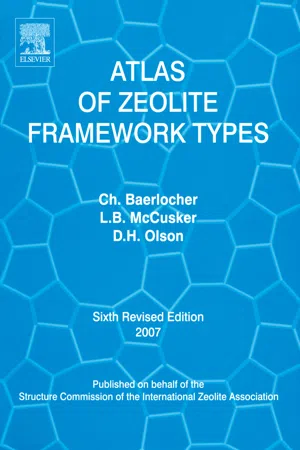
Atlas of Zeolite Framework Types
About this book
Zeolite scientists, whether they are working in synthesis, catalysis, characterization or application development, use the Atlas of Zeolite Framework Types as a reference. It describes the main features of all of the confirmed zeolite framework structures, and gives references to the relevant primary structural literature. Since the last edition 34 more framwork types have been approved and are described in this new edition. A further new feature will be that characteristic building units will be listed for each of the framework types.Zeolites and their analogs are used as desiccants, as water softeners, as shape-selective acid catalysts, as molecular sieves, as concentrators of radioactive isotopes, as blood clotting agents, and even as additives to animal feeds. Recently, their suitability as hosts for nanometer spacing of atomic clusters has also been demonstrated. These diverse applications are a reflection of the fascinating structures of these microporous materials. Each time a new zeolite framework structure is reported, it is examined by the Structure Commission of the International Zeolite Association (IZA-SC), and if it is found to be unique and to conform to the IZA-SC's definition of a zeolite, it is assigned a 3-letter framework type code. This code is part of the official IUPAC nomenclature for microporous materials. The Atlas of Zeolite Framework Types is essentially a compilation of data for each of these confirmed framework types. These data include a stereo drawing showing the framework connectivity, features that characterize the idealized framework structure, a list of materials with this framework type, information on the type material that was used to establish the framework type, and stereo drawings of the pore openings of the type material.
- Clear stereo drawings of each of the framework types
- Description of the features of the framework type, allowing readers to quickly see if the framework type is suitable to their needs
- References to isotypic materials, readers can quickly identify related materials and consult the appropriate reference
Information
Table of contents
- Cover image
- Title page
- Table of Contents
- Preface
- Chapter 1: Introduction and explanatory notes
- Chapter 2: Imma
- Chapter 3: Im3¯m
- Chapter 4: Cmcm
- Chapter 5: Imma
- Chapter 6: Cmce
- Chapter 7: Cmcm
- Chapter 8: P63/mmc
- Chapter 9: P6/mcc
- Chapter 10: C2/m
- Chapter 11: Cmcm
- Chapter 12: Pmmn
- Chapter 13: P63/mcm
- Chapter 14: P63/mmc
- Chapter 15: P63/mmc
- Chapter 16: P3¯1m
- Chapter 17: Cmcm
- Chapter 18: Ia3¯d
- Chapter 19: Cmce
- Chapter 20: Cmce
- Chapter 21: Fm3¯m
- Chapter 22: P4/mcc
- Chapter 23: I4/mmm
- Chapter 24: R3¯m
- Chapter 25: Cmcm
- Chapter 26: Pmma
- Chapter 27: Cmme
- Chapter 28: Cmce
- Chapter 29: P4/nmm
- Chapter 30: I4/mmm
- Chapter 31: P4122
- Chapter 32: P42/mmc
- Chapter 33: Cmcm
- Chapter 34: Imma
- Chapter 35: P6¯2m
- Chapter 36: P21lm
- Chapter 37: P63lmmc
- Chapter 38: Cmcm
- Chapter 39: Cmcm
- Chapter 40: Imma
- Chapter 41: C2/m
- Chapter 42: Pnma
- Chapter 44: Pbcn
- Chapter 46: C2/m
- Chapter 47: P6122
- Chapter 48: C2/m
- Chapter 50: P6/mmm
- Chapter 51: P42/mmc
- Chapter 52: P6/mmm
- Chapter 53: Cmcm
- Chapter 54: P63/mmc
- Chapter 55: P4¯m2
- Chapter 56: P63/mmc
- Chapter 57: Pmmn
- Chapter 58: C2/m
- Chapter 59: P63/mmc
- Chapter 60: Pnma
- Chapter 61: P63mc
- Chapter 62: Cmme
- Chapter 63: Imma
- Chapter 64: PG3/mmc
- Chapter 65: Fd3¯m
- Chapter 66: Immm
- Chapter 67: P3¯m1
- Chapter 68: I41/amd
- Chapter 69: P63/mmc
- Chapter 70: P63/mmc
- Chapter 71: Cmmm
- Chapter 72: C2221
- Chapter 73: C2/m
- Chapter 74: C2/m
- Chapter 75: Cmce
- Chapter 76: Cmcm
- Chapter 77: P42/mmc
- Chapter 78: Cmcm
- Chapter 79: Amm2
- Chapter 80: C2/m
- Chapter 81: Cmmm
- Chapter 82: Fmmm
- Chapter 83: Pbam
- Chapter 84: Pmma
- Chapter 85: Im3¯m
- Chapter 86: C2/m
- Chapter 87: R3¯m
- Chapter 88: P6¯m2
- Chapter 89: Pnma
- Chapter 90: P63/mmc
- Chapter 91: P42/mmc
- Chapter 92: Pm3¯m
- Chapter 93: P6/mmm
- Chapter 94: Fd3¯m
- Chapter 95: P63/mmc
- Chapter 96: P63/mmc
- Chapter 97: P63/m
- Chapter 98: I4¯m2
- Chapter 99: Pm3¯n
- Chapter 100: I4/mmm
- Chapter 101: Pnma
- Chapter 102: Imm2
- Chapter 103: 141/amd
- Chapter 104: Cmcm
- Chapter 105: P6/mmm
- Chapter 106: P42/mnm
- Chapter 107: R3¯m
- Chapter 108: C2/m
- Chapter 109: Fd3¯m
- Chapter 110: Pmmn
- Chapter 111: C2/m
- Chapter 112: P6/mmm
- Chapter 113: I4¯m2
- Chapter 114: I41/amd
- Chapter 115: Fmmm
- Chapter 116: Fmmm
- Chapter 117: P63/mmc
- Chapter 118: C2/m
- Chapter 119: I4/mmm
- Chapter 120: Offretite
- Chapter 121: I4/mmm
- Chapter 122: P6222
- Chapter 123: Pmma
- Chapter 124: C2/c
- Chapter 125: Im3¯m
- Chapter 126: Cmcm
- Chapter 127: Pca21
- Chapter 128: Im3¯m
- Chapter 129: I4/mcm
- Chapter 130: P2/c
- Chapter 131: Cmmm
- Chapter 132: C2/m
- Chapter 133: C2/m
- Chapter 134: C2/m
- Chapter 135: /41/amd
- Chapter 136: Im3¯m
- Chapter 137: I4¯m2
- Chapter 138: I4/mmm
- Chapter 139: R3¯m
- Chapter 140: P4/nmm
- Chapter 141: I4/mmm
- Chapter 142: P63/mmc
- Chapter 143: R3¯m
- Chapter 144: P21/m
- Chapter 145: P21/m
- Chapter 146: Pmma
- Chapter 147: Cmcm
- Chapter 148: C2/m
- Chapter 149: C2/m
- Chapter 150: 141/amd
- Chapter 151: Cmcm
- Chapter 152: Im3¯m
- Chapter 153: Pmna
- Chapter 154: Pmmn
- Chapter 155: C2/m
- Chapter 156: Fmmm
- Chapter 157: P21In
- Chapter 158: Cmmm
- Chapter 159: Cmcm
- Chapter 160: Pmma
- Chapter 161: P3¯m1
- Chapter 162: Cmcm
- Chapter 163: Fm3¯m
- Chapter 164: C2/m
- Chapter 165: Fmm2
- Chapter 166: I4/mmm
- Chapter 167: P4/nnc
- Chapter 168: C2/m
- Chapter 169: C2/m
- Chapter 170: P4¯
- Chapter 171: P63/mcm
- Chapter 172: P42/ncm
- Chapter 173: I41/amd
- Chapter 174: Cccm
- Chapter 175: P6¯2m
- Chapter 176: C2/m
- Chapter 177: Pbcm
- Appendix A: Additional information for the data sheets of CHA, GIS IMF, IWW, MFI, PAU, TUN, UTL
- Appendix B: Rules for Framework Type Assignment
- Appendix C: Secondary Building Units and their Symbols
- Appendix D: Selected Composite Building Units
- Appendix E: Channel System Dimensions
- Appendix F: Topological Densities
- Appendix G: Origin of 3-Letter Codes and Material Names
- Isotypic Material Index
Trusted by 375,005 students
Access to over 1.5 million titles for a fair monthly price.
Study more efficiently using our study tools.
Frequently asked questions
Yes, you can cancel anytime from the Subscription tab in your account settings on the Perlego website. Your subscription will stay active until the end of your current billing period. Learn how to cancel your subscription
No, books cannot be downloaded as external files, such as PDFs, for use outside of Perlego. However, you can download books within the Perlego app for offline reading on mobile or tablet. Learn how to download books offline
Perlego offers two plans: Essential and Complete
- Essential is ideal for learners and professionals who enjoy exploring a wide range of subjects. Access the Essential Library with 800,000+ trusted titles and best-sellers across business, personal growth, and the humanities. Includes unlimited reading time and Standard Read Aloud voice.
- Complete: Perfect for advanced learners and researchers needing full, unrestricted access. Unlock 1.5M+ books across hundreds of subjects, including academic and specialized titles. The Complete Plan also includes advanced features like Premium Read Aloud and Research Assistant.
We are an online textbook subscription service, where you can get access to an entire online library for less than the price of a single book per month. With over 1.5 million books across 990+ topics, we’ve got you covered! Learn about our mission
Look out for the read-aloud symbol on your next book to see if you can listen to it. The read-aloud tool reads text aloud for you, highlighting the text as it is being read. You can pause it, speed it up and slow it down. Learn more about Read Aloud
Yes! You can use the Perlego app on both iOS and Android devices to read anytime, anywhere — even offline. Perfect for commutes or when you’re on the go.
Please note we cannot support devices running on iOS 13 and Android 7 or earlier. Learn more about using the app
Please note we cannot support devices running on iOS 13 and Android 7 or earlier. Learn more about using the app
Yes, you can access Atlas of Zeolite Framework Types by Ch. Baerlocher,Lynne B. McCusker,D.H. Olson in PDF and/or ePUB format, as well as other popular books in Technology & Engineering & Mineralogy. We have over 1.5 million books available in our catalogue for you to explore.