eBook - ePub
Biomathematics
Mathematics of Biostructures and Biodynamics
- 525 pages
- English
- ePUB (mobile friendly)
- Available on iOS & Android
eBook - ePub
Biomathematics
Mathematics of Biostructures and Biodynamics
About this book
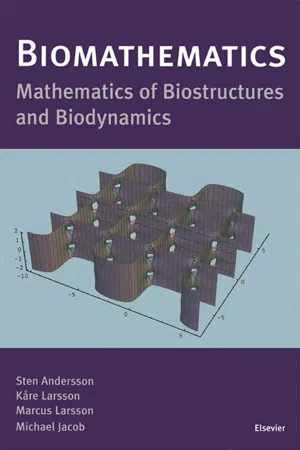
This book presents new mathematics for the description of structure and dynamics in molecular and cellular biology. On an exponential scale it is possible to combine functions describing inner organisation, including finite periodicity, with functions for outside morphology into a complete definition of structure. This mathematics is particularly fruitful to apply at molecular and atomic distances. The structure descriptions can then be related to atomic and molecular forces and provide information on structural mechanisms. The calculations have been focussed on lipid membranes forming the surface layers of cell organelles. Calculated surfaces represent the mid-surface of the lipid bilayer. Membrane dynamics such as vesicle transport are described in this new language. Periodic membrane assemblies exhibit conformations based on the standing wave oscillations of the bilayer, considered to reflect the true dynamic nature of periodic membrane structures. As an illustration the structure of an endoplasmatic reticulum has been calculated. The transformation of such cell membrane assemblies into cubosomes seems to reflect a transition into vegetative states. The organisation of the lipid bilayer of nerve cells is analyzed, taking into account an earlier observed lipid bilayer phase transition associated with the depolarisation of the membrane. Evidence is given for a new structure of the alveolar surface, relating the mathematical surface defining the bilayer organisation to new experimental data. The surface layer is proposed to consist of a coherent phase, consisting of a lipid-protein bilayer curved according to a classical surface - the CLP surface. Without employing this new mathematics it would not be possible to give an analytical description of this structure and its deformation during the respiration cycle. In more general terms this mathematics is applied to the description of the structure and dynamic properties of motor proteins, cytoskeleton proteins, and RNA/DNA. On a macroscopic scale the motions of cilia, sperm and flagella are modelled. This mathematical description of biological structure and dynamics, biomathematics, also provides significant new information in order to understand the mechanisms governing shape of living organisms.
Information
Table of contents
- Cover image
- Title page
- Table of Contents
- Copyright
- Chapter 1: Introduction
- Chapter 2: Counting, Algebra and Periodicity - the Roots of Mathematics are the Roots of Life
- Chapter 3: Nodal Surfaces of Tetragonal and Hexagonal Symmetry, and Rods
- Chapter 4: Nodal Surfaces, Planes, Rods and Transformations
- Chapter 5: Motion in Biology
- Chapter 6: Periodicity in Biology - Periodic Motion
- Chapter 7: Finite Periodicity and the Cubosomes
- Chapter 8: Cubic Cell Membrane Systems/Cell Organelles and Periodically Curved Single Membranes
- Chapter 9: Cells and their Division - Motion in Muscles and in DNA
- Chapter 10: Concentration Gradients, Filaments, Motor Proteins and again - Flagella
- Chapter 11: Transportation
- Chapter 12: Icosahedral Symmetry, Clathrin Structures, Spikes, Axons, the Tree, and Solitary Waves
- Chapter 13: Axon Membranes and Synapses - A Role of Lipid Bilayer Structure in Nerve Signals
- Chapter 14: The Lung Surface Structure and Respiration
- Chapter 15: Epilogue
- The Plane, the Cylinder and the Sphere
- Periodicity
- The Exponential Scale, the GD function, Cylinder and Sphere Fusion
- The Exponential Scale, the Planes and the Natural Function, Addition and Subtraction
- Multiplication of Planes, Saddles and Spirals
- Symmetry
- The Complex Exponential, the Natural Exponential and the GD-Exponential - General Examples and Finite Periodicity
- Classical Differential Geometry and the Exponential Scale
- Mathematica
- Subject Index
Trusted by 375,005 students
Access to over 1.5 million titles for a fair monthly price.
Study more efficiently using our study tools.
Frequently asked questions
Yes, you can cancel anytime from the Subscription tab in your account settings on the Perlego website. Your subscription will stay active until the end of your current billing period. Learn how to cancel your subscription
No, books cannot be downloaded as external files, such as PDFs, for use outside of Perlego. However, you can download books within the Perlego app for offline reading on mobile or tablet. Learn how to download books offline
Perlego offers two plans: Essential and Complete
- Essential is ideal for learners and professionals who enjoy exploring a wide range of subjects. Access the Essential Library with 800,000+ trusted titles and best-sellers across business, personal growth, and the humanities. Includes unlimited reading time and Standard Read Aloud voice.
- Complete: Perfect for advanced learners and researchers needing full, unrestricted access. Unlock 1.5M+ books across hundreds of subjects, including academic and specialized titles. The Complete Plan also includes advanced features like Premium Read Aloud and Research Assistant.
We are an online textbook subscription service, where you can get access to an entire online library for less than the price of a single book per month. With over 1.5 million books across 990+ topics, we’ve got you covered! Learn about our mission
Look out for the read-aloud symbol on your next book to see if you can listen to it. The read-aloud tool reads text aloud for you, highlighting the text as it is being read. You can pause it, speed it up and slow it down. Learn more about Read Aloud
Yes! You can use the Perlego app on both iOS and Android devices to read anytime, anywhere — even offline. Perfect for commutes or when you’re on the go.
Please note we cannot support devices running on iOS 13 and Android 7 or earlier. Learn more about using the app
Please note we cannot support devices running on iOS 13 and Android 7 or earlier. Learn more about using the app
Yes, you can access Biomathematics by S. Andersson,K. Larsson,M. Larsson,M. Jacob in PDF and/or ePUB format, as well as other popular books in Mathematics & Applied Mathematics. We have over 1.5 million books available in our catalogue for you to explore.