eBook - ePub
Geochemistry of Earth Surface Systems
A derivative of the Treatise on Geochemistry
- 688 pages
- English
- ePUB (mobile friendly)
- Available on iOS & Android
eBook - ePub
Geochemistry of Earth Surface Systems
A derivative of the Treatise on Geochemistry
About this book
Geochemistry of Earth Surface Systems offers an interdisciplinary reference for scientists, researchers and upper undergraduate and graduate level geochemistry students a sampling of articles on earth surface processes from The Treatise on Geochemistry that is more affordable than the full Treatise. For professionals, this volume will provide an overview of the field as a whole. For students, it will provide more in-depth introductory content than is found in broad-based geochemistry textbooks. Articles were selected from chapters across all volumes of the full Treatise, and include: Volcanic Degassing, Hydrothermal Processes, The Contemporary Carbon Cycle, Global Occurrence of Major Elements in Rivers, Organic Matter in the Contemporary Ocean, The Biological Pump, and Evolution of Sedimentary Rocks.
- Comprehensive, interdisciplinary and authoritative content selected by leading subject experts
- Robust illustrations, figures and tables
- Affordably priced sampling of content from the full Treatise on Geochemistry
Information
Topic
Physical SciencesSubtopic
Geology & Earth Sciences1
Volcanic Degassing
C. Oppenheimer University of Cambridge, UK
NOMENCLATURE
reff effective aerosol radius
D diffusion coefficient of given volatile in melt
I solar irradiance at given level in atmosphere
Io solar irradiance at top of the atmosphere
KR constant in vesicularity equation (2)
N constant in solubility equation (1)
P pressure
Pe Peclet number
R bubble radius
S constant in solubility equation (1)
Vg/V1 ratio between the volumes of gas and melt at given pressure


η melt dynamic viscosity
τ aerosol optical depth
τd timescale of volatile diffusion
τη timescale of viscous relaxation
ΔP oversaturation pressure
Θ solar zenith angle
Nature only reveals her secrets if we ask the right questions and listen, and listening in geochemistry means sampling, analyzing, plotting. (Werner Giggenbach, 1992b)
1.1 INTRODUCTION
Humans have long marveled at the odorous and colorful manifestations of volcanic emissions, and, in some cases, have harnessed them for their economic value (Figure 1). Moreover, the degassing of magma that is responsible for them is one of the key processes influencing the timing and nature of volcanic eruptions, and the emissions of these volatiles to the atmosphere can have profound effects on the atmospheric and terrestrial environment, and climate, at timescales ranging from a few years to > 1 Myr, and spatial scales from local to global (Oppenheimer et al., 2003a). Even more fundamental are the relationships between the history of planetary outgassing, differentiation of the Earth’s interior, chemistry of the atmosphere and hydrosphere, and the origin and evolution of life (e.g., Kelley et al., 2002).
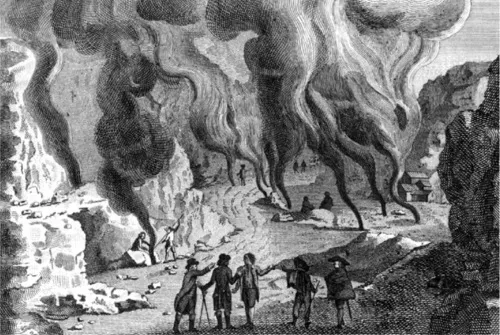
Figure 1 “The burning valley called Vulcan’s Cave near Naples” or Solfatara (Campi Flegrei), from Bankes’s New System of Geography (~1800).
This chapter focuses on the origins, composition and flux, and the environmental impacts of volcanic volatile emissions. This introductory section sets the scene by considering the general context and significance of volcanic degassing. Several chapters in this volume interface with this one on volcanic degassing, and in particular the reader is referred to the chapters on hydrothermal systems and ore formation.
1.1.1 Earth Outgassing, Atmospheric Evolution and Global Climate
Volcanic emissions have occurred throughout Earth history, and have provided the inventory of volatile elements that take part in the major geochemical cycles involving the lithosphere, hydrosphere, atmosphere, and biosphere (Sections 1.2 and 1.5; Holland, 1984; Arthur, 2000; see Chapter 5). The mantle is an important reservoir for volatiles, and its concentration of carbon, sulfur, hydrogen, oxygen, and halogens has changed through Earth history as a result of differentiation. Anhydrous minerals such as olivine, pyroxene, and garnet can hold structurally bound OH−, while molecular water is present in amphibole, phologopite, and apatite. Carbon is present in carbonate minerals or in elemental form (e.g., diamond and graphite), and sulfur in sulfide minerals. Volatiles probably also exist in the mantle in intergranular films. Since the volatile species are incompatible, they partition into the melt phase during partial melting of the mantle. In this way, magmagenesis plays a key role in transferring volatiles between the mantle and the crust. Magma evolution then partitions volatiles between the crust and the atmosphere/hydrosphere via degassing and eruption (with important feedbacks on magma differentiation), and plate recycling ensures a return flux of a proportion of the volatiles back to the mantle.
Major changes have occurred in atmospheric composition and in greenhouse gas forcing over Earth history, in part coupled to the evolution of life, and interacting with changes in solar flux and planetary albedo to control global climate. Over timescales exceeding 1 Myr, the carbon cycle operates as a climate thermostat on the Earth. The Archean atmosphere was anoxic, even after the onset of oxygenic ph...
Table of contents
- Cover image
- Title page
- Table of Contents
- Copyright page
- Introduction
- Contributors
- 1: Volcanic Degassing
- 2: Hydrothermal Processes
- 3: The Contemporary Carbon Cycle
- 4: The Global Sulfur Cycle
- 5: The History of Planetary Degassing as Recorded by Noble Gases
- 6: Natural Weathering Rates of Silicate Minerals
- 7: Soil Formation
- 8: Global Occurrence of Major Elements in Rivers
- 9: Trace Elements in River Waters
- 10: The Geologic History of the Carbon Cycle
- 11: Organic Matter in the Contemporary Ocean
- 12: The Biological Pump
- 13: The Biological Pump in the Past
- 14: The Oceanic CaCO3 Cycle
- 15: The Global Oxygen Cycle
- 16: The Global Nitrogen Cycle
- 17: Evolution of Sedimentary Rocks
- 18: Generation of Mobile Components during Subduction of Oceanic Crust
- Appendix 1: Periodic Table of the Elements
- Appendix 2: Table of Isotopes
- Appendix 3: The Geologic Timescale
- Appendix 4: Useful Values
- Index
Trusted by 375,005 students
Access to over 1.5 million titles for a fair monthly price.
Study more efficiently using our study tools.
Frequently asked questions
Yes, you can cancel anytime from the Subscription tab in your account settings on the Perlego website. Your subscription will stay active until the end of your current billing period. Learn how to cancel your subscription
No, books cannot be downloaded as external files, such as PDFs, for use outside of Perlego. However, you can download books within the Perlego app for offline reading on mobile or tablet. Learn how to download books offline
Perlego offers two plans: Essential and Complete
- Essential is ideal for learners and professionals who enjoy exploring a wide range of subjects. Access the Essential Library with 800,000+ trusted titles and best-sellers across business, personal growth, and the humanities. Includes unlimited reading time and Standard Read Aloud voice.
- Complete: Perfect for advanced learners and researchers needing full, unrestricted access. Unlock 1.5M+ books across hundreds of subjects, including academic and specialized titles. The Complete Plan also includes advanced features like Premium Read Aloud and Research Assistant.
We are an online textbook subscription service, where you can get access to an entire online library for less than the price of a single book per month. With over 1.5 million books across 990+ topics, we’ve got you covered! Learn about our mission
Look out for the read-aloud symbol on your next book to see if you can listen to it. The read-aloud tool reads text aloud for you, highlighting the text as it is being read. You can pause it, speed it up and slow it down. Learn more about Read Aloud
Yes! You can use the Perlego app on both iOS and Android devices to read anytime, anywhere — even offline. Perfect for commutes or when you’re on the go.
Please note we cannot support devices running on iOS 13 and Android 7 or earlier. Learn more about using the app
Please note we cannot support devices running on iOS 13 and Android 7 or earlier. Learn more about using the app
Yes, you can access Geochemistry of Earth Surface Systems by Heinrich D Holland,Karl K. Turekian in PDF and/or ePUB format, as well as other popular books in Physical Sciences & Geology & Earth Sciences. We have over 1.5 million books available in our catalogue for you to explore.