eBook - ePub
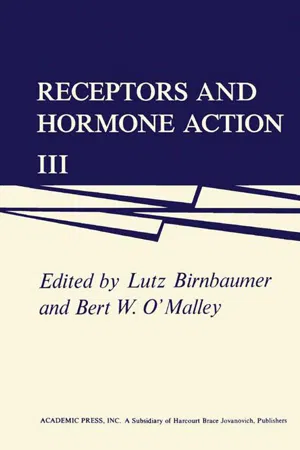
Receptors and Hormone Action
Volume III
- 648 pages
- English
- ePUB (mobile friendly)
- Available on iOS & Android
eBook - ePub
Receptors and Hormone Action
Volume III
About this book
Receptors and Hormone Action, Volume III, is part of a multivolume series that summarizes advances in the field of hormone action. The articles contained in these books are oriented toward a description of basic methodologies and model systems used in the exploration of the molecular bases of hormone action, and are aimed at a broad spectrum of readers including those who have not yet worked in the field as well as those who have considerable expertise in one or another aspect of hormone action. This book opens with a chapter on the physiological properties of the thyroid hormone receptors in the intact animal. This is followed by separate chapters on ?-adrenergic receptors; the study of hormone-receptor interaction by measuring the biological responses induced by the actions of gonadotropins on Leydig cells; chemical and immunochemical properties of hCG and PMSG treated with glycosidases; and binding of follitropin (FSH) to rat testes. Subsequent chapters deal with the control of changes of gonadotropin responsiveness of the granulosa cell during follicular maturation; regulation of prolactin receptors by steroid hormones; and the role of membrane protein phosphorylation in the effects of neurotransmitters.
Information
1
Nuclear Receptors for Triiodothyronine: A Physiological Perspective
J.H. OPPENHEIMER and W.H. DILLMANN*
Publisher Summary
This chapter discusses the excess and deficiency of thyroid hormone, the dynamics of T3 bound to nuclear sites, physiological role of the nuclear T3 binding site, the possibility of other initiating sites, and speculations on molecular mechanisms. The excess or deficiency of thyroid hormone, which is termed as hypothyroidism and hyperthyroidism, results in a number of abnormalities. In particular, the changes in the enzyme activity are related with the alteration in thyroid state. Many enzymes enhances in activity with thyroid hormone administration, whereas others decrease. Among the enzymes that parallel thyroid state with an especially wide excursion are mitochondrial α-glycerophosphate dehydrogenase (a-GPD) and malic enzyme which is located in cytosol. In hypothyroidism, α-GPD and malic enzyme decline to almost undetectable levels. The function of these enzymes is poorly understood, although α-GPD is known to be linked to the respiratory chain, and malic enzyme is considered to be important in supplying NADPH for fatty acid synthesis.
I. Introduction: Thyroid Hormone Deficiency and Excess
II. Dynamics of T3 Bound to Nuclear Sites
III. Physiological Role of the Nuclear T3 Binding Site
IV. The Possibility of Other Initiating Sites
V. Speculations on Molecular Mechanisms
VI. Concluding Remarks
References
I INTRODUCTION: THYROID HORMONE DEFICIENCY AND EXCESS
The biological role of the thyroid hormones is currently understood largely in terms of a catalogue of apparently unrelated effects that are observed in the hypothyroid and hyperthyroid state. These are produced experimentally in animals or in the course of therapeutic manipulations or spontaneous disease in man. Thus, in the absence of a functioning thyroid gland, growth and development are severely retarded. In man, such retardation, especially in the growth and differentiation of the skeletal and central nervous systems, results in the syndrome of cretinism. In the tadpole, absence of thyroid hormone prevents progression to metamorphosis, a complex series of biochemical, physiological, and morphological events that characterizes the transition from the aquatic to the terrestrial state. In the adult form, the thyroprival state is associated yet with another series of abnormalities. Of these, the most generally recognized is the decrease in oxygen consumption, both in the whole animal and in certain excised tissues. Other changes that occur in hypothyroidism include slowing of the heart rate, accumulation of mucopolysaccharides in skin, alterations in lipid concentration in blood, and a decreased fractional metabolism of many metabolites and drugs. In fact, physiological and biochemical changes of one sort or another characterize almost every organ system. These are well described in standard texts. On the other hand, hyperthyroidism is associated with oppositely directed changes including increased oxygen consumption, both in the whole animal as well as in certain excised tissues, an accelerated heart rate, and an enhanced fractional turnover of metabolites and drugs.
Of particular interest are the changes in enzyme activity that are associated with alterations in thyroid state. Many enzymes increase in activity with thyroid hormone administration, whereas others decrease. Among the enzymes that parallel thyroid state with an especially wide excursion are mitochondrial α-glycerophosphate dehydrogenase (α-GPD) (Ruegamer et al., 1964) and malic enzyme, which is located in cytosol (Young, 1968). In hypothyroidism, α-GPD and malic enzyme decline to almost undetectable levels. Whether the residual activity is due to basal enzyme activity independent of thyroid hormone influence or reflects incomplete hypothyroidism has not been established. The function of these enzymes is poorly understood, although α-GPD is known to be linked to the respiratory chain (Ringler and Singer, 1959), and malic enzyme is considered to be important in supplying NADPH for fatty acid synthesis (Youngs et al., 1964).
The poorly defined interrelationships of these parameters pose an obstacle in any effort to define the mechanism of thyroid hormone action at a cellular level. It cannot even be assumed that there exists a single point of hormone initiation. Conceivably, multiple intracellular pathways could be involved in reaching separate end points of thyroid hormone action. Moreover, among the various thyroid hormone actions, only the suppression of TSH can be considered to be in any way “specific.” Unfortunately, inhibition of pituitary TSH appears to be an unusually complex process, since it is believed to occur as a result of the stimulation of an inhibitory protein (Lee et al., 1968). Under any circumstance, this process must be considered to be highly specialized and, thus, possibly unrepresentative of other manifestations of thyroid hormone action.
A fundamental problem also arises as to whether or not a given tissue is responsive to thyroid hormone. Of the various criteria that have been applied, perhaps the change in oxygen consumption with thyroid hormone administration and deprivation is generally regarded as the best index of response (Barker and Klitgaard, 1952). Although the association between thyroid hormones and oxygen consumption has been established for many years, it is not clear, however, that changes in oxygen consumption represent a sine qua non for thyroid hormone response. This presents an especially vexing problem in relationship to brain, a tissue which is apparently unresponsive by the criterion of oxygen consumption but nonetheless exhibits functional alterations in clinical states of thyroid excess and deficiency. It appears possible that the appropriate parameters for assessing thyroid hormone response in this tissue have not been defined.
Another obstacle to the analysis of thyroid hormone action has been the uncertain significance of many in vitro models for the study of thyroid hormone effects. Frequently, the concentrations of thyroid hormone required to produce changes have been many orders of magnitude above those required to achieve similar end points under physiological circumstances (Buchanan and Tapley, 1966; Gordon et al., 1973). Moreover, many of the in vitro interactions have been characterized by a rapid onset after the addition and a rapid cessation of effect after the withdrawal of hormone from the proposed initiating site. Thus, the increase in amino acid incorporation into mitochondrial proteins begins within minutes after addition of thyroxine (T4) and is quickly reduced when the concentration bound to the mitochondria is reduced. As will be detailed subsequently, these characteristics do not reflect the slow rates of initiation and dissipation of tissue responses to thyroid hormone in the intact animal.
In view of these problems, it is not surprising that, despite the venerable history of the thyroid hormones, our concepts of their mechanism of action at the cellular level remain both primitive and fragmentary. The recent description of what appear to be specific nuclear binding sites for triiodothyronine (T3) in various tissues of the rat (Oppenheimer et al., 1972a, 1974a; Samuels and Tsai, 1973; De Groot and Strausser, 1974; Latham et al., 1976) and in other species (Tsai and Samuels, 1974; Kistler et al., 1975) presents an unusual opportunity for the study of the mechanism of action of thyroid hormone at a molecular level. If it can be demonstrated that the nuclear binding sites are receptors instrumental in the initiation of thyroid hormone action, a biochemical intracellular reference point will be available, which should be helpful in defining the subsequent reactions which lead to hormone action.
Accordingly, we propose in this chapter to review our current state of knowledge with regard to the physiological properties of the thyroid hormone receptors in the intact animal. We shall consider first the quantitative relationships between hormone bound to the specific nuclear sites and hormone in cytosol and plasma. We shall discuss in vivo kinetic techniques, which have allowed definition of nuclear binding capacity, the mass of iodothyronine normally bound to the nucleus, and the affinity of these sites. We shall then consider the available evidence supporting the concept that these sites are true receptors involved in the initiation of thyroid hormone action. The possibility of extranuclear receptors will also be examined. An analysis of the quantitative relationship between nuclear hormonal occupancy and tissue response will follow. The temporal...
Table of contents
- Cover image
- Title page
- Table of Contents
- Contributors
- Copyright
- List of Contributors
- Preface
- Contents of Previous Volumes
- Chapter 1: Nuclear Receptors for Triiodothyronine: A Physiological Perspective
- Chapter 2: In Vitro Studies on Thyroid Hormone Receptors
- Chapter 3: Regulation of Gene Expression by Thyroid Hormones
- Chapter 4: Direct Identification and Characterization of β-Adrenergic Receptors and Functional Relationship of Adenylyl Cyclase
- Chapter 5: Heart β-Adrenoceptors
- Chapter 6: Regulation of β-Adrenergic Receptors by β-Adrenergic Agonists
- Chapter 7: Regulation of β-Adrenergic Function in the Rat Pineal Gland
- Chapter 8: A Model for Peptide Hormone Action Based upon Measurement of Functional Hormone Binding
- Chapter 9: Role of Carbohydrate in the Action of Gonadotropins
- Chapter 10: Gonadotropin Receptors and Regulation of Interstitial Cell Function in the Testis
- Chapter 11: Follitropin Receptors in Rat Testis Tubule Membranes: Characterization, Solubilization, and Study of Factors Affecting Interaction with FSH
- Chapter 12: Mechanism of Action of FSH in the Male Rat
- Chapter 13: Physiological Aspects of Appearance and Desensitization of Gonadotropin-Sensitive Adenylyl Cyclase in Ovarian Tissues and Membranes of Rabbits, Rats, and Pigs
- Chapter 14: Development and Hormonal Regulation of Gonadotropin Responsiveness in Granulosa Cells of the Mammalian Ovary
- Chapter 15: Regulation of Prolactin Receptors by Steroid Hormones and Use of Radioligand Assays in Endocrine Research
- Chapter 16: Hormone Regulation of Ovarian Hormone Receptors
- Chapter 17: Interactions of TRH, LH-RH, and Somatostatin in the Anterior Pituitary Gland
- Chapter 18: Brain Receptors for Neurotransmitters
- Chapter 19: The Mechanism of Opiate Agonist and Antagonist Action
- Chapter 20: Hormonal Regulation of Cyclic Nucleotide Phosphodiesterases
- Chapter 21: Phosphorylation of Membrane Proteins in the Actions of Hormones and Neurotransmitters
- Index
Trusted by 375,005 students
Access to over 1.5 million titles for a fair monthly price.
Study more efficiently using our study tools.
Frequently asked questions
Yes, you can cancel anytime from the Subscription tab in your account settings on the Perlego website. Your subscription will stay active until the end of your current billing period. Learn how to cancel your subscription
No, books cannot be downloaded as external files, such as PDFs, for use outside of Perlego. However, you can download books within the Perlego app for offline reading on mobile or tablet. Learn how to download books offline
Perlego offers two plans: Essential and Complete
- Essential is ideal for learners and professionals who enjoy exploring a wide range of subjects. Access the Essential Library with 800,000+ trusted titles and best-sellers across business, personal growth, and the humanities. Includes unlimited reading time and Standard Read Aloud voice.
- Complete: Perfect for advanced learners and researchers needing full, unrestricted access. Unlock 1.5M+ books across hundreds of subjects, including academic and specialized titles. The Complete Plan also includes advanced features like Premium Read Aloud and Research Assistant.
We are an online textbook subscription service, where you can get access to an entire online library for less than the price of a single book per month. With over 1.5 million books across 990+ topics, we’ve got you covered! Learn about our mission
Look out for the read-aloud symbol on your next book to see if you can listen to it. The read-aloud tool reads text aloud for you, highlighting the text as it is being read. You can pause it, speed it up and slow it down. Learn more about Read Aloud
Yes! You can use the Perlego app on both iOS and Android devices to read anytime, anywhere — even offline. Perfect for commutes or when you’re on the go.
Please note we cannot support devices running on iOS 13 and Android 7 or earlier. Learn more about using the app
Please note we cannot support devices running on iOS 13 and Android 7 or earlier. Learn more about using the app
Yes, you can access Receptors and Hormone Action by Lutz Birnbaumer, Bert O'Malley, Lutz Birnbaumer,Bert O'Malley,Bert W. O'Malley in PDF and/or ePUB format, as well as other popular books in Biological Sciences & Zoology. We have over 1.5 million books available in our catalogue for you to explore.