eBook - ePub
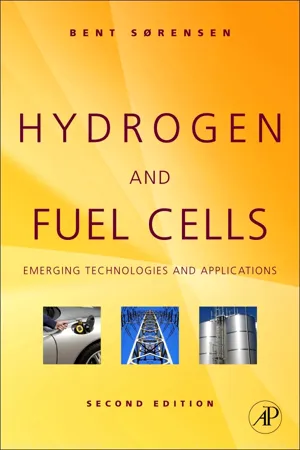
Hydrogen and Fuel Cells
Emerging Technologies and Applications
- 512 pages
- English
- ePUB (mobile friendly)
- Available on iOS & Android
eBook - ePub
About this book
A hydrogen economy, in which this one gas provides the source of all energy needs, is often touted as the long-term solution to the environmental and security problems associated with fossil fuels. However, before hydrogen can be used as fuel on a global scale we must establish cost effective means of producing, storing, and distributing the gas, develop cost efficient technologies for converting hydrogen to electricity (e.g. fuel cells), and creating the infrastructure to support all this. Sorensen is the only text available that provides up to date coverage of all these issues at a level appropriate for the technical reader.
The book not only describes the "how" and "where" aspects of hydrogen fuels cells usage, but also the obstacles and benefits of its use, as well as the social implications (both economically and environmental). Written by a world-renowned researcher in energy systems, this thoroughly illustrated and cross-referenced book is an excellent reference for researchers, professionals and students in the field of renewable energy.
- Updated sections on PEM fuel cells, Molten carbonate cells, Solid Oxide cells and Biofuel cells
- Updated material to reflect the growing commercial acceptance of stationary and portable fuel cell systems, while also recognizing the ongoing research in automotive fuel cell systems
- A new example of a regional system based on renewable energy sources reflects the growing international attention to uses of renewable energy as part of the energy grid
- Examples of life cycle analysis of environmental and social impacts
Information
Table of contents
- Cover image
- Table of Contents
- Front matter
- Copyright
- Preface
- Preface to first edition
- Units and conversion factors
- Chapter 1. Introduction
- Chapter 2. Hydrogen
- Chapter 3. Fuel Cells
- 3.2. Molten carbonate cells
- 3.3. Solid oxide cells
- 3.4. Acid and alkaline cells
- 3.5. Proton exchange membrane cells
- 3.6. Direct methanol and other non-hydrogen fuel cells
- 3.7. Biofuel cells
- 3.8. Problems and discussion topics
- Chapter 4. Systems
- Chapter 5. Implementation Scenarios
- 5.2. Safety and norm issues
- 5.3. Scenarios based on fossil energy
- 5.4. Scenarios based on nuclear energy
- 5.5. Scenarios based on renewable energy
- 5.6. Problems and discussion topics
- Chapter 6. Social Implications
- Chapter 7. Conclusion: A Conditional Outcome
- References
- Index
Trusted by 375,005 students
Access to over 1.5 million titles for a fair monthly price.
Study more efficiently using our study tools.
Frequently asked questions
Yes, you can cancel anytime from the Subscription tab in your account settings on the Perlego website. Your subscription will stay active until the end of your current billing period. Learn how to cancel your subscription
No, books cannot be downloaded as external files, such as PDFs, for use outside of Perlego. However, you can download books within the Perlego app for offline reading on mobile or tablet. Learn how to download books offline
Perlego offers two plans: Essential and Complete
- Essential is ideal for learners and professionals who enjoy exploring a wide range of subjects. Access the Essential Library with 800,000+ trusted titles and best-sellers across business, personal growth, and the humanities. Includes unlimited reading time and Standard Read Aloud voice.
- Complete: Perfect for advanced learners and researchers needing full, unrestricted access. Unlock 1.5M+ books across hundreds of subjects, including academic and specialized titles. The Complete Plan also includes advanced features like Premium Read Aloud and Research Assistant.
We are an online textbook subscription service, where you can get access to an entire online library for less than the price of a single book per month. With over 1.5 million books across 990+ topics, we’ve got you covered! Learn about our mission
Look out for the read-aloud symbol on your next book to see if you can listen to it. The read-aloud tool reads text aloud for you, highlighting the text as it is being read. You can pause it, speed it up and slow it down. Learn more about Read Aloud
Yes! You can use the Perlego app on both iOS and Android devices to read anytime, anywhere — even offline. Perfect for commutes or when you’re on the go.
Please note we cannot support devices running on iOS 13 and Android 7 or earlier. Learn more about using the app
Please note we cannot support devices running on iOS 13 and Android 7 or earlier. Learn more about using the app
Yes, you can access Hydrogen and Fuel Cells by Bent Sorensen,Bent Sørensen in PDF and/or ePUB format, as well as other popular books in Tecnología e ingeniería & Recursos energéticos. We have over 1.5 million books available in our catalogue for you to explore.