- 608 pages
- English
- ePUB (mobile friendly)
- Available on iOS & Android
eBook - ePub
Gas Well Deliquification
About this book
Liquid loading can reduce production and shorten the lifecycle of a well costing a company millions in revenue. A handy guide on the latest techniques, equipment, and chemicals used in de-watering gas wells, Gas Well Deliquification, 2nd Edition continues to be the engineer's choice for recognizing and minimizing the effects of liquid loading. The 2nd Edition serves as a guide discussing the most frequently used methods and tools used to diagnose liquid loading problems and reduce the detrimental effects of liquid loading on gas production. With new extensive chapters on Coal Bed Methane and Production this is the essential reference for operating engineers, reservoir engineers, consulting engineers and service companies who supply gas well equipment. It provides managers with a comprehensive look into the methods of successful Production Automation as well as tools for the profitable use, production and supervision of coal bed gases.
- Turnkey solutions for the problems of liquid loading interference
- Based on decades of practical, easy to use methods of de-watering gas wells
- Expands on the 1st edition's useful reference with new methods for utilizing Production Automation and managing Coal Bed Methane
Information
CHAPTER 1
INTRODUCTION
Publisher Summary
This chapter deals with the recognition and operation of gas wells experiencing liquid loading. It presents materials on methods and tools to enable the diagnosis of liquid loading problems and indicate how to operate more efficiently by reducing the detrimental effects of liquid loading on gas production. This study serves as a primer to introduce the majority of the possible and most frequently used methods that can help produce gas wells when liquids start becoming a problem. Be aware that liquid loading can be a problem in both high- and low-rate wells, depending on the tubular sizes, the surface pressure, and the amount of liquids being produced with the gas. This chapter discusses how to recognize liquid loading when it occurs, how to model gas well liquid loading, how to design well to minimize liquid loading effects, and what tools are available to assist in designing and analysis of gas wells for liquid loading problems. It also describes the best methods of minimizing the effects of liquids in lower velocity gas wells and the advantages and disadvantages of the best methods.
1.1 INTRODUCTION
Simply put, liquid loading of a gas well is the inability of the produced gas to remove the produced liquids from the wellbore. Under this condition, produced liquids will accumulate in the wellbore, leading to reduced production and shortening of the time until the well no longer will produce.
This book deals with the recognition and operation of gas wells experiencing liquid loading. It will present materials on methods and tools to enable you to diagnose liquid loading problems and indicate how to operate your well more efficiently by reducing the detrimental effects of liquid loading on gas production.
This book will serve as a primer to introduce the majority of the possible and most frequently used methods that can help produce gas wells when liquids start becoming a problem. Be aware that liquid loading can be a problem in both high- and low-rate wells, depending on the tubular sizes, the surface pressure, and the amount of liquids being produced with the gas.
In this book you will discover:
• How to recognize liquid loading when it occurs
• How to model gas well liquid loading
• How to design your well to minimize liquid loading effects
• What tools are available to assist you in design and analysis of gas wells for liquid loading problems
• The best methods of minimizing the effects of liquids in lower velocity gas wells and the advantages and disadvantages of the best methods
• How and why to apply various artificial lift methods for liquid removal
• What should be considered when selecting a lift method for liquids removal
1.2 MULTIPHASE FLOW IN A GAS WELL
To understand the effects of liquids in a gas well, we must understand how the liquid and gas phases interact under flowing conditions.
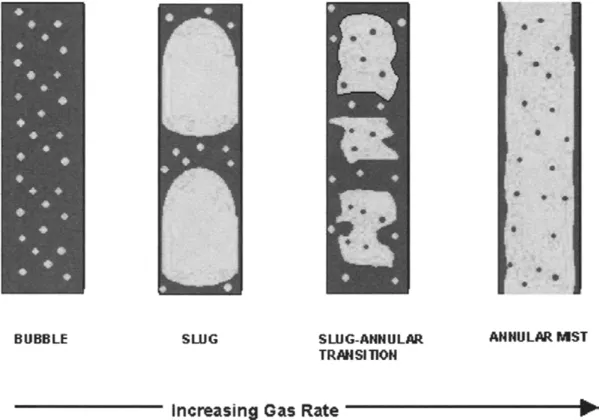
Multiphase flow in a vertical conduit is usually represented by four basic flow regimes as shown in Figure 1-1. A flow regime is determined by the velocity of the gas and liquid phases and the relative amounts of gas and liquid at any given point in the flow stream.
At any given time in a well’s history, one or more of these regimes will be present.
• Bubble Flow. The tubing is almost completely filled with liquid. Free gas is present as small bubbles, rising in the liquid. Liquid contacts the wall surface and the bubbles serve only to reduce the density.
• Slug Flow. Gas bubbles expand as they rise and coalesce into larger bubbles, then slugs. Liquid phase is still the continuous phase. The liquid film around the slugs may fall downward. Both gas and liquid significantly affect the pressure gradient.
• Slug-Annular Transition. The flow changes from continuous liquid to continuous gas phase. Some liquid may be entrained as droplets in the gas. Gas dominates the pressure gradient, but liquid is still significant.
• Annular-Mist Flow. The gas phase is continuous and most of the liquid is entrained in the gas as a mist. The pipe wall is coated with a thin film of liquid, but pressure gradient is determined predominately from ...
Table of contents
- Cover image
- Title page
- Table of Contents
- Chapter 1: INTRODUCTION
- Chapter 2: RECOGNIZING SYMPTOMS OF LIQUID LOADING IN GAS WELLS
- Chapter 3: CRITICAL VELOCITY
- Chapter 4: SYSTEMS NODAL ANALYSIS
- Chapter 5: SIZING TUBING
- Chapter 6: COMPRESSION
- Chapter 7: PLUNGER LIFT
- Chapter 8: USE OF FOAM TO DELIQUIFY GAS WELLS
- Chapter 9: HYDRAULIC PUMPING
- Chapter 10: USE OF BEAM PUMPS TO DELIQUIFY GAS WELLS
- Chapter 11: GAS LIFT
- Chapter 12: ELECTRIC SUBMERSIBLE PUMPS
- Chapter 13: PROGRESSING CAVITY PUMPS
- Chapter 14: COAL BED METHANE
- Chapter 15: PRODUCTION AUTOMATION
- APPENDIX A: DEVELOPMENT OF CRITICAL VELOCITY EQUATIONS
- APPENDIX B: DEVELOPMENT OF PLUNGER LIFT EQUATIONS
- APPENDIX C: GAS FUNDAMENTALS
- Index
Trusted by 375,005 students
Access to over 1.5 million titles for a fair monthly price.
Study more efficiently using our study tools.
Frequently asked questions
Yes, you can cancel anytime from the Subscription tab in your account settings on the Perlego website. Your subscription will stay active until the end of your current billing period. Learn how to cancel your subscription
No, books cannot be downloaded as external files, such as PDFs, for use outside of Perlego. However, you can download books within the Perlego app for offline reading on mobile or tablet. Learn how to download books offline
Perlego offers two plans: Essential and Complete
- Essential is ideal for learners and professionals who enjoy exploring a wide range of subjects. Access the Essential Library with 800,000+ trusted titles and best-sellers across business, personal growth, and the humanities. Includes unlimited reading time and Standard Read Aloud voice.
- Complete: Perfect for advanced learners and researchers needing full, unrestricted access. Unlock 1.5M+ books across hundreds of subjects, including academic and specialized titles. The Complete Plan also includes advanced features like Premium Read Aloud and Research Assistant.
We are an online textbook subscription service, where you can get access to an entire online library for less than the price of a single book per month. With over 1.5 million books across 990+ topics, we’ve got you covered! Learn about our mission
Look out for the read-aloud symbol on your next book to see if you can listen to it. The read-aloud tool reads text aloud for you, highlighting the text as it is being read. You can pause it, speed it up and slow it down. Learn more about Read Aloud
Yes! You can use the Perlego app on both iOS and Android devices to read anytime, anywhere — even offline. Perfect for commutes or when you’re on the go.
Please note we cannot support devices running on iOS 13 and Android 7 or earlier. Learn more about using the app
Please note we cannot support devices running on iOS 13 and Android 7 or earlier. Learn more about using the app
Yes, you can access Gas Well Deliquification by James F. Lea Jr.,Henry V. Nickens,James F. Lea, Jr. in PDF and/or ePUB format, as well as other popular books in Technology & Engineering & Chemical & Biochemical Engineering. We have over 1.5 million books available in our catalogue for you to explore.